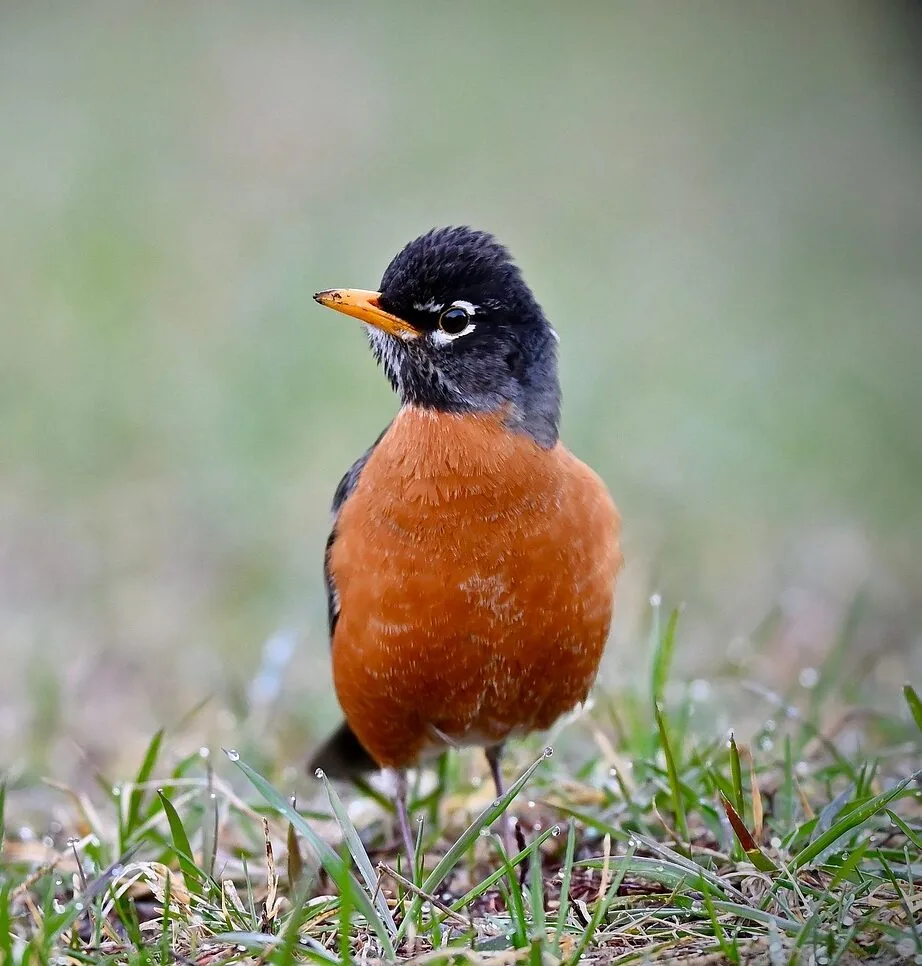
The Thrush in a Robin’s Costume
The bird isn’t actually a robin. When European settlers arrived in the Nearctic region, they felt homesick and slapped the name “robin” on anything with an orange chest. Biologically, it is a true thrush, which explains its scientific name, Turdus migratorius. This translates directly from Latin as “Migratory Thrush.” Across the globe, its names more accurately reflect this lineage. In Mexico, you might hear it called Zorzal Americano, while in Iceland, where it is a rare and exciting vagrant, it is known as the Farþröstur—the “travel-thrush.”
Biological Warfare and the Blue Egg Template
While it looks friendly on a greeting card, the American Robin is an active combatant in an evolutionary arms race against the Brown-headed Cowbird. Most birds are suckers for “brood parasitism,” raising the cowbird’s offspring while their own chicks starve. Not the robin. They are “grasp ejectors,” possessing the beak strength to physically chuck foreign eggs out of the nest. They operate on a strict internal template of their own iconic cyan eggs. Research shows they are particularly sensitive to “brownness,” immediately detecting the speckled camouflage of a cowbird egg and tossing it within minutes to protect their brood.
The Guardian of the Embers
This fiery-breasted bird carries a heavy cultural weight that goes far beyond “signs of spring.” In the oral traditions of the Sechelt people, the robin isn’t just a singer; she is a hero who saved a village from freezing. Legend says that while a boy fell asleep guarding the last fire, a wolf approached. A small brown bird flew down and fanned the dying embers with her wings to keep them alive. The heat scorched her breast red, creating the mark we see today.
Even its modern reputation has a chaotic edge. In the winter, robins abandon their “run-and-stop” worm hunting for a diet of berries. If you find a robin in the northern states looking uncoordinated or “judgmental” in a social media meme, it might be literally drunk. They have been known to feast on fermented holly or juniper berries, leading to a state of avian intoxication that is a far cry from their refined dawn caroling. Whether acting as a guardian of the flame or a territorial bouncer, this thrush is far more than a simple garden visitor.
Sources:
- Wikipedia:American robin
- Animal Diversity Web:Turdus migratorius
- BC Field Ornithologists:How do American Robins find earthworms?
- Oneida Indian Nation:The Robin Legend
- University of Illinois:Examining causes and characteristics of egg ejection behaviour in American robins
- Feathered Guru:American Robin Songs & Calls
- Southern Wisconsin Bird Alliance:Who’s That Singing? American Robin