
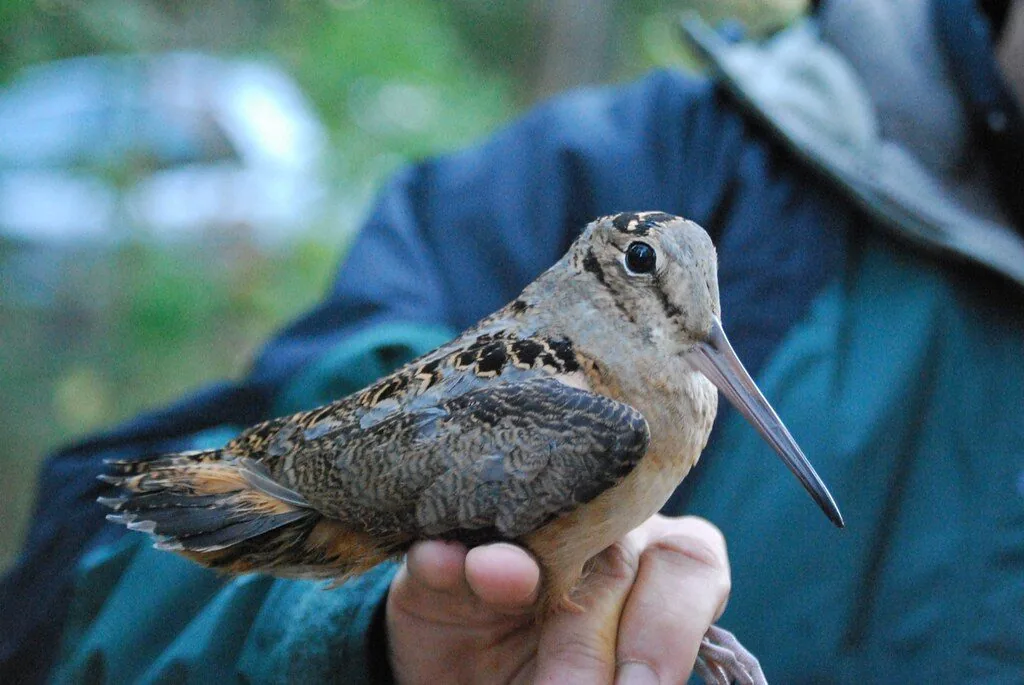
The American Woodcock is a biological glitch masquerading as a bird. While its appearance suggests a creature assembled from spare parts, every oddity—from its upside-down brain to its “glitchy” walk—is a masterclass in specialized evolution. Native to the forests of North America, this “timberdoodle” has transitioned from a hidden forest dweller to a global digital icon, proving that being “built backwards” is a winning strategy for survival.
The Stake-Face and the Inverted Brain
The scientific name Scolopax minor offers the first clue to its mechanical nature. Derived from the Greek skolops (meaning a “pointed stake”), it describes a bill that functions like high-end surgical machinery. The tip of the upper mandible is prehensile; the woodcock can flex the end of its beak while it is buried deep in the mud to grab earthworms without opening its entire mouth.
To accommodate eyes that sit so high and far back they provide 360-degree vision, the woodcock’s brain has undergone a radical evolutionary relocation. It is effectively upside down. The cerebellum, which governs balance and coordination, sits at the base of the skull directly above the spinal column—a complete inversion of the standard avian layout. This unique anatomy led the Seneca people to describe the woodcock in their traditional oral histories as being made from the “leftover parts” of every other bird.
Rhythmic Glitches and Internet Fame
In a damp thicket, you might witness the woodcock’s famous “rocking walk.” The bird takes a step and then bobs its entire body back and forth while keeping its head perfectly still. While biologists suggest this creates vibrations that trick earthworms into moving, the modern world has adopted a different interpretation.
On platforms like TikTok and Reddit, this “silly walk” has become a viral sensation, often edited to upbeat hip-hop tracks. The bird’s signature nasal “peent” call has its own digital cult following, frequently rebranded as a “meep” in internet subcultures. This digital obsession reached a peak with users posting the bird “meeping” in perfect synchronization with the song “Shine” by Collective Soul—a far cry from its role in traditional stories like “The Trials and Death of Inchworm,” where woodcock people are portrayed as mysterious forest guardians.
Sources:
- BirdNote: The American Woodcock’s Silly Walk
- Project Upland: The Evolution of the American Woodcock
- Project Upland: Nicknames of the American Woodcock
- Audubon: 10 Fun Facts About the American Woodcock
- Birdfy: What is the Slowest Bird in the World?
- Boing Boing: Does the Adorable American Woodcock Peent or Meep?
- Oreate AI: The Woodcock Song Meme: A Quirky Journey Through Internet Humor