
The Thermostat in the Leaf Litter
Most birds sit on their eggs. The Australian Brushturkey builds a compost heap instead. The male rakes together a mound of leaves and soil as big as a small car, and the heat thrown off by all that decay incubates the eggs buried inside. He never warms a single egg with his own body. For weeks his whole job is to manage the rot, holding the temperature steady while the clutch develops underground.
It Isn’t a Turkey, and Nobody Babysits
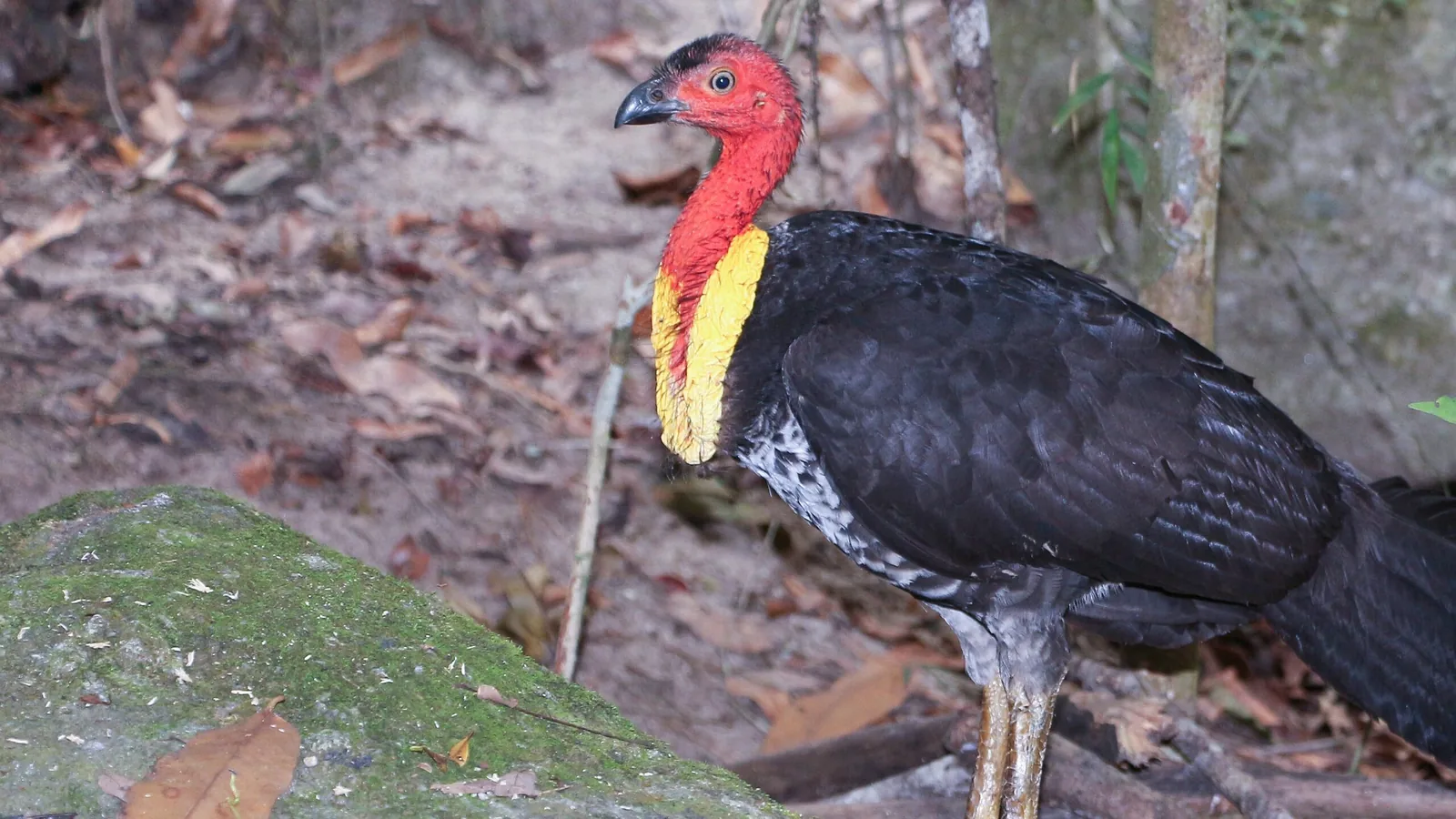
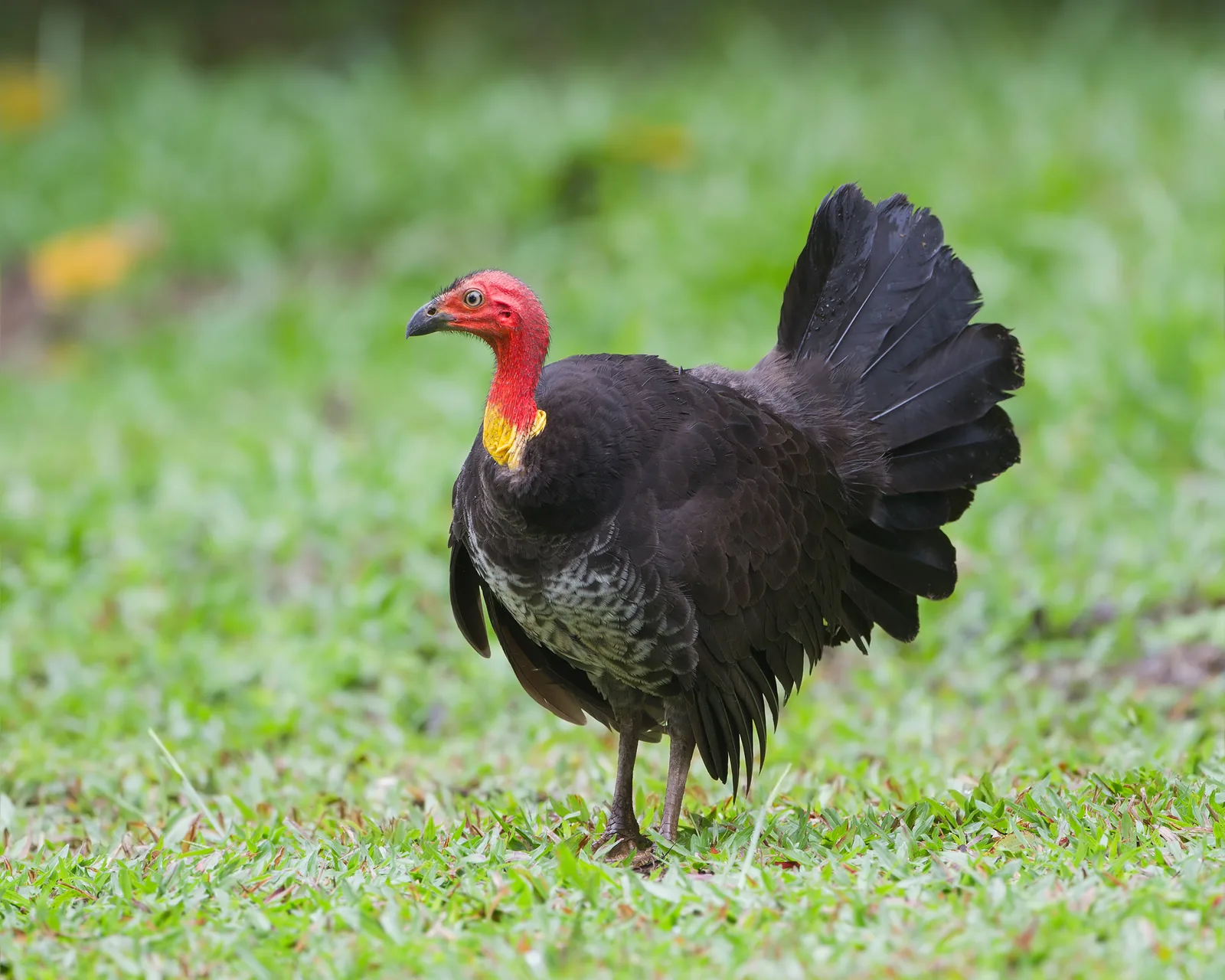
Despite the name, this is no relation of the Thanksgiving bird. Its scientific name is Alectura lathami. The second half honors John Latham, the English ornithologist who catalogued Australia’s birds in the 1820s; the first half comes from Greek for “cock-tail”, a nod to that upright, folded fan. It belongs to the megapodes, a word meaning “big foot”, and the feet are the whole point: this bird uses them to build, not to perch. You will not mistake it: a sooty black body under a bare scarlet head, with a floppy yellow wattle swinging at the throat. What you will never see is a brushturkey family. The chicks hatch deep in the mound and claw their way to the surface, ready to fly within hours. No parent feeds them or guards them. They are on their own from the first breath, and most do not survive.
The Male Runs a Compost-Powered Incubator
The mound is a serious build, a heap of forest litter up to four metres across and more than a metre tall that a male tends for months. As the buried vegetation rots it releases heat, and his job is to keep that heat steady. He checks it by driving his bill deep into the pile, and when it runs too warm or too cool he piles on more litter or rakes some away until it holds around 33 to 35 degrees Celsius. Females are not swayed by his looks. They inspect his mound and lay only in the well-built ones, then leave him to mind the heat alone.
Warm Eggs, Cool Eggs
Here is where it turns odd. In 2005, biologists Ann Göth and David Booth found that the heat inside the mound does more than decide whether an egg hatches. It tilts whether the chick comes out male or female. Cooler mounds yield more males and warmer mounds more females; at the 34-degree mark the ratio settles at a clean 1:1. It was the first time anyone had shown temperature skewing the sex ratio in a bird. The reason, confirmed a few years later, is blunt: male embryos die more often when the mound runs hot, female embryos when it runs cold. The thermostat in the leaf litter is quietly editing the next generation.
So what does all this sound like? If you wake up in a Brisbane or Sydney suburb, the tell is a deep, three-note boom, oo-oo-oom, made by inflating that yellow neck wattle with air and forcing it out. For a bird that has handed incubation over to a heap of rotting leaves, it carries a surprising distance. Worth listening for, if a brushturkey ever decides your garden mulch looks like good building material.
Sources:
- Wikipedia: Australian brushturkey
- Biology Letters (2005): Göth & Booth, “Temperature-dependent sex ratio in a bird”
- Proc. R. Soc. B (2008): Eiby, Wilmer & Booth, “Temperature-dependent sex-biased embryo mortality in a bird”
- Birds in Backyards (BirdLife Australia): Australian Brush-turkey
- Birds of the World: Alectura etymology, Key to Scientific Names
- San Diego Zoo Wildlife Alliance: Australian Brush-turkey, Taxonomy & History
- Sydney Birder: Strange call of the brush-turkey
- Wild Ambience: Australian Brushturkey sounds