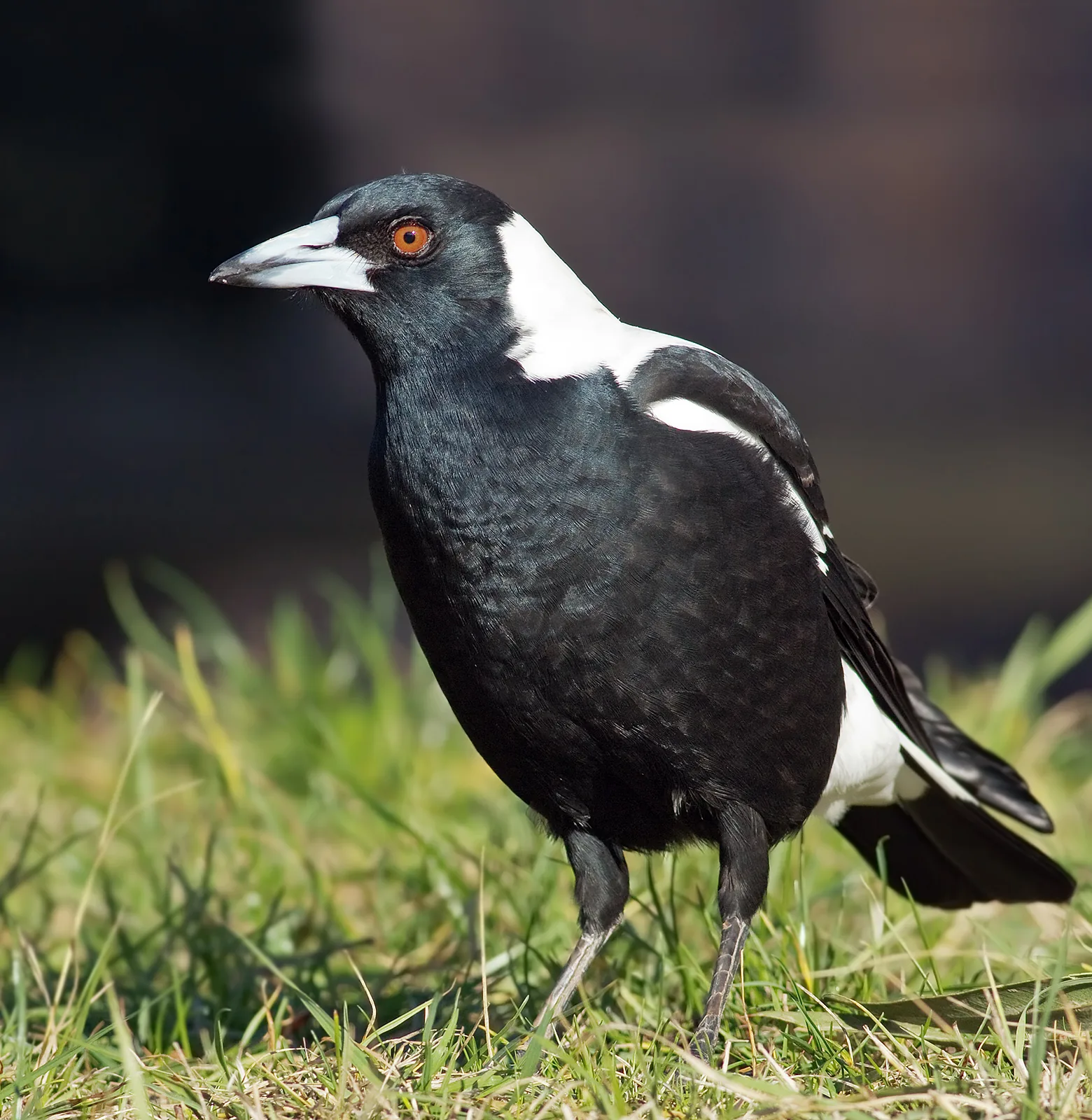
The Australian magpie keeps forcing scientists to re-explain what they think birds can do. In a 2018 field study, magpies fitted with tracking harnesses didn’t just try to remove them individually. One bird began picking at the straps on another, then others joined in, until several birds were freed. The key detail is not cooperation in general, but directed helping. The bird without a device stopped its own foraging to solve someone else’s problem. That kind of targeted assistance is rare in wild animals and almost unheard of in birds.
Their intelligence shows up in quieter ways too. Australian magpies are elite mimics. Not parrots repeating words on cue, but birds that absorb soundscapes. They copy other bird species, car alarms, dogs, human whistles, and occasionally human speech, weaving those sounds into long, improvised songs. Each local group develops its own variations. If you hear a magpie that sounds slightly “off” compared to another suburb, that is not imagination. It is local culture.
“Magpies are capable of complex social cognition, including targeted helping behaviour.” — Dr. Alex Maisey, Deakin University
Friend or foe
No other bird has a reputation split this cleanly. To some people, the Australian magpie is a backyard companion that remembers faces, accepts food, and brings its chicks close as if introducing them. To others, it is the bird that turned a normal commute into a panic sprint.
Both views are accurate. Australian magpies can recognize individual human faces and remember them for years. Long-term observations and experiments show they distinguish between threatening and non-threatening people, even when clothing changes. During breeding season, some males aggressively defend a specific territory and a specific set of enemies. Cyclists and runners are targeted not because they are cyclists or runners, but because they pass quickly through a defended zone and fit a remembered pattern.
Names & culture
The Australian magpie is not a true magpie. Early European settlers named it for its black-and-white plumage, borrowing the name from the European magpie, but genetically it sits with butcherbirds and currawongs. Its scientific name, Gymnorhina tibicen, translates roughly to “bare-nosed flute player.” That second part matters. The dawn song, often performed as a duet or group chorus, is one of the most complex and musical bird vocalizations in Australia.
People have tried to put words to that sound for over a century. Poet Denis Glover famously rendered it as “quardle oodle ardle wardle doodle,” a line Australians still quote because it feels oddly accurate. In Aboriginal Australian stories, magpies appear as creators of morning light, lifting the sky and bringing sunrise with their voices. That cultural link between magpie song and the start of the day is not symbolic fluff. It reflects daily experience on the continent.
This bird lives only in Australia and nearby regions. Its intelligence, its memory, and its sound have shaped how people talk about mornings, danger, friendliness, and territory there for generations.
“The magpie’s song is part of how Australia wakes up.” — Museums Victoria
Sources
- BirdLife Australia: Australian Magpie Profile
- The Australian Museum: Australian Magpie - Gymnorhina tibicen
- eBird (Cornell Lab of Ornithology): Australian Magpie
- Gisela Kaplan: The Australian Magpie: Biology and Behaviour of an Unusual Songbird
- NSW Environment & Heritage: Australian Magpie Fact Sheet
- Wildlife Victoria: Living with Magpies