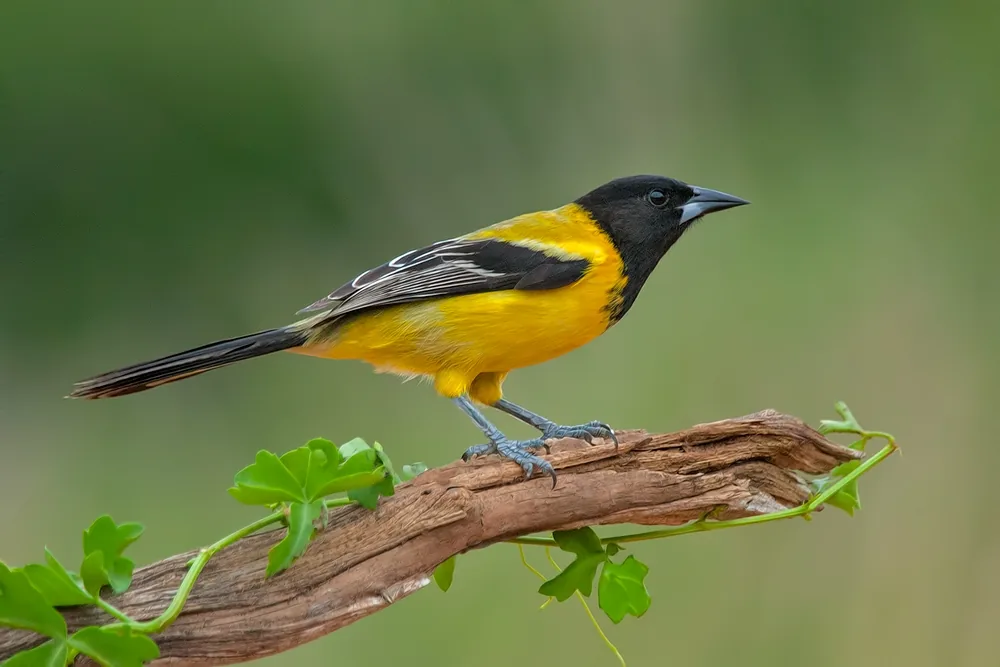
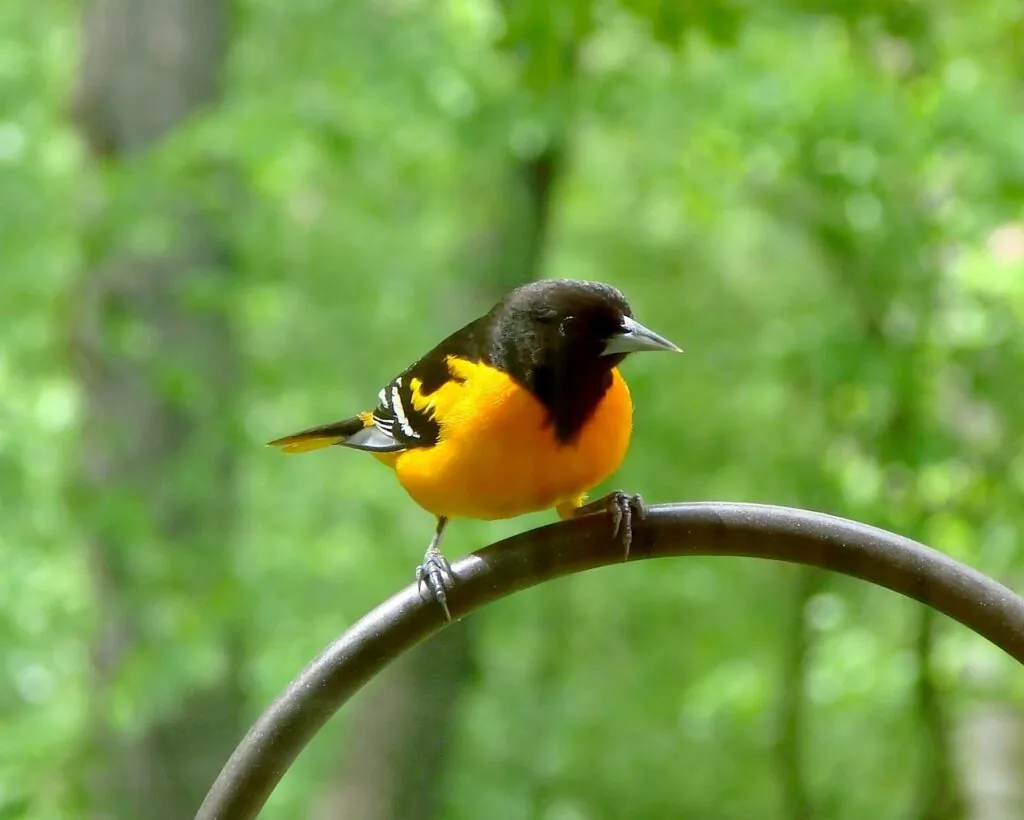
The Baltimore oriole is a striking black-and-orange songbird that’s hard to miss when it’s in view. Adult males are bright orange with a black head, back, and wings, while females and younger birds are more muted, showing yellow-orange tones and grayish wings. Baltimore orioles are found in eastern North America, especially in open woodlands, forest edges, river corridors, and leafy suburban areas, where they spend much of their time high in the canopy.
Songs and calls
Baltimore orioles are known for their rich, whistled songs, often described as clear, fluid, and slightly slurred. Males sing frequently during the breeding season, producing a series of short phrases that can vary widely between individuals. In addition to songs, they give sharp, chatter-like calls and nasal notes used for alarm or communication, which sound noticeably different from their more musical singing voice.
Fun fact
The Baltimore oriole weaves one of the most elaborate hanging nests of any North American bird. Using plant fibers, grasses, and even string, it creates a deep, pouch-like nest that dangles from the tips of tree branches, sometimes swaying noticeably in the wind. These nests can take over a week to complete and are strong enough to hold growing chicks despite their delicate appearance.
Sources:
- Audubon: Baltimore Oriole Field Guide
- Wikipedia: Baltimore Oriole Overview
- All About Birds: Baltimore Oriole Life History
- Hiker’s Notebook: The Baltimore Oriole
- Our Fine Feathered Friends: Baltimore Oriole
- Laura Erickson: For the Birds - Baltimore Oriole
- Georgia Wildlife: Out My Backdoor - Baltimore Orioles
- Outdoor Alabama: Baltimore Oriole
- The Auk (Digital Commons): Historical Ornithology Research
- BioOne: Intraclutch Variation in Egg Appearance
- Chicago Birder: Dan’s Feathursday Feature - Baltimore Oriole
- Lee’s Bird: The Baltimore Oriole
- Birds of PEI: Baltimore Oriole Species Profile
- USFWS/USDA (1941): Common Birds in Relation to Agriculture