.jpg)
The Sand Bank's Smallest Tunneler
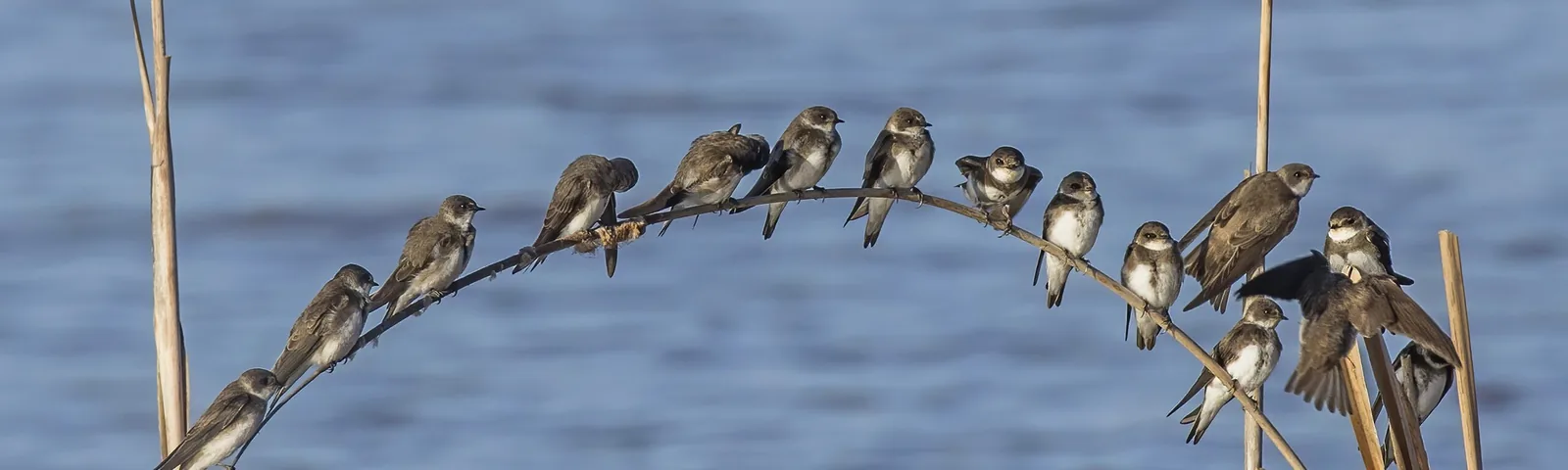
The Bank Swallow is one of the smallest swallows in the world, and one of the few that does any serious digging. Both sexes drive a tunnel two feet into a sand cliff and kick the loose dirt out behind them with their feet. The chamber at the back gets a soft lining of grass and feathers. In Britain the same bird is called Sand Martin. Two continents named it for the substrate it disappears into.
A Bird Named for the Riverbank, Twice
Carl Linnaeus, the Swedish naturalist who established modern taxonomy, catalogued the species in 1758 in Systema Naturae as Hirundo riparia, “an ash-grey swallow, with white throat and belly.” Latin ripa means “bank” or “shore.” Later taxonomists moved the burrowing swallows into their own genus and kept the same word twice. Riparia riparia, bank of the bank, is one of the more emphatic doublings in bird taxonomy.
In North America the species is the Bank Swallow. Across Britain, Ireland, and the rest of Europe it is the Sand Martin. Same Holarctic bird, found from the Pacific coast of Asia to the Atlantic coast of Maine. Two halves of one substrate, named on two continents that never compared notes.
Two Feet of Sand, by Beak and by Foot
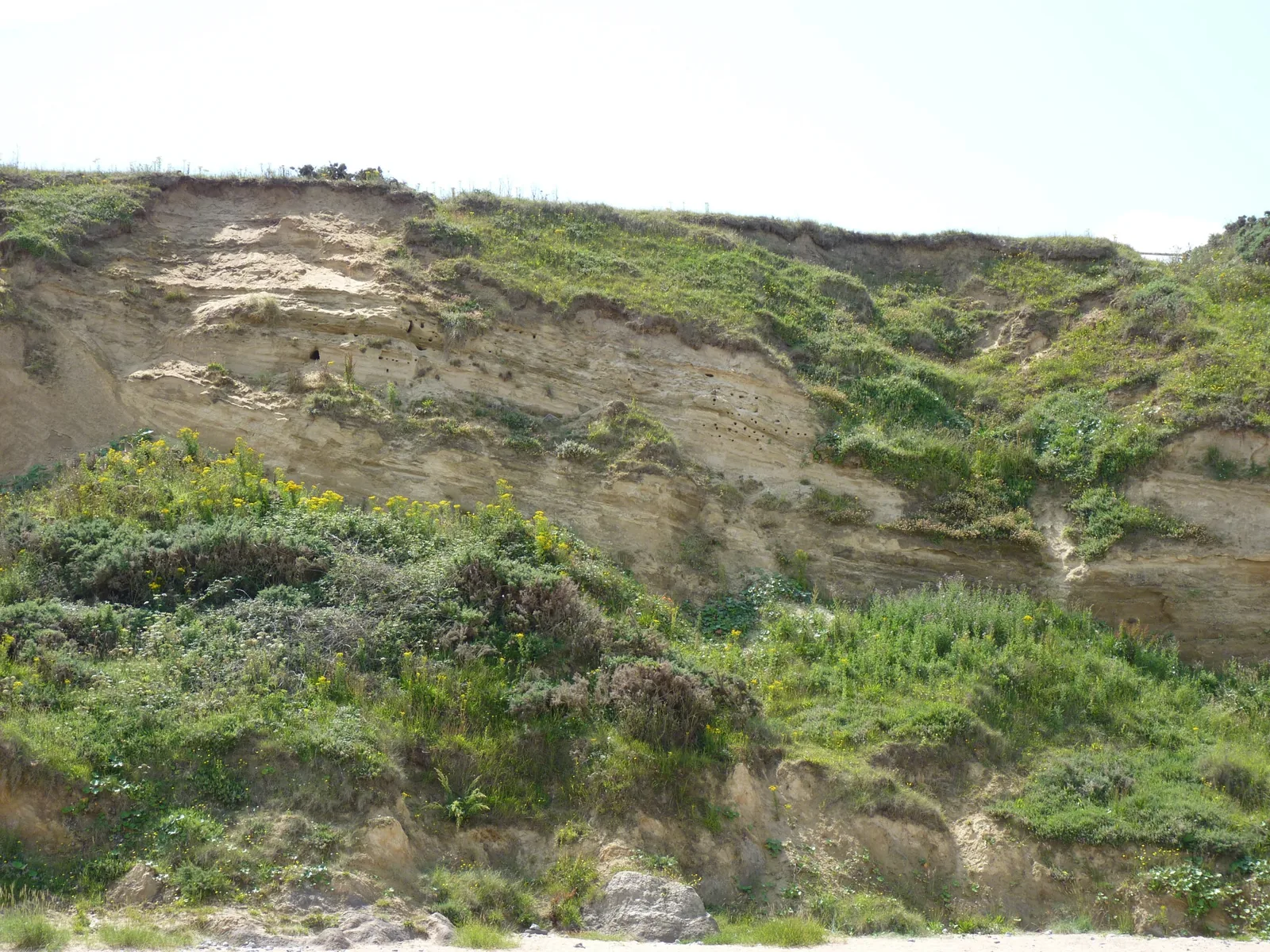
In February 1774 the Hampshire curate Gilbert White, the parson-naturalist whose Natural History of Selborne would shape English nature writing for the next century, sent a letter on the species to Daines Barrington, a fellow of the Royal Society. While the house-martin and barn-swallow build elaborate mud cups under eaves and on rafters, White noted, “the bank-martin terebrates a round and regular hole in the sand or earth, which is serpentine, horizontal, and about two feet deep.” Two and a half centuries later, the description still holds.
Modern observers add the technique. Both sexes start the burrow with their bills, clinging to the cliff face. Once the entrance is in, they crawl forward and kick the loose sand back with their feet. The tunnel runs two to three feet, sometimes five, and ends in a chamber lined with fine grass and feathers, often goose feathers picked up nearby. A single bank can carry from a dozen to nearly two thousand active nests at once.
The Sahel Is the Other Half of British Spring
Bank Swallows are long-haul migrants. The North American population winters in lowland South America. The European population crosses the Sahara to spend the British winter on the southern side of it, more than four thousand kilometres from a Yorkshire quarry pond. The bird that does this weighs about half an ounce.
That is why droughts in West Africa show up in British bird counts. The Sahel is the semi-arid belt that runs across Africa just south of the Sahara, and it is exactly where the European Sand Martin population spends the winter. Severe droughts there in 1968 and 1985 cut the UK breeding population sharply, and modern BTO data still ties annual survival to rainfall on the wintering grounds before the birds head north. In Canada, the species has lost an estimated 98 percent of its population over the last forty years and is listed as Threatened under the federal Species at Risk Act.
The Bank Swallow drills a two-foot tunnel into a sand cliff and crosses thousands of kilometres twice a year to reach it. Gilbert White recorded the burrow in 1774. The migration link came into focus only two centuries later, when droughts on the African wintering grounds began to crash British populations.
Sources:
- Wikipedia: Sand martin
- Project Gutenberg: Gilbert White, The Natural History of Selborne, Vol. 2, Letter XX (26 February 1774)
- Wiktionary: ripa
- British Trust for Ornithology: Sand Martin BirdFacts
- National Audubon Society: Bank Swallow field guide
- Cornell Lab, Birds of the World: Bank Swallow, Introduction
- London Biodiversity Partnership: Sand Martin Species Action Plan
- Wikimedia Commons: Sand martins (Riparia riparia), Charles J. Sharp, El Rocio
- Wikimedia Commons: Sand Martin colony below Howards Hill, Richard Law / geograph.org.uk
- YouTube: Sand Martin Bird Sound
