.jpg)
A Striped Wheelbarrow With Wings
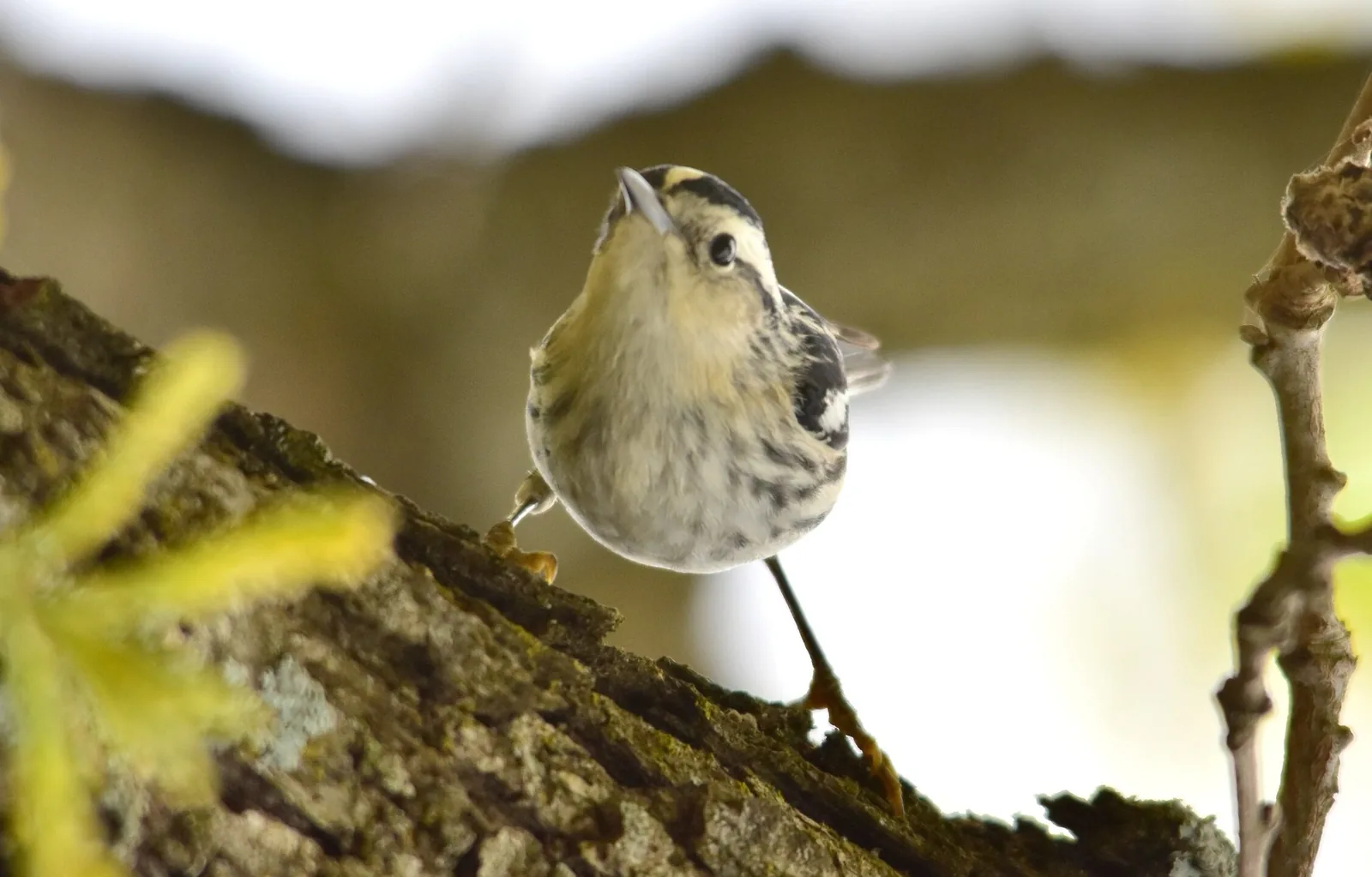
Most warblers stay in the canopy, picking caterpillars off the underside of a maple leaf. This one walks sideways down a tree trunk like it’s late for something. The plumage says wood-warbler. Almost nothing else about the bird does.
A Warbler That Walks Trees
The Black-and-white Warbler creeps along bark like it can’t pick a direction. It walks up a trunk, then comes straight back down head-first a minute later. Cornell notes that this is unusual even compared to the trunk specialists. Brown Creepers tend to spiral upward, nuthatches tend to face downward, and this one does all of it. Evolution gave it the wrong toes for a warbler. Heavier legs and an extra-long hind claw let it grip vertical bark; every other warbler in North America is stuck gleaning from leaves.
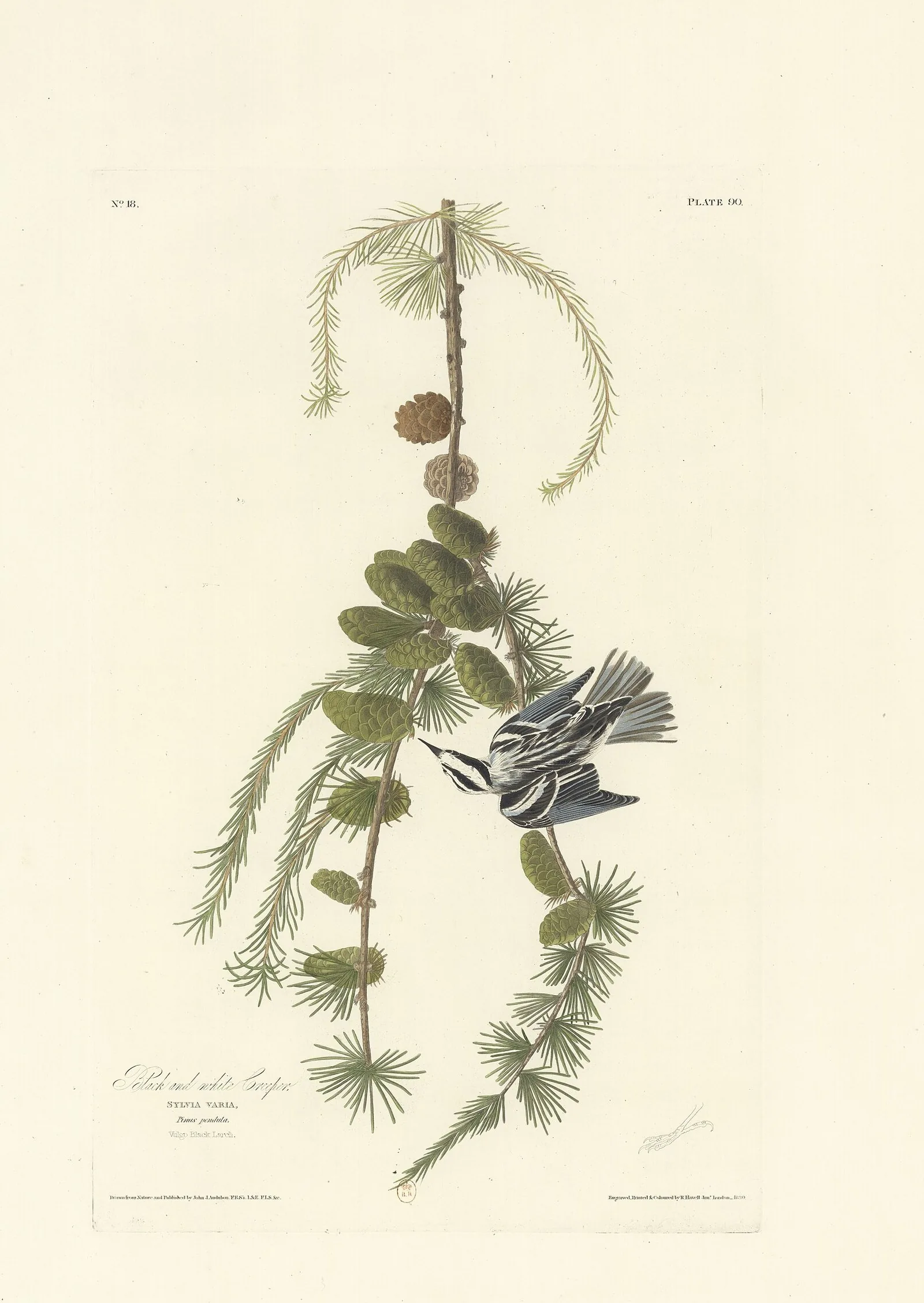
John James Audubon saw it that way too. When the nineteenth-century American naturalist painted the species for Birds of America in 1830, his plate is labeled Black and white Creeper, and the bird hangs head-down from a black larch. The “Creeper” name stuck for most of the nineteenth century. Field guides eventually moved it back into the warblers, but the bird has yet to update its résumé.
A Flying Humbug
The scientific name doubles down on the act. Mniotilta varia is built from Greek and Latin roots that translate to “striped moss-plucker,” which happens to be exactly what the bird does for a living. Linnaeus, the Swedish father of modern taxonomy, formally described the species in 1766, working partly from notes the Irish physician Hans Sloane had taken on a “small black and white bird” in 1725 Jamaica.
The other thing everyone notices is the candy. A breeding male is so boldly striped that birders nicknamed it a “flying humbug,” after the British peppermint sweet that has been black-and-white striped since at least the 1820s. The comparison only really works in motion: a humbug, made of feathers, working its way around a tree trunk.
A Squeaky Wheel With a Temper
The song is a thin, high weesy-weesy-weesy, repeated about six times across three seconds. The American field guide author Kenn Kaufman compares the call to a squeaky wheelbarrow in his Lives of North American Birds, and the phrase sticks immediately.
The temperament is louder than the look. Black-and-white Warblers physically attack other species that wander into their territory, and Cornell’s list of the usual victims is awkward: Black-capped Chickadees, Red-breasted Nuthatches, American Redstarts. So you have a small warbler that climbs like a nuthatch and picks fights with actual nuthatches that wander through. The song sounds like a wheelbarrow that needs oil. No other warbler in North America walks down trees.
Sources:
- Wikipedia: Black-and-white warbler
- Cornell Lab of Ornithology: Black-and-white Warbler Overview
- Audubon: Black-and-white Warbler field guide
- Wikimedia Commons: Audubon’s Birds of America, Plate 90, “Black and white Creeper”
- Wikipedia: Humbug (sweet), black-and-white striped peppermint candy from the 1820s
- Friends of Woodland Park: Black and White Warbler, the “flying humbug”
_18,_Plate_90,_Black_and_white_Creeper_(i.e._Black-and-White_Warbler)_;_Vulgo_Black_Larch_-_estampe_-_Drawn_from_Nature_and_Published_by_John_J._Audubon_;_Engraved,_Printed_%26..._-_btv1b53143989h.jpg)