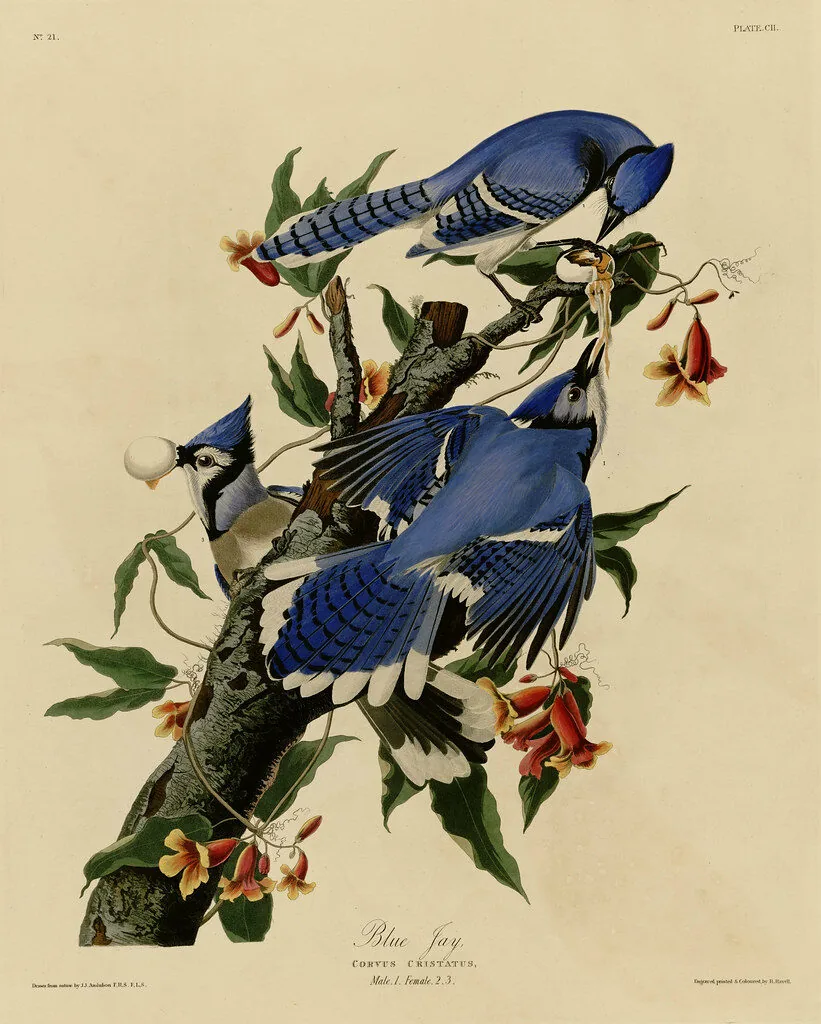
If you wake up in the oak-heavy corridors of eastern North America, you aren’t just hearing a bird; you are listening to a professional liar. The Blue Jay (Cyanocitta cristata) is a master of the double-take—a creature that refuses to be as simple as its vibrant plumage suggests. From its chemical composition to its role in folklore, every aspect of this bird is an elaborate performance.
The Azure Illusion: A Biological Fraud
The scientific designation, Cyanocitta cristata, translates bluntly to “crested blue chatterer.” It’s an apt title, though the “blue” part is a total biological fraud. Blue Jays possess zero blue pigment. Instead, their feathers are a structural trick—a nanostructured spongy keratin that scatters light like a prism, reflecting only sapphire wavelengths.
If you were to crush a jay feather, this “prism” would break, leaving behind only the dull brown of its true melanin. This penchant for deception extends to their voices. They are the tricksters of the canopy, capable of mimicking a Red-shouldered Hawk so perfectly that they can clear a crowded bird feeder or warn the neighborhood of a real predator’s arrival. This mimicry is a calculated tactical weapon used to manipulate both competitors and threats alike.

The Costco Shopper of the Forest
Beyond the drama, Blue Jays are the unintentional architects of the modern landscape. While a squirrel is a “shopper in the express lane”—carrying one nut at a time—the Blue Jay is a “Costco” bird. Using a specialized gular pouch in its throat, a single jay can haul up to five acorns in one trip.
In a single month, a small group of fifty jays can bury 150,000 acorns. Because they often fly a mile or more from the parent tree and possess a conveniently imperfect memory, they are responsible for the massive northern expansion of oak forests after the last glaciers retreated. They don’t just live in the forest; they built it.
The Devil’s Scribe and the Mark Twain Obsession
This “informed observer” of the woods has long been viewed with suspicion. In Southern folklore, the jay was labeled the “Devil’s messenger,” allegedly spending every Friday in hell to carry kindling for the fires and report on human sins. Their raucous Saturday morning calls were often interpreted as a celebration of their return from the underworld.
Even Mark Twain was obsessed with their human-like complexity, famously noting that a jay has “more moods and more different kinds of feelings than any other creature.”
Sources
- High Park Nature Centre:Blue Jays aren’t actually blue!
- St. Charles County Nature:Blue Jays - Key to Forest Regeneration
- American Literature:Mark Twain’s Baker’s Bluejay Yarn
- Via Hedera:The Devil’s Messenger in Folklore
- Ojibwe People’s Dictionary:Diindiisi