
A Throat Lit in Ultraviolet
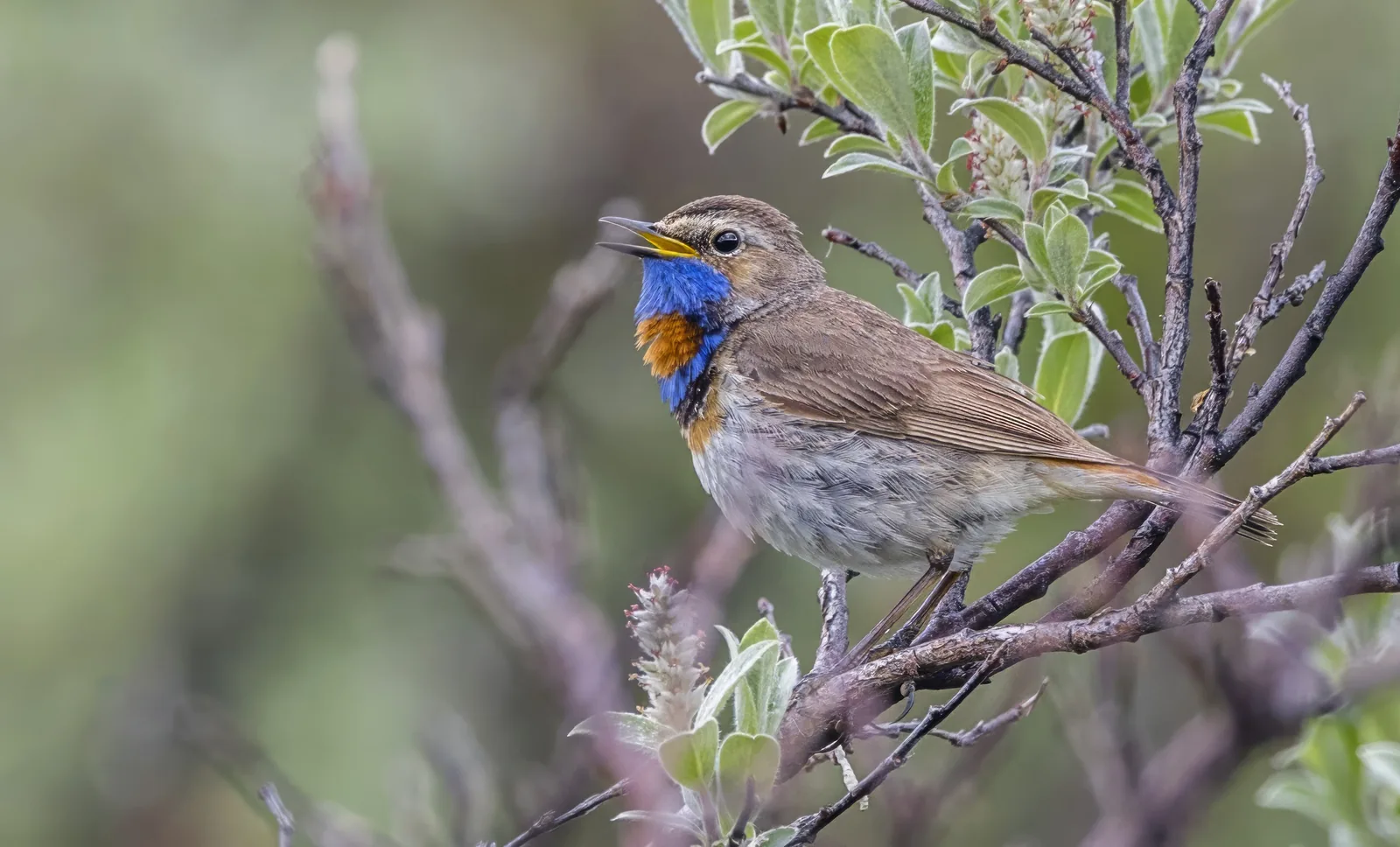
The male Bluethroat looks like a small brown robin that has dipped its chest in paint. Its throat is a vivid, glossy blue, bordered below by bands of black and rusty red. If you wake up near wet thickets in Europe or Asia, or on the tundra of Alaska in summer, you may hear a male singing a long, varied song from the top of a bush, often copying pieces of other birds’ songs.
Red Spots and White Spots
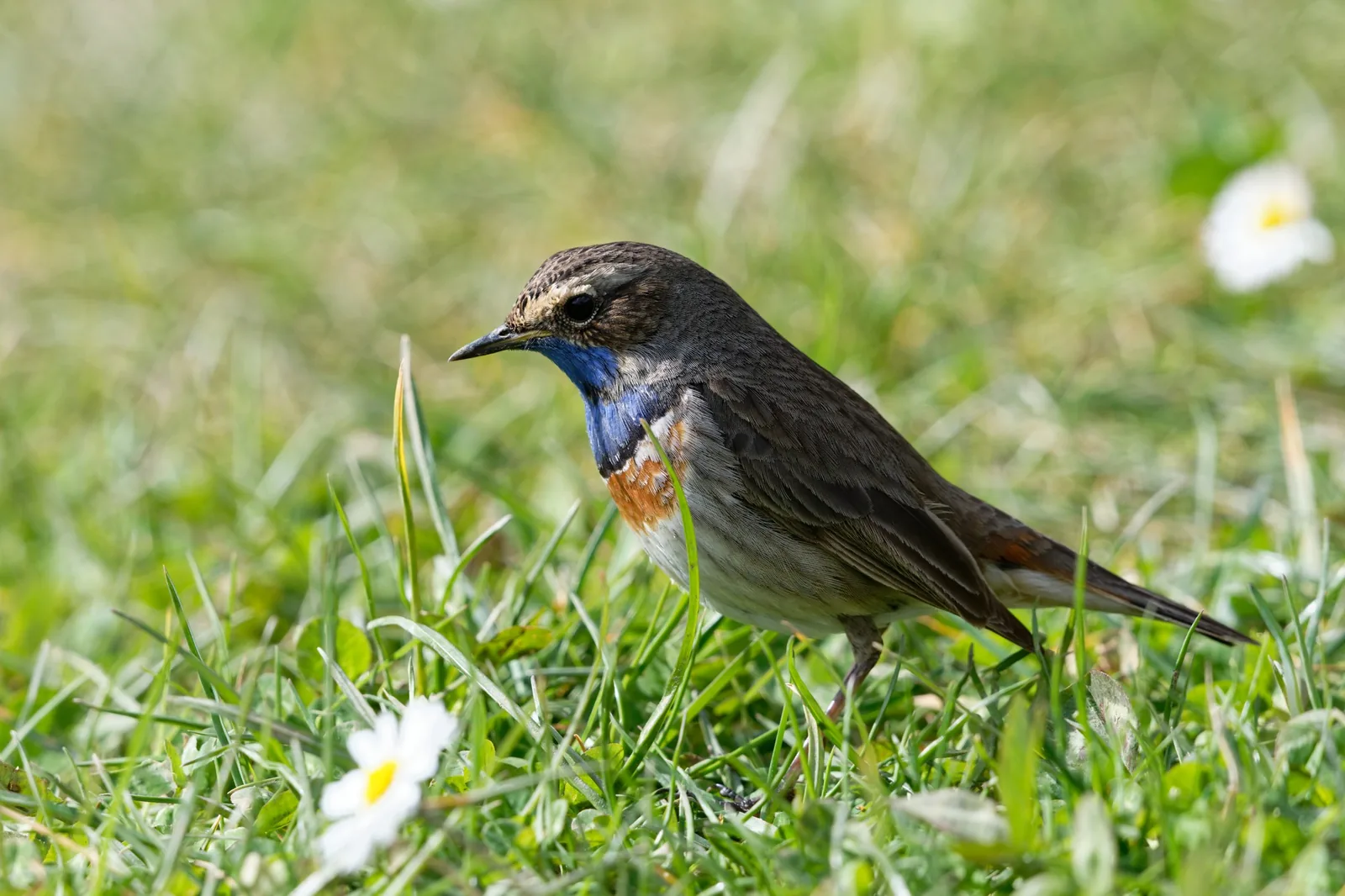
Not every Bluethroat wears the same badge. Males from Alaska to northern Europe have a red spot in the middle of the blue. In central and southern Europe, the spot is white, or the throat is blue all the way across. Females usually have just a dark crescent and a little blue on a cream throat.
The bird was named in 1758 by Carl Linnaeus, the Swedish naturalist who created the modern system of scientific names. He called it svecica, Latin for “Swedish.” Despite the bright colors, it is a secretive bird that creeps through thick, low plants. It is easiest to see when a male sings or performs a display flight, or when it fans its tail to flash the rusty patches at the base.
A Color Made for Bird Eyes
The blue on that throat also shines in ultraviolet, light that birds can see and people cannot. Two studies from the late 1990s tested whether that hidden color matters.
In a 1997 experiment, researchers gave each of 16 females a choice between two males. One male’s throat had its ultraviolet reduced with chemicals used in sunscreen. The other’s throat was dimmed evenly across all colors. In 13 of the 16 trials, the female chose the male whose ultraviolet was untouched.
A 1998 study took the test into the wild. Males with reduced ultraviolet seemed to have more trouble finding a mate. They fathered fewer chicks in other males’ nests and lost more paternity in their own. The authors called it the first experimental evidence that ultraviolet signals affect mating success in free-living birds.
From Alaska to Asia
In North America, the Bluethroat breeds only on the tundra of Alaska and Yukon. It is one of a handful of birds that nest in North America but spend the winter in Asia, and exactly where the American birds go is still unknown. Its nest is a cup of grasses and fine twigs on the ground in a thicket, and the eggs are blue or bluish green, speckled with red.
So the next time you see a Bluethroat’s blue throat, remember that a female Bluethroat sees even more color there than you do.
Sources:
- Cornell Lab of Ornithology: Bluethroat overview, All About Birds
- Cornell Lab of Ornithology: Bluethroat life history, All About Birds
- Proceedings of the Royal Society B (via PubMed Central): Andersson and Amundsen (1997), Ultraviolet colour vision and ornamentation in bluethroats
- Proceedings of the Royal Society B (via PubMed Central): Johnsen et al. (1998), Ultraviolet plumage ornamentation affects social mate choice and sperm competition in bluethroats
- Wikipedia: Bluethroat