,_Male_04.jpg)
From Audubon's Ghost to Common Bird
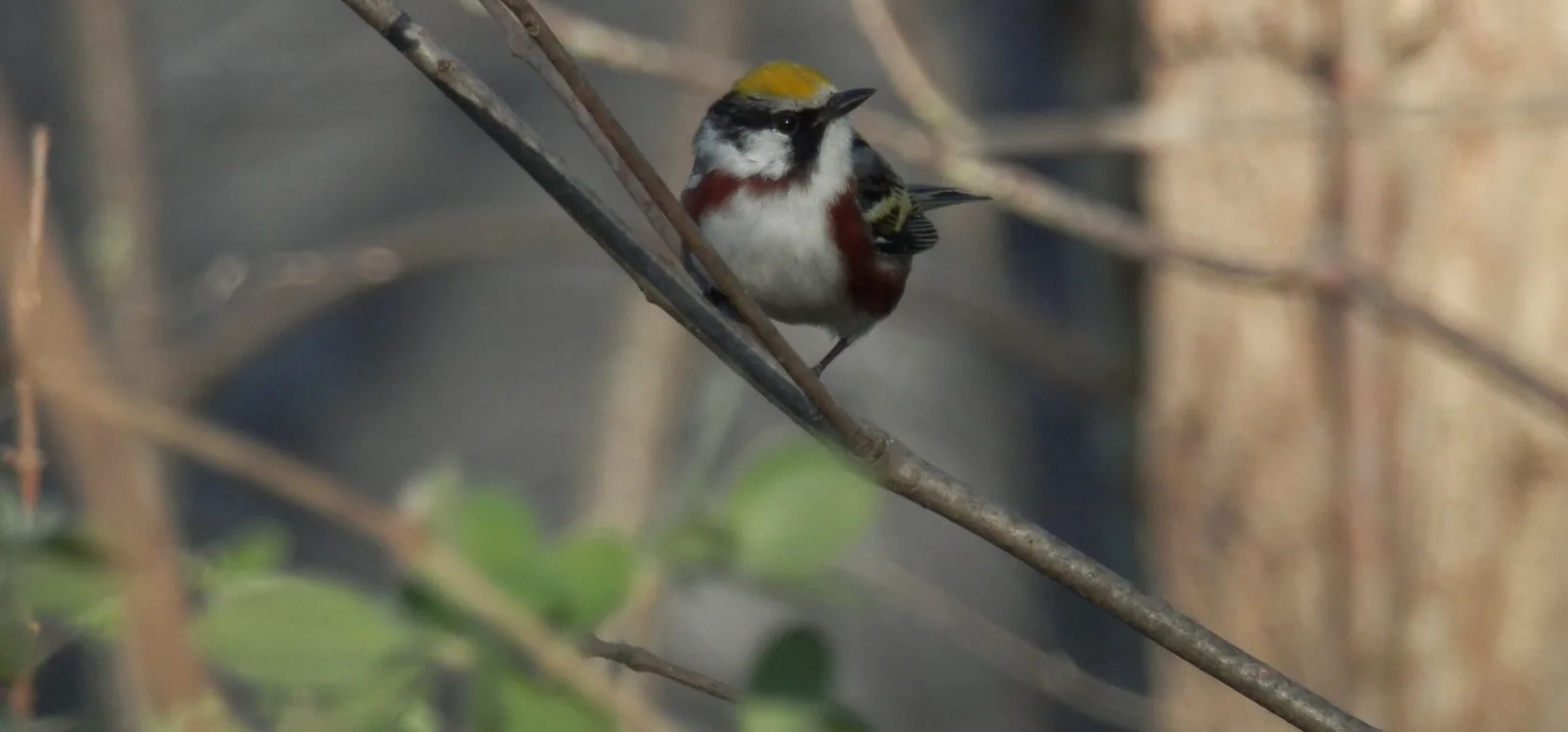
John James Audubon (the great cataloguer of American birds) spent his career walking the eastern half of a continent with a sketchbook, and in all that time he saw exactly five Chestnut-sided Warblers. All five turned up on a single cold morning in May 1808, near Potts-grove, Pennsylvania, with snow falling though the apple trees were already in bloom, the birds drooping on the lower rails of a fence, half-starved. He shot all five. “I have never met with a single individual of this species since,” he wrote, more than twenty years and three Great Lakes later. Today the bird is one of the commonest warblers in eastern North America. The forest changed, and the bird walked into the gap.
Audubon’s Nemesis
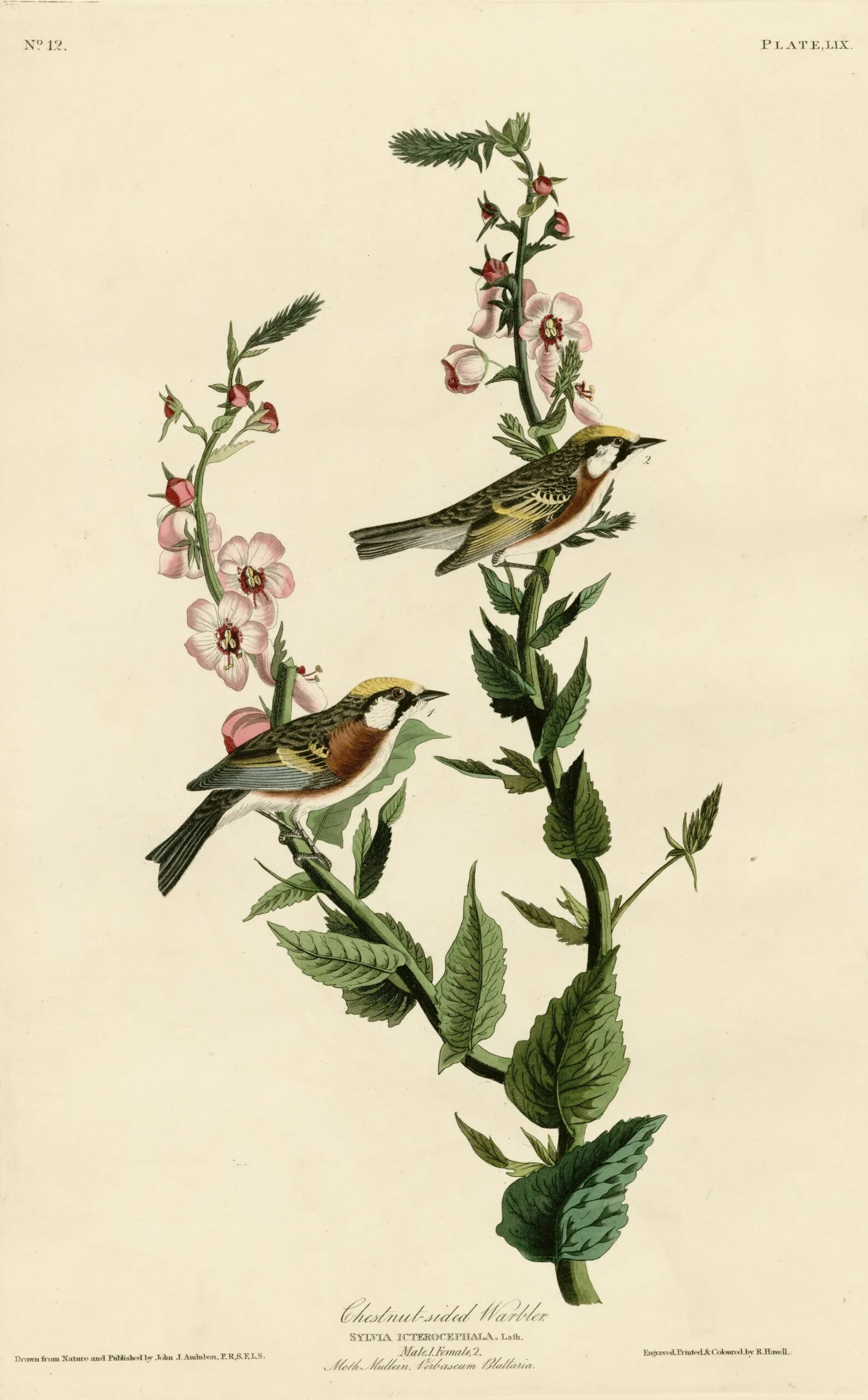
When Audubon was working in the early 1800s, the East was still cloaked in mature forest, which is exactly the wrong habitat for a Chestnut-sided Warbler. The bird wants brambles and the scrappy second growth that comes after a tree falls. Audubon’s contemporaries Alexander Wilson and Thomas Nuttall barely encountered it either. Then the forest got cut. By 1907, the American ornithologist Frank Chapman could write, “In my own experience, covering the past twenty-five years . . . I have seen this Warbler become established as an increasingly common summer resident.” Two decades later, Massachusetts state ornithologist Edward Howe Forbush put it more flatly: “Its numbers have increased until it has become one of the commonest of eastern warblers.”
The Bird That Clearcuts Made
What changed was the forest. Settlers cleared the East for farmland, then abandoned a lot of those farms in the late 1800s. The fields filled with brambles and saplings, exactly the brushy mess this warbler needs. Numbers swelled. Cornell’s data show that on a fresh clearcut, Chestnut-sided Warblers move in within a year and peak around year seven or eight before the maturing canopy pushes them out again. The bird is essentially a connoisseur of recovering land. So the same axe that emptied the eastern forests of cougars and wolves quietly invented an entirely new bird abundance, one we think of now as native and timeless. It is not. It is a 19th-century accident.
Pleased to Meet You
The territorial song is the easiest way to hear one. Birders mnemonic-ize it as “pleased, pleased, pleased to meetcha!”, with a hard accented kick on the last syllable. Once that phrase is in your head, it is impossible to unhear in a Pennsylvania June. The catch is that those second-growth thickets are aging. Many of the abandoned fields it colonized are now mature woods, and the species has slipped into a slow decline, down about 1.2% per year since 1966. If you wake up to its song on the Bird Rise app, you are listening to a bird whose entire abundance was built by deforestation, and is now being undone by reforestation. The forest writes the bird, both ways.
Sources:
- Audubon Magazine: Meet John James Audubon’s Nemesis Bird: the Chestnut-sided Warbler
- Audubon Field Guide: Chestnut-sided Warbler
- Wikipedia: Chestnut-sided warbler
- eBird News: Chestnut-sided Warbler
- Cornell Lab Land Trust Bird Conservation Initiative: Chestnut-sided Warbler (CSWA)
- John James Audubon, Ornithological Biography, Vol. 1 (1831): Chestnut-sided Warbler entry, p. 306
- Frank M. Chapman, The Warblers of North America (1907): Chestnut-sided Warbler entry, p. 188