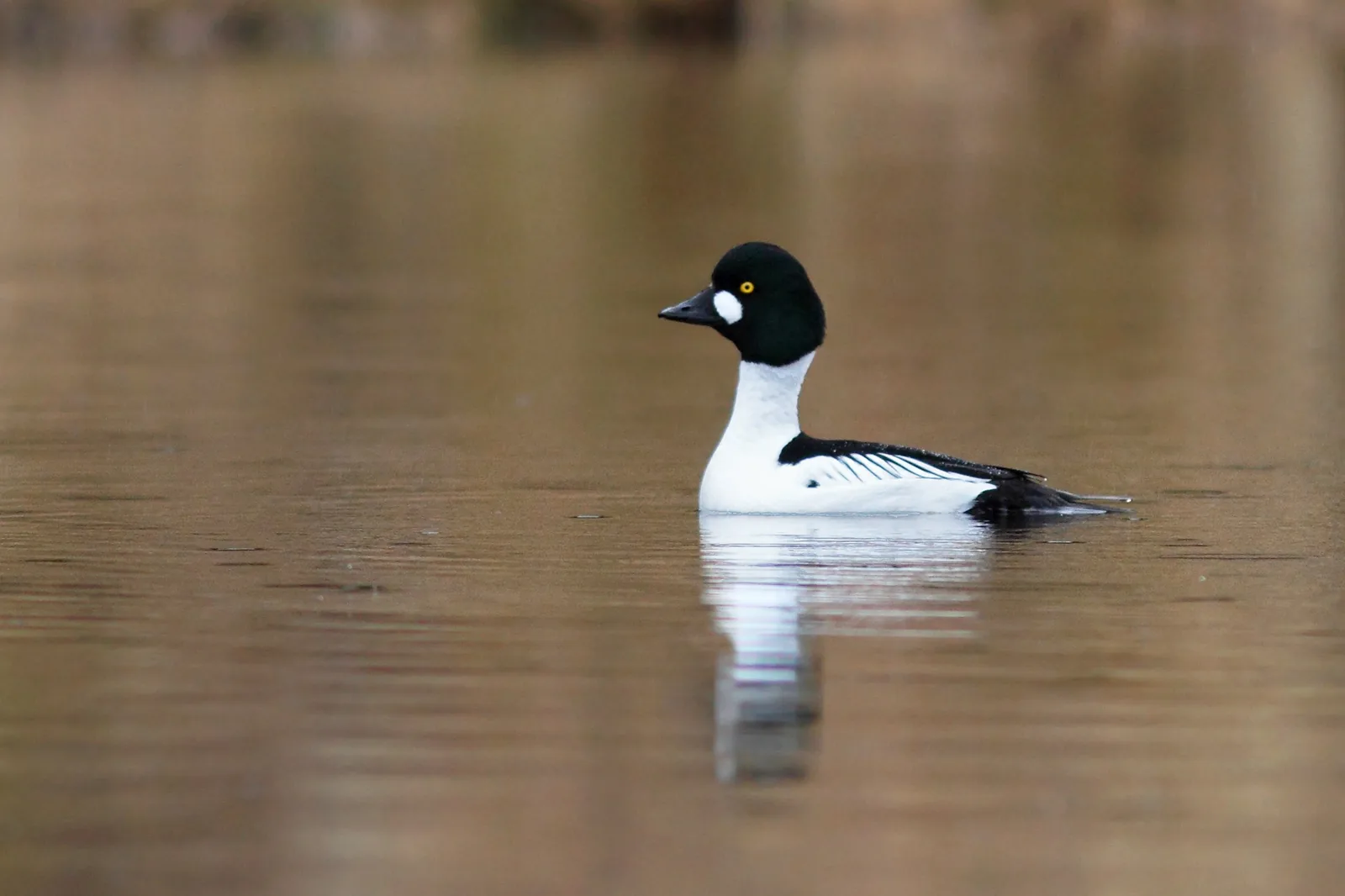

The Sound Before the Silhouette
On a Northern lake at dawn, a Common Goldeneye announces itself before you spot it. The duck arrives as a sound first, a thin mechanical whistle from the wings carrying across the water. Hunters in North America have a name for this species. They do not call it goldeneye. They call it whistler.
A Name Built From Noise
The scientific name Bucephala clangula names the bird’s two most obvious features. Bucephala is Greek for “bull-headed,” after the duck’s large, dome-shaped skull. Clangula is Latin, from clangere, “to resound.” Carl Linnaeus, the 18th-century Swedish naturalist who founded modern biological taxonomy, described the species in 1758 as Anas clangula. Clangula has been the bird’s tag for nearly three hundred years.
The folk names converge. Norwegian Kvinand means “whistle-duck,” from the male’s kvinende vingelyd, his whining wing-sound. Icelandic Hvinönd is built the same way: the second element önd means duck, and the first carries the sense of the wing-noise. In Russian and Ukrainian the species is гоголь (gogol), the word that gave the satirist Nikolai Gogol his family name. People who lived near these ducks, in very different languages, kept reaching for words that meant noise.
Nine Beats a Second
A goldeneye in flight beats its wings about nine times a second, and the rush of air through stiff primaries produces a fast, high whistle. North American hunters dubbed the species “whistler” or “whistle-wing” centuries ago, and the British Trust for Ornithology still records “Rattlewing” as a regional English folkname. On a still January morning, a hunter in a duck blind can pick the species out of a passing flock by ear alone, before the birds clear the treeline.
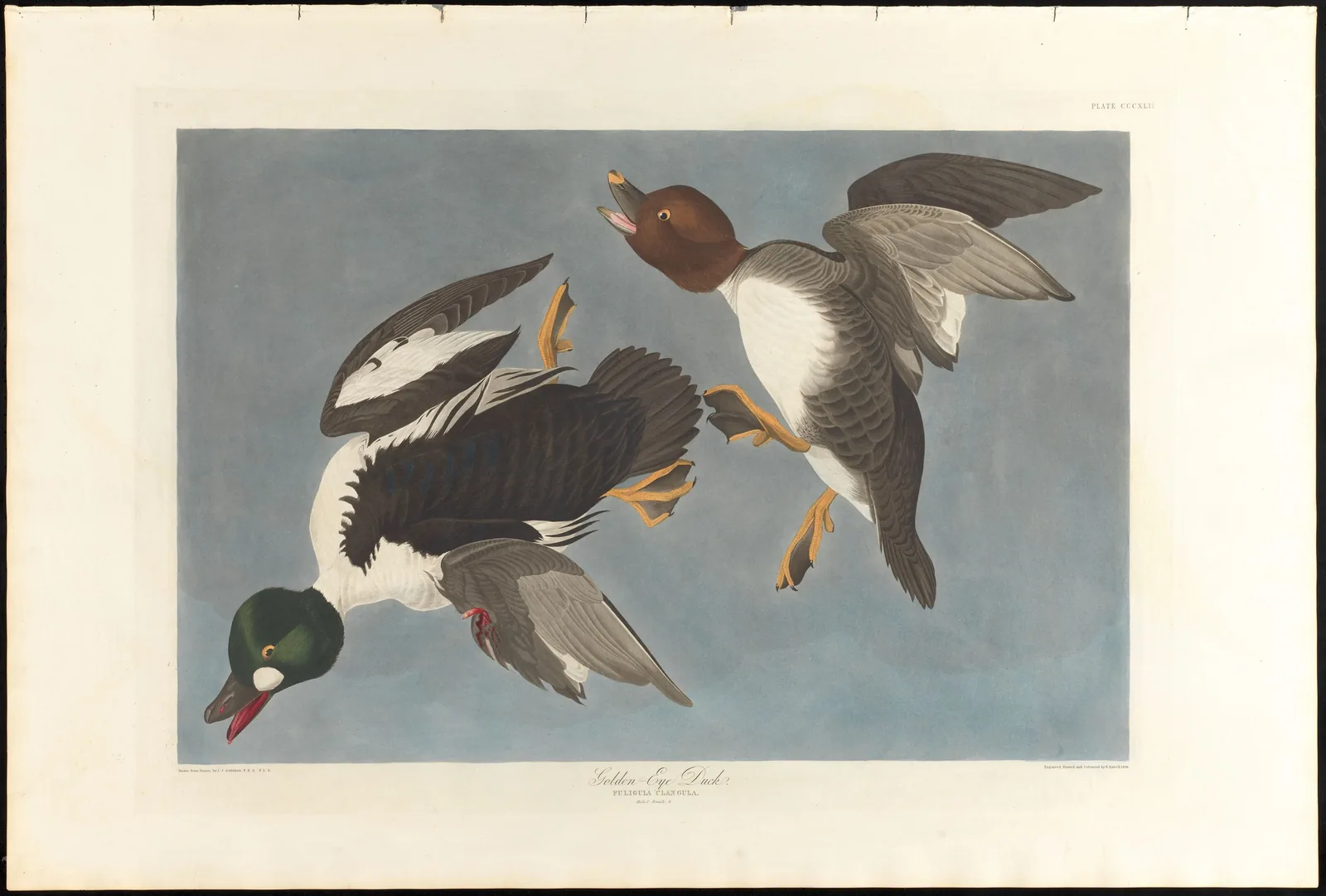
The voice is almost an afterthought. Drakes are mostly silent; the male only breaks his hush during courtship, with a single short peent. Hens give a low croaking gack when alarmed. Goldeneye conversation, such as it is, plays second fiddle to goldeneye flight.
Born High Up the Trunk
The other surprise is where the duck nests. Goldeneye hens look for hollow tree cavities five to sixty feet above the ground, often old pileated woodpecker holes or broken trunk limbs near a lake. The chicks hatch in the dark of the cavity. Within twenty-four to thirty-six hours, the mother flies down to the water and calls them. They do not climb out. They jump, sometimes falling forty feet through the air, and land softly enough that the down absorbs the impact. Then they follow her overland to a brood-rearing pond she has chosen.
Fourteen Displays on Open Water
In late winter, drakes assemble on open water and run through a catalogue of fourteen distinct courtship displays. The signature move is the head-throw-kick. The male whips his iridescent green head all the way back until the nape touches his rump and the bill points to the sky. Then he gives the buzzy peent and kicks a small fountain of water out behind him with his orange feet. The whole performance takes about a second. He resets and does it again.
The goldeneye gives you almost nothing to listen to and everything to listen for. The voice barely registers, but the wings carry the bird across three Northern languages and most of the boreal world. Clangula was the right word.
Sources:
- Wikipedia: Common goldeneye
- Wikipedia: Carl Linnaeus
- Wikipedia: Nikolai Gogol
- Wikipedia (Norwegian): Kvinand
- Wiktionary: Gogol (Slavic surname)
- National Audubon Society: Common Goldeneye field guide
- British Trust for Ornithology: Goldeneye Birdfacts
- BirdNote: Winter Romance: Common Goldeneyes
- Northern Naturalist: Whistle-wing, Common Goldeneye
- Schlitz Audubon Nature Center: Bird Profile: Common Goldeneye
- Wikimedia Commons: Audubon, Birds of America Plate 342, Golden-eye Duck
- YouTube, Jean Iron: Common Goldeneye Courtship Displays
.jpg)