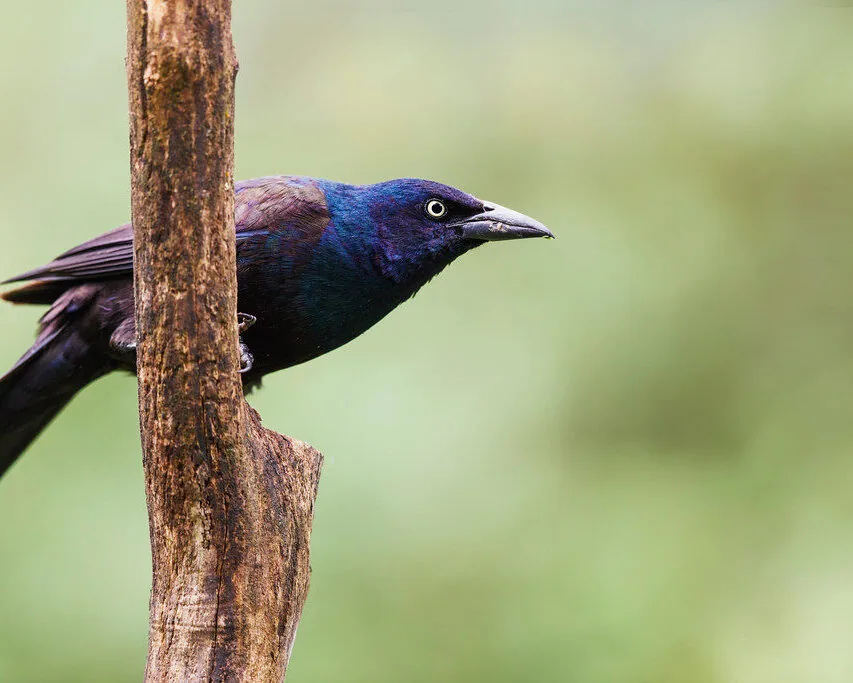
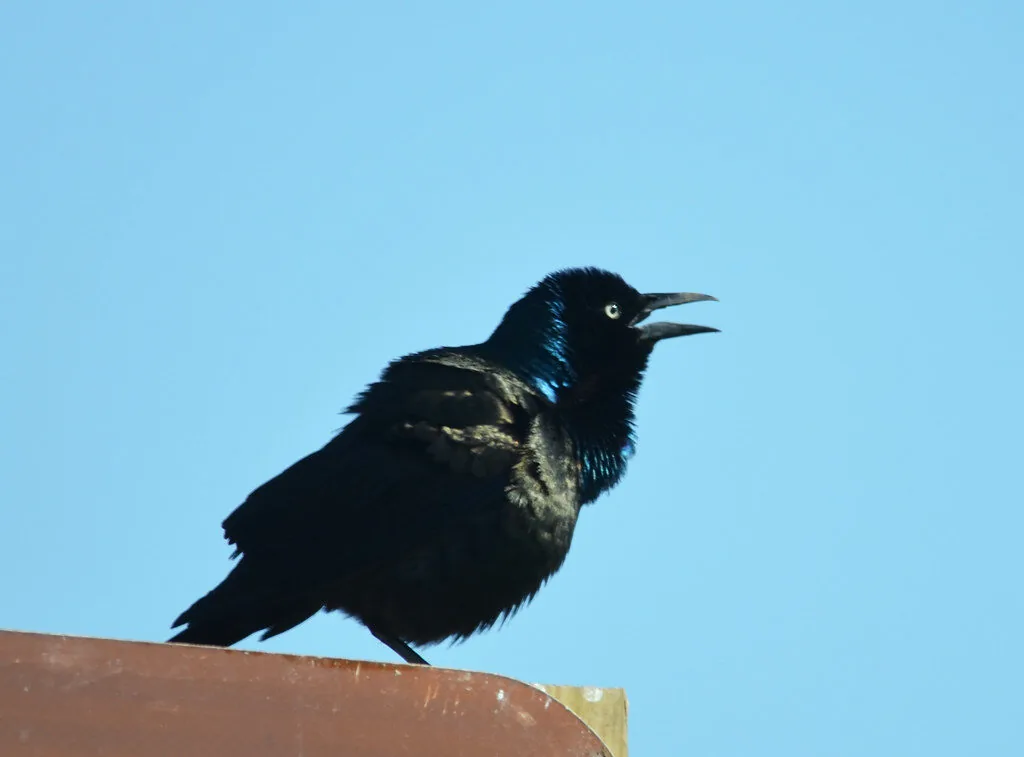
If you happen to wake up in a suburban neighborhood across the eastern half of North America, your morning isn’t greeted by a delicate melody. Instead, you hear the sound of a rusted iron gate swinging on hinges that haven’t seen oil since the 1970s. This is the song of the Common Grackle. It is a rising, metallic screech that lacks vowels, relying instead on a percussive series of clicks that makes the bird sound like it was assembled in a clockwork shop rather than hatched from an egg.
A Saw-Blade Beak and a Taino Legacy
The bird’s scientific name, Quiscalus quiscula, sounds like a rhythmic chant, but its origins are a bit of a linguistic puzzle. While the Latin root quiscula generally refers to a “small bird,” some historians link the genus to the Taíno word quisqueya, meaning “mother of all lands.” This was the indigenous name for the island of Hispaniola, where the grackle’s ancestors once patrolled the shores long before they ever saw a paved parking lot. Colonial settlers, lacking a better term for a creature with oil-slick feathers and judgmental yellow eyes, simply called it the “Crow Blackbird.”
Inside that beak is a piece of biological hardware that separates the grackle from your average songbird. It possesses a hard, sharp ridge called a palatal keel. In its native range, if you see a grackle with an acorn, it isn’t just pecking at the shell. It uses that keel as a literal saw, rotating the nut inside its bill to score a line around the circumference. This weakens the structure until the bird can bite the nut perfectly in half, exhibiting a level of mechanical efficiency that is frankly intimidating.
Chemical Spas and Stolen Songs
The grackle’s most bizarre behavior is a habit called “anting.” You might see one alight on an ant hill and intentionally allow insects to swarm its body. This isn’t a lapse in sanity; it is a chemical treatment. Ants of the subfamily Formicinae secrete formic acid, which the grackle uses as an insecticide to kill mites hiding in its feathers. When ants are scarce, these resourceful birds have been known to “ant” with lemon wedges, marigold blossoms, or even discarded cigarette butts to get their chemical fix.
This adaptability has earned the bird a legendary reputation. In Mexican folklore, the zanate (a close relative of the Common Grackle) was said to have been born without a voice. The legend claims it stole seven songs from the sea turtle, resulting in a repertoire that ranges from “tinkling murmurs” to sounds like rending sheet metal. In the modern era, the grackle has become a mascot for an internet subculture that celebrates the “trash bird.” It is admired for its proficiency at thriving in fast-food drive-thrus and its haughty, dinosaur-like demeanor while guarding a dropped french fry.
The Common Grackle is a mirror of our own urban success—loud, persistent, and messily effective. It has traded the pristine marshes for the neon convenience of the city, and it clearly doesn’t care if you find its industrial song “ugly.” It is simply the bird our modern world deserves.
Sources:
- All About Birds: Common Grackle Overview
- Audubon: In Praise of the Great-tailed Grackle
- Texas Highways: In Defense of the Grackle
- Animal Diversity Web: Quiscalus quiscula
- Wikipedia: Anting (behavior)