
.jpg)
The Composer's Plagiarist
On 27 May 1784, Mozart walked into a Vienna pet shop and walked out with a starling. He paid 34 kreuzer and wrote down the tune the bird had whistled at him on the way in. It was the third-movement theme of his own Piano Concerto No. 17 in G, finished six weeks earlier. The bird had it close. Not perfect. A fermata sat in the wrong place, and one of the G’s had drifted up to G-sharp.
A Bird That Quotes Back
No one knows how the starling learned the concerto. The pet shop sat near a music seller who had been hawking the score, so a whistle through an open window is the working theory. Mozart kept the bird for three years. When it died on 4 June 1787 he buried it in his garden behind a procession of veiled mourners, with an epitaph he had written himself. The eulogy was teary and theatrical. The grief, by every account, was real.
Anyone who has lost a pet recognises the tone. No working composer arranges a real funeral for a bird that couldn’t hold pitch unless the pitch wasn’t quite the point. A wild starling has been observed to copy a sound after hearing it once. Captive males build repertoires of up to thirty-five song types and another fourteen kinds of clicks, lifting from other birds, telephones, car alarms, and whatever street they live on.
A Songbook of Whatever’s Around
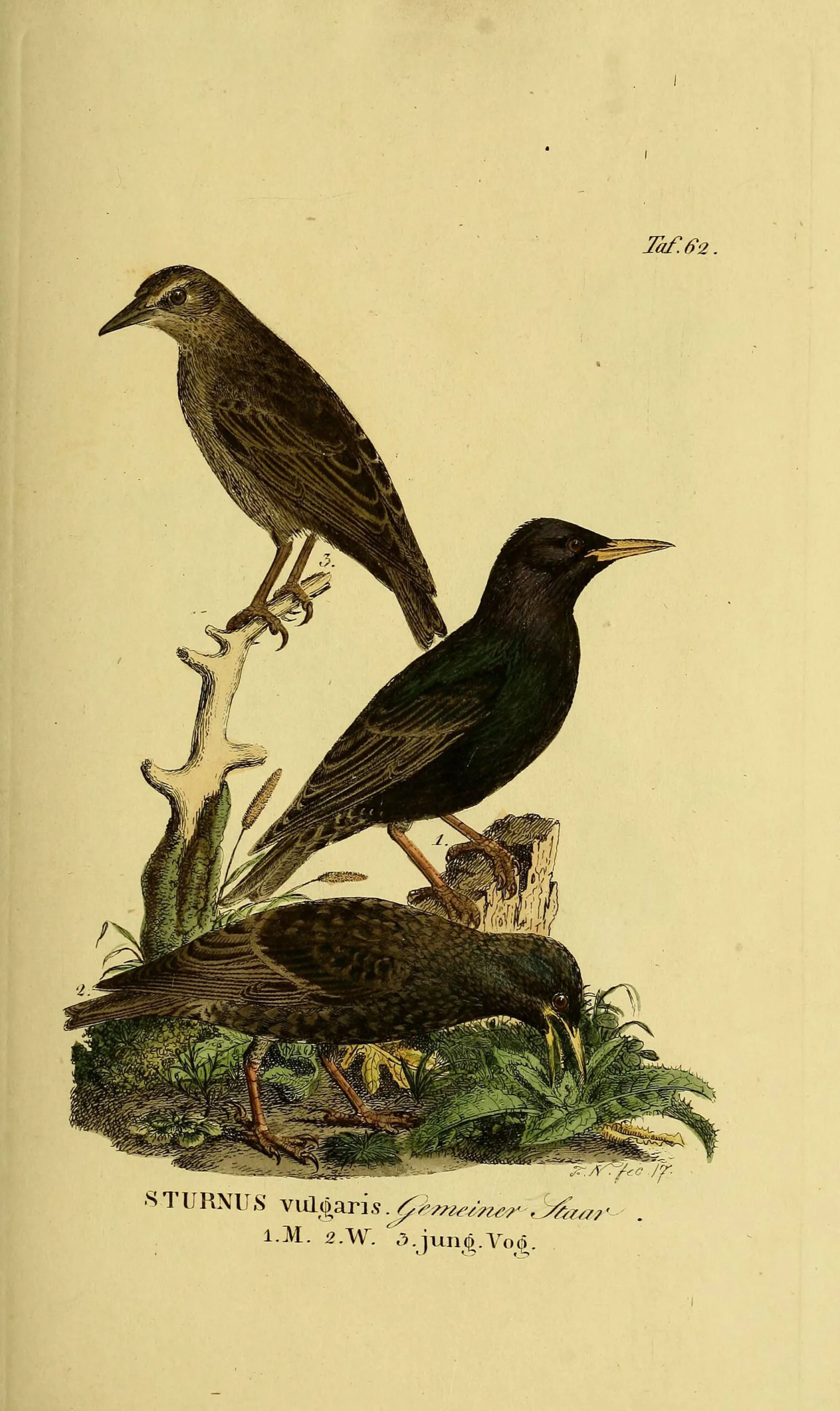
A male starling’s repertoire is a kind of CV. Females prefer mates whose phrases run longer and draw from more sources, because a thick songbook takes years to build. A first-spring male can only quote what he picked up as a chick. A four-year-old has had four springs of ringtones, sirens, and rival songs to plunder.
The choice isn’t random. Starlings preferentially imitate sounds that are acoustically simple: alarms, monotone whistles, and the simpler songs of common neighbours. Local dialects emerge. A city starling builds up a working library of car alarms and ringtones. A starling in your roof eaves will, given a few weeks, start sounding faintly like your kettle.
Sit by an open window in spring and the full performance is mostly hiss, click, and whistled fragments of things you almost recognise. A pause, then the punchline.
Ten days after the bird’s death, Mozart finished A Musical Joke, K. 522, a piece full of phrases that wander into wrong keys and stop short of resolution. Those are the same kinds of slips a starling makes when it imitates a tune: a missed pitch, a fermata in the wrong place, a phrase that breaks off mid-thought. The biologists Meredith West and Andrew King argued in a 1990 paper that the bird’s fingerprints are all over the score. Listen to the third movement and see if you agree.
Sources:
- Wikipedia: Common starling
- Wikipedia: Mozart’s starling
- Wikipedia: A Musical Joke (K. 522)
- RSPB: Starling
- British Trust for Ornithology: BirdFacts: Starling