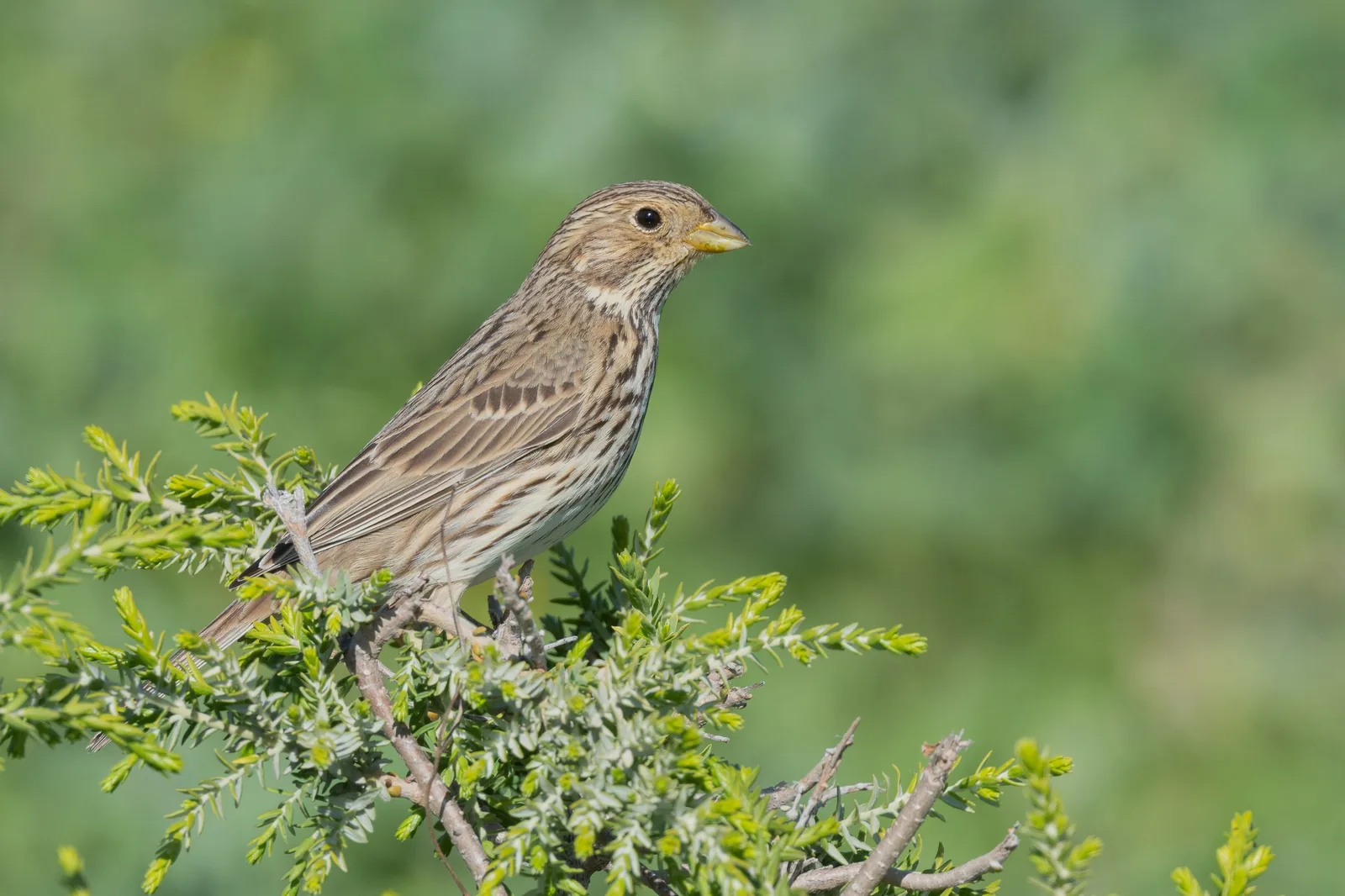

The Fat Bird's Local Accent
Most readers will need a hint to even spot a Corn Bunting. Britain’s biggest, plumpest farmland songbird picks a single fencepost or telephone wire and shakes out a song the field guides have called the same thing since the 1880s: a bunch of jangling keys. The strange part is that the keys jangle differently in Sussex and on Tiree.
A Bunch Of Keys, Locally Tuned
In 1980, the British biologist Peter McGregor parked himself in Sussex farmland and recorded every Corn Bunting he could find. He published the result in Zeitschrift für Tierpsychologie: each population of 30 to 100 males all sang the same form and the same number of song types. Cross a hedge into the next dialect, and the song changed. The Corn Bunting became the first species described as having both clear local dialects and a full repertoire of song types. Later researchers added a stranger finding, summarised in a 2020 Frontiers in Psychology review of vocal cultural transmission. The Corn Bunting is the only songbird known to change the details of its dialects in concert from year to year. The whole village rewrites the chorus together.
The Fat Bird Of The Barley
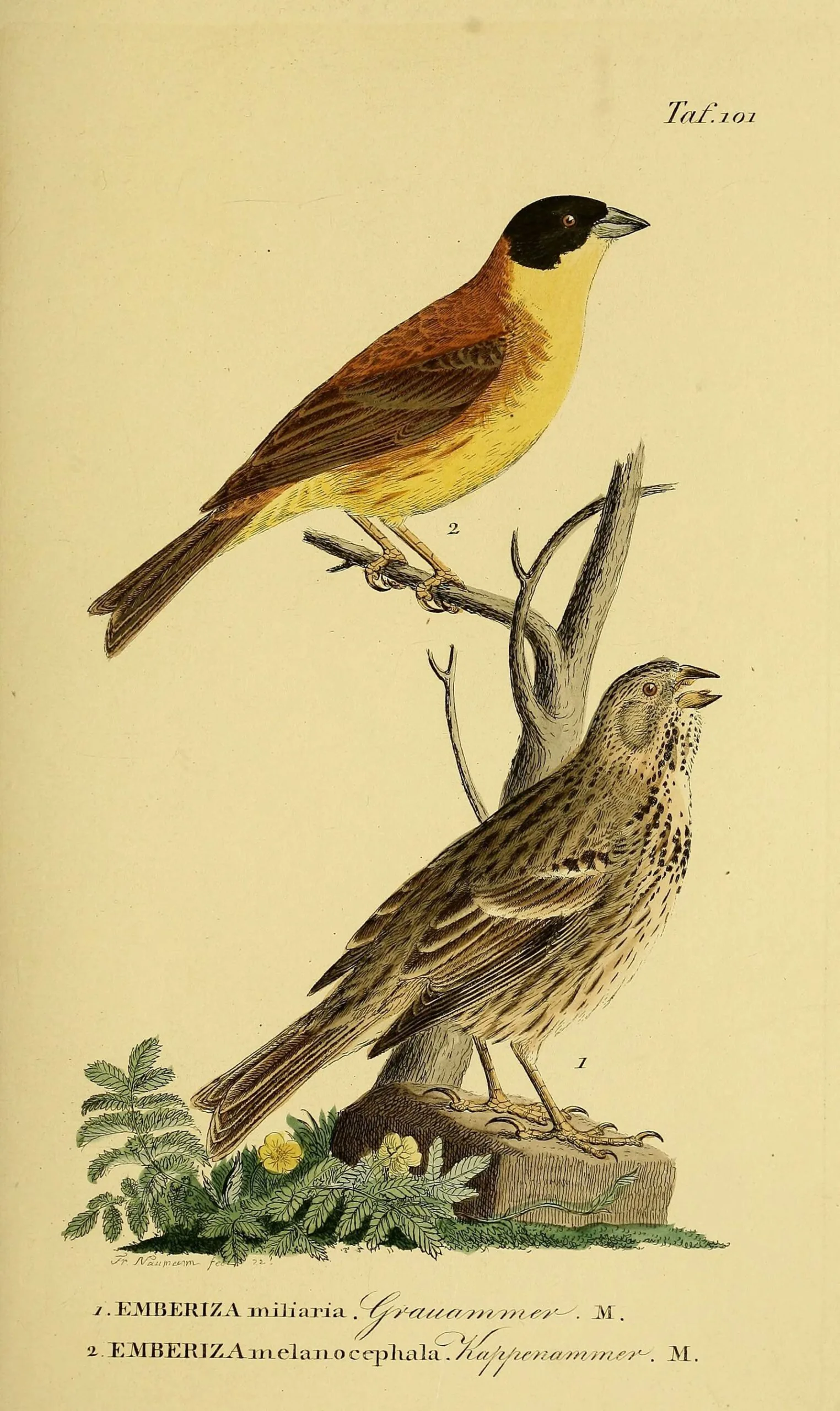
The Scottish folk name is the fat bird of the barley, and it is earned. The Corn Bunting is the largest of Europe’s buntings. It flies heavily, with legs dangling across the stubble like a bird that has not quite committed to airworthiness. The Swedish naturalist Carl Linnaeus described the bird in 1758 and placed it in his new genus Emberiza, a Latinisation of the Old German Embritz for a bunting. The species name calandra comes from the Greek for a calandra lark, because earlier naturalists thought the heavy, streaked bird looked more like a small lark than a finch.
The voice is what gives it away. So does the family life. One Corn Bunting male can hold a territory of up to three females, and most males take no part in nest-building or incubation. The females sit alone for the twelve days the eggs need, then feed the chicks on their own until the male turns up to help once the chicks are over half-grown. For a small brown bird in a wheat field, that is an unusually open social arrangement.
A Shrinking Map Of Songs
The dialect map is now the conservation map. Britain’s Corn Bunting population has fallen 83 percent since 1967, putting the species on the UK Red List. The cause is well understood. From the 1970s on, British farms switched from spring-sown to autumn-sown cereals. Mixed farming gave way to monoculture. Agrochemicals stripped the seeds and insects the bird depends on. Whole dialects vanished with the fields that held them. The bird is gone as a breeder from Wales and Ireland. What survives is patchy: Scotland’s east coast holds the densest population, with smaller pockets scattered across southern England and the Hebrides.
On the Bird Rise app, the recording you wake up to is one accent of many that used to cover the country. The bird is still out there, jangling its keys for whoever is left to listen.
Sources:
- Wikipedia: Corn bunting (Emberiza calandra)
- RSPB: Corn Bunting bird facts
- BTO: Corn Bunting BirdFacts
- Frontiers in Psychology (2020): Cultural Transmission, Evolution, and Revolution in Vocal Displays
- GOV.UK: Wild bird populations in the UK and England, 1970 to 2024
- RSPB: Corn Bunting: advice for farmers