The Whistle in Its Wings
Picture a flock of plump grey pigeons pecking around a car park somewhere in suburban Australia. Something spooks them, and the whole group bursts upward in a sharp, ringing whistle. Here is the strange part. That alarm did not come from a single throat. It came from their wings.
A Swift Pigeon With a Spike
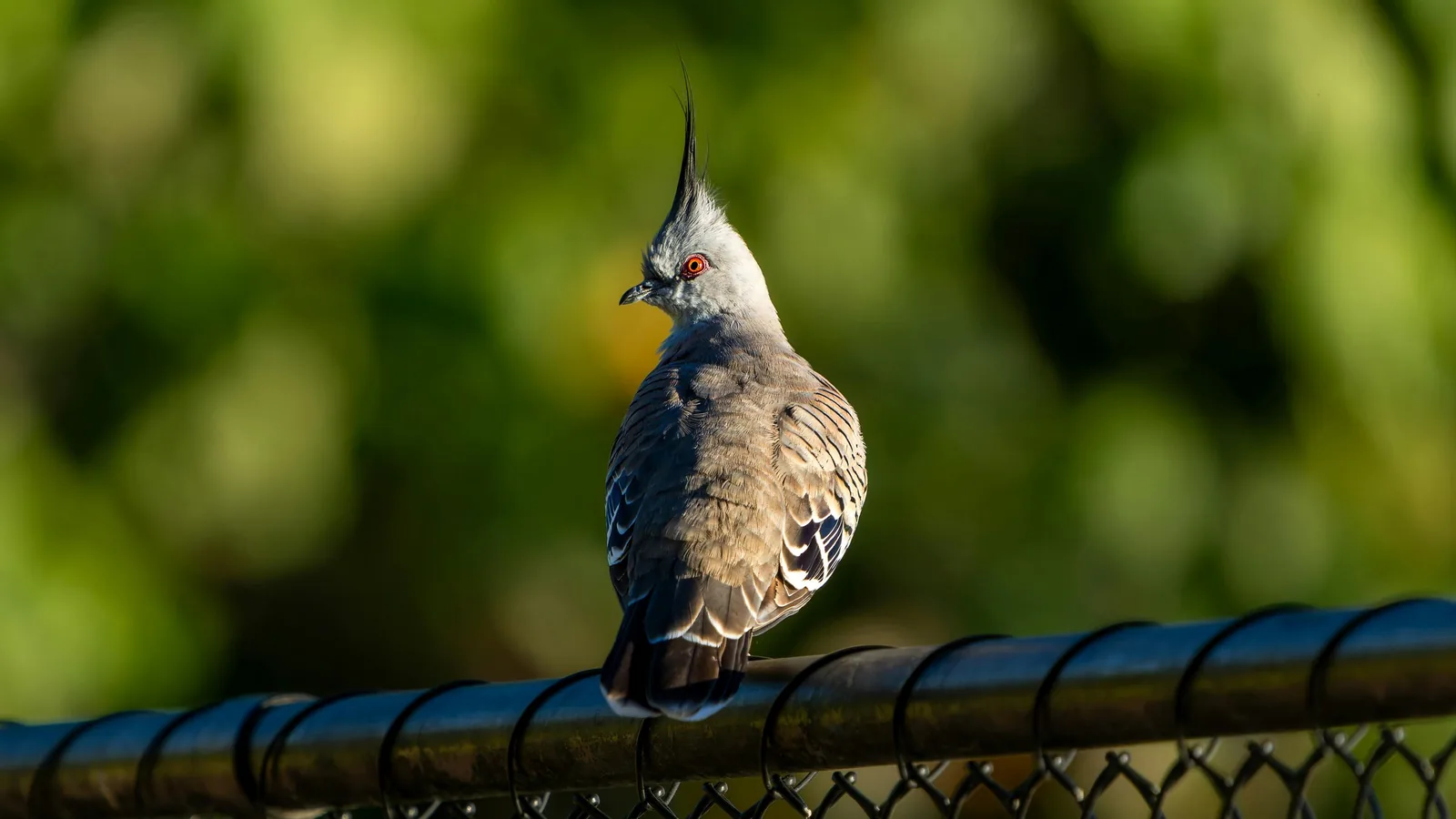
The Crested Pigeon is hard to confuse with anything else. It wears a thin black crest that stands straight up like a punctuation mark, and it is one of only two Australian pigeons that carry an erect crest of this kind. Catch it in good light and the wing turns to oil-slick colour, with bands of green and violet laid over the grey. Its scientific name suits it. Ocyphaps comes from the Greek for “swift” and “pigeon,” and lophotes means “crested.” A swift, crested pigeon. Whoever named it in 1822 was paying attention.
The Alarm Is Built Into the Wing
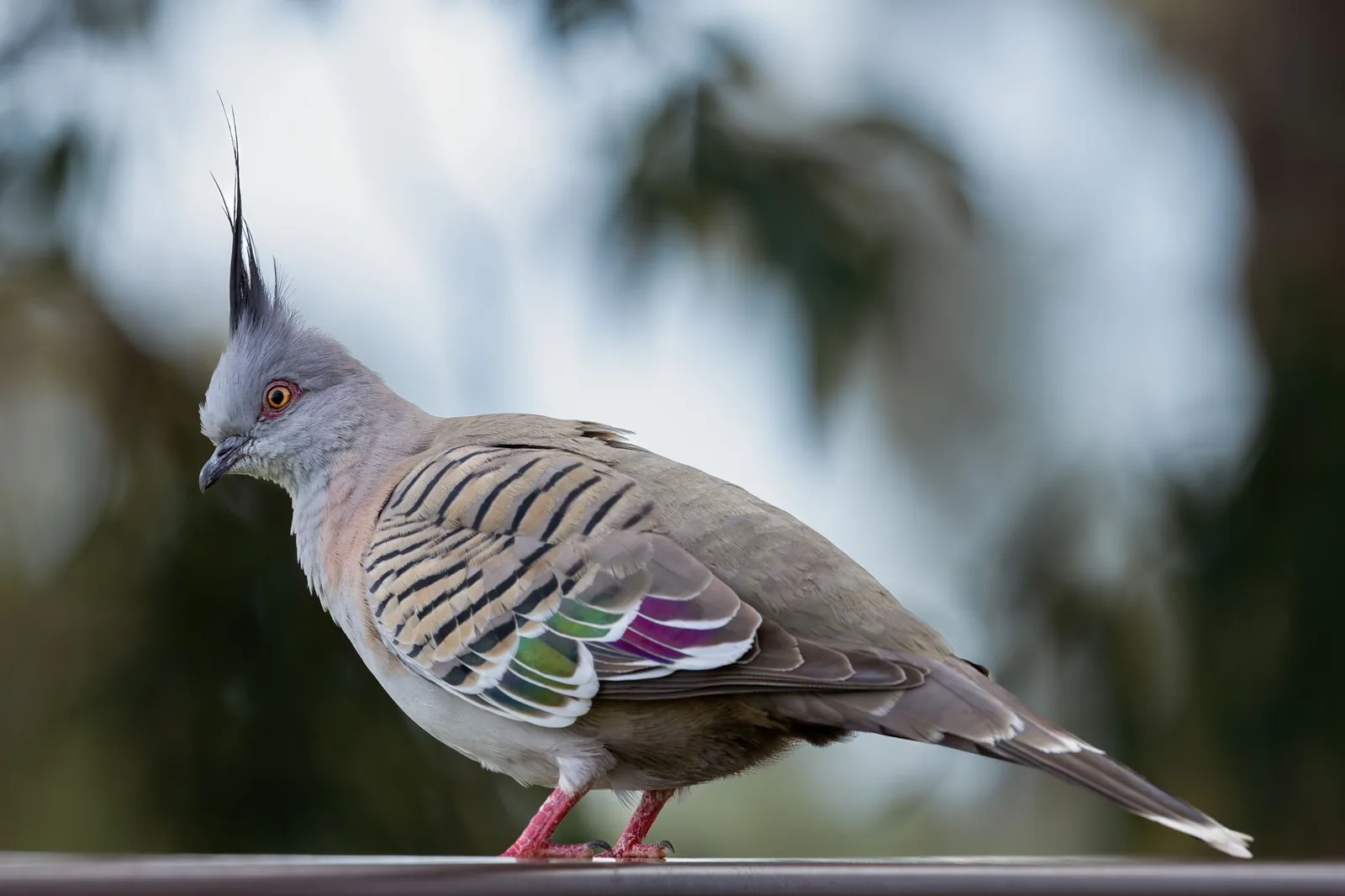
The whistle is what this bird is famous for, and for years nobody knew how it worked. The answer turned out to be a single feather. The eighth primary feather on each wing, counting outward from the body, is oddly narrow, about half the width of the feathers on either side of it. Every downstroke pushes air across that slim feather and it sounds a clear note.
In 2009 two behavioural ecologists at the Australian National University, Mae Hingee and Robert Magrath, showed this was not just noise. A pigeon taking off in a panic beats its wings faster, so the whistle comes out louder and at a quicker tempo. When they played alarmed whistles back to a feeding flock, the other birds bolted. Calm flight sounds left them sitting. The pigeons were reading the tempo, not simply the volume.
A second study in 2017 pinned it to that one feather. When the team removed the modified eighth primary, the escape flight stopped carrying its warning. The bird had lost its voice without opening its beak. Charles Darwin, the naturalist, once put the “instrumental music” that birds make with feathers on equal footing with song. It took nearly 150 years to confirm the idea in a suburban pigeon.
From the Dry Interior to the Back Fence
Two centuries ago this was mostly a bird of the arid inland. Then farming spread across the country, clearing scrub and leaving stock dams and troughs behind, and the Crested Pigeon followed the water. It has to drink every day, so all that artificial water let it push out across nearly the whole of mainland Australia and straight into the cities. If you wake up in an Australian suburb today, the chunky grey pigeon on the back fence or the powerline is very likely this one. It has skipped only the far northern tropics and Tasmania.
So the next time a flock clatters up off a lawn in that bright rush of whistles, listen for what it really is. Not a song. Not a call from the throat. An alarm bell that evolution bolted onto a feather.
Sources:
- Wikipedia: Crested pigeon
- Wiktionary: Ocyphaps (etymology)
- Birds in Backyards (BirdLife Australia): Crested Pigeon
- Hingee & Magrath, 2009 (Proc. R. Soc. B): Flights of fear: a mechanical wing whistle sounds the alarm in a flocking bird
- Murray, Zeil & Magrath, 2017 (Current Biology): Sounds of Modified Flight Feathers Reliably Signal Danger in a Pigeon
- National Geographic: Crested pigeons give off warning whistles simply by taking off
- Xeno-canto: Ocyphaps lophotes recordings