
The Cobbler's Awl With Wings
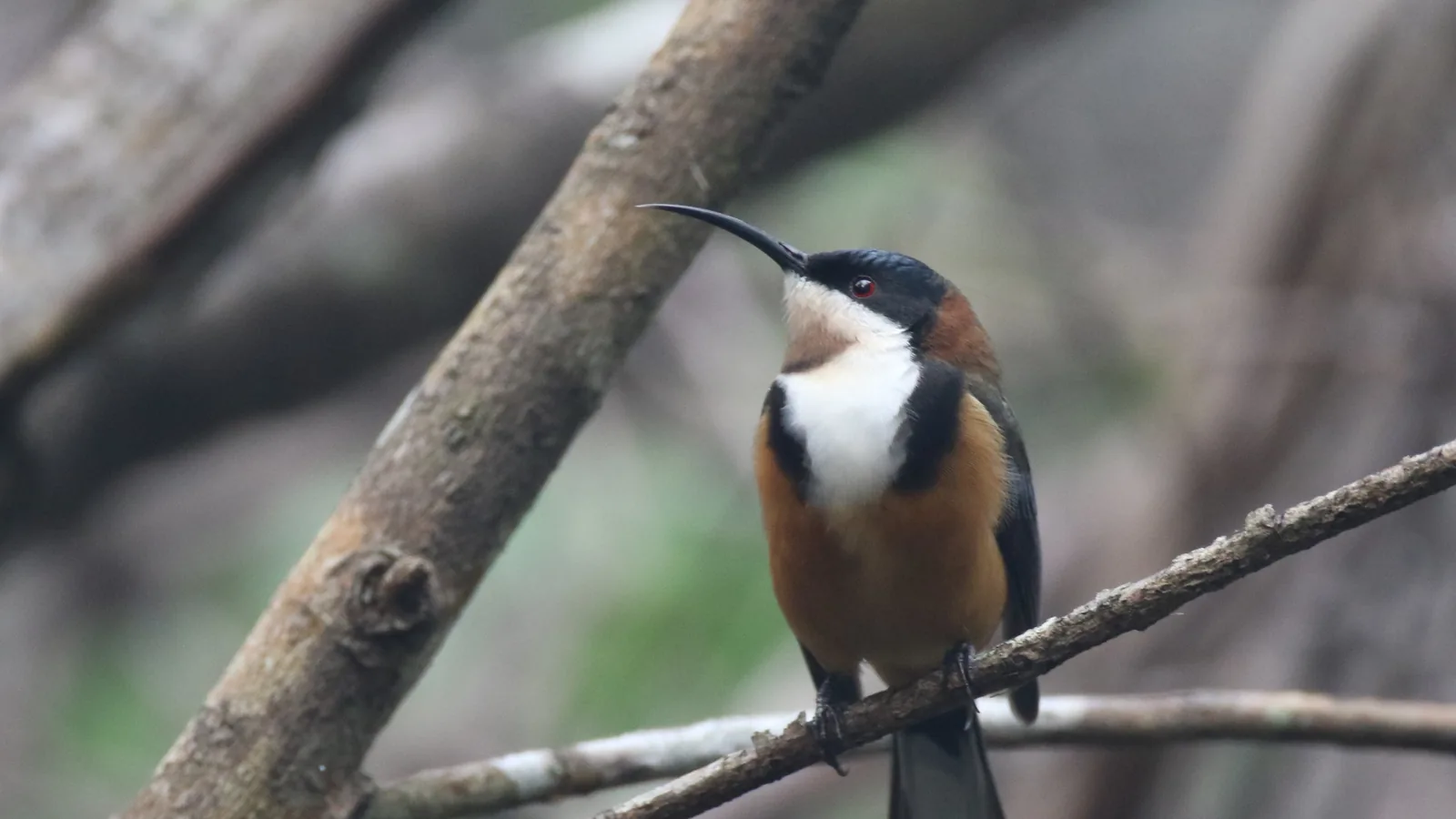
Picture a shoemaker’s awl, the slim curved spike that punches holes through leather, and give it a red eye and a pair of wings. That is more or less an Eastern Spinebill, a small honeyeater in rust and clean white that works the grevillea and bottlebrush from Cooktown down to Tasmania. Keep a flowering garden anywhere along Australia’s east coast and it has probably already found you, announcing itself with a high, ringing chip-chip-chip before you ever spot the bill.
A Beak Named for a Cobbler’s Tool
The scientific name says the same thing twice. Acanthorhynchus is Greek for thorn-bill, and tenuirostris is Latin for slender-billed. The English ornithologist John Latham, who catalogued much of Australia’s bird life for European science, formally described the species in 1801. The name that stuck in country Australia was earthier: for generations people simply called it the cobbler’s awl bird. A 1936 piece in the Sydney Morning Herald leaned into the pun, noting that “Cobbler’s Awl seems as though it should be Cobblers All,” because the bird’s tightly woven nests showed “workmanship the equal of any shoemaker.” And that bill is no ornament. Its downward curve is built to slide inside tubular flowers, especially native heaths like Epacris impressa, that blunt-billed birds cannot reach.
It Hovers Like a Hummingbird
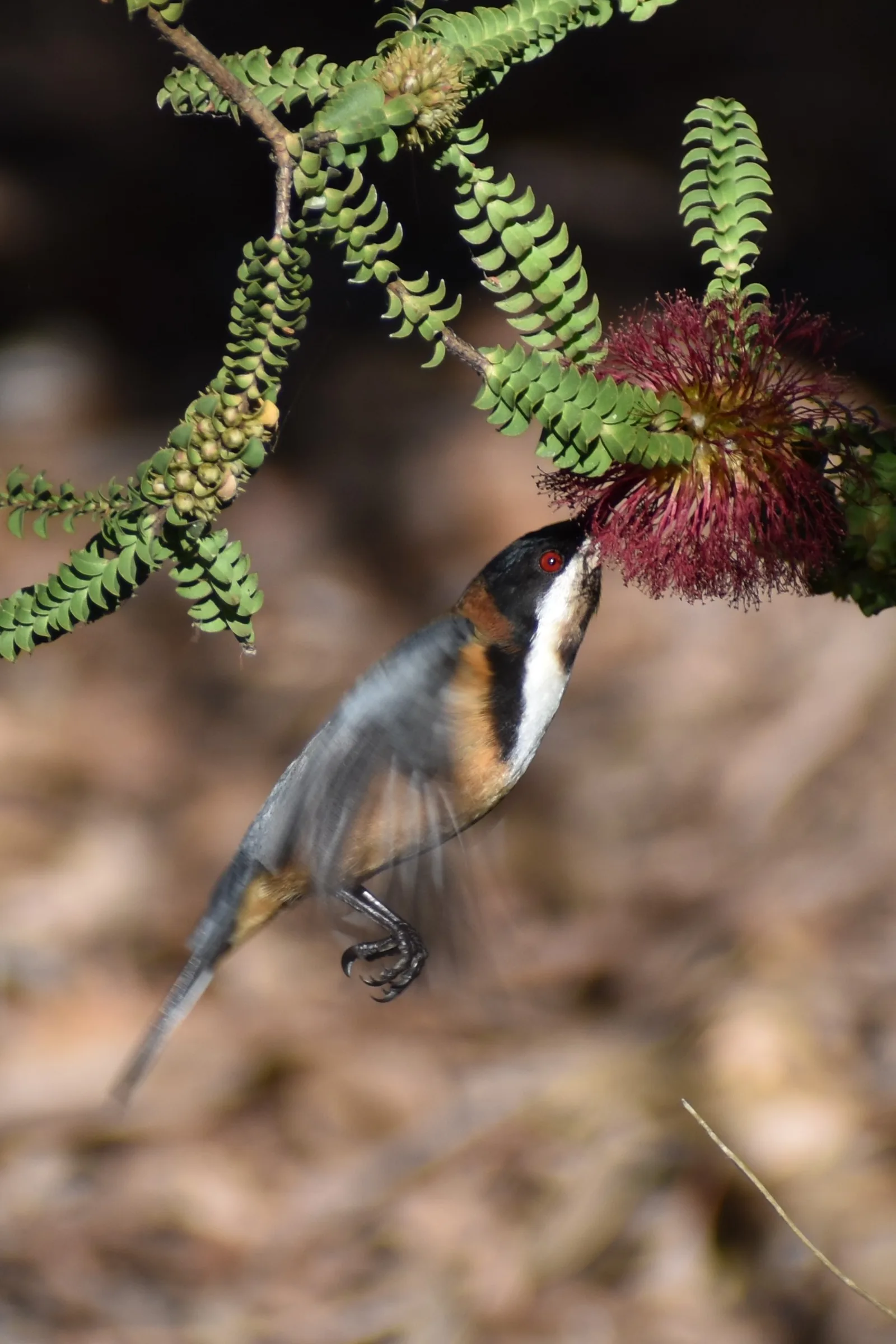
Here is the part that stops backyard birders. Most honeyeaters grip a stem and lean in to feed. The Eastern Spinebill can skip the perch and hover instead, wings beating to a blur as it holds steady at a flower, the way a hummingbird does. Australia has no hummingbirds, and few of its birds feed on the wing like this. Moving through a patch of blossom, the spinebill ferries pollen bloom to bloom, a tiny unpaid gardener working for sugar. Watch for the flash of white outer tail feathers as it flits off.
A Furnace That Can Throttle Down
For such a slight bird, it takes on punishing conditions. In the high country of New England National Park in northern New South Wales, the spinebill is the commonest honeyeater right through winter, even as nights fall to minus five. The nectar supply up there is erratic, thinnest just after the coldest nights, so the bird can run an energy deficit for days. A 1990 study in the journal Emu by Chan, Ford and Ambrose described how it likely copes: a spinebill can drop its daytime metabolic rate toward the low idle it saves for sleep, and may even let its body cool, stretching its fat until the flowers refill. A bird of about eleven grams, running its own thermostat.
None of this shows in a field-guide silhouette. The Eastern Spinebill reads as a pretty garden regular, all rust and clean white, until you clock the awl on the front of its face and learn what it does with the cold. A Victorian newspaper in 1943 caught the sound best, calling its “Chink! Chink! Chink!” as “resonant and mellow as a golden bell.” Plant a few tubular natives and you can wake to that bell.
Sources:
- Wikipedia: Eastern spinebill
- Birds in Backyards: Eastern Spinebill
- BirdLife Australia: Eastern Spinebill
- Emu (Chan, Ford & Ambrose, 1990): Ecophysiological Adaptations of the Eastern Spinebill to a High Altitudinal Winter Environment
- Pauline Conolly: The Eastern Spinebill, aka Cobbler’s Awl
- Animal Diversity Web: Acanthorhynchus tenuirostris