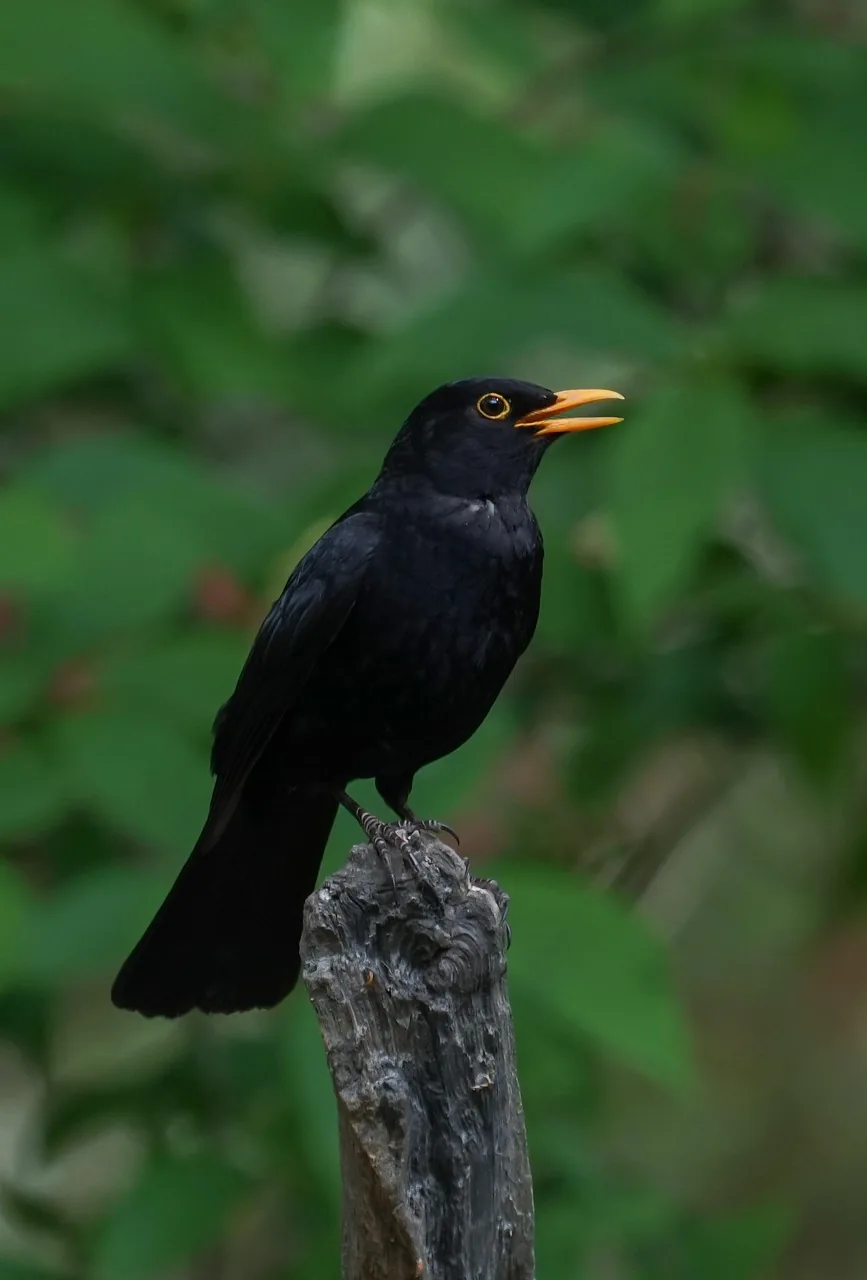
The Eurasian Blackbird (Turdus merula) is a biological marvel of resilience and musicality. Originally a shy, solitary inhabitant of deep forests, it has managed a rare feat: it successfully transitioned into the heart of the concrete city without losing its essence.
In cities across Europe, and in its introduced ranges in Melbourne and New Zealand, this bird is a fixture of the daily soundscape. It is a Thrush, which makes it a direct relative of the American Robin. This lineage is why its song is so distinctive—a rich, mellow, and fluted melody that stands in stark contrast to the harsher calls of other urban species.
The “Colly” Confusion
Long before the species was standardized as the “Blackbird,” Old English speakers called it the Osel (a relative of the modern German Amsel). But by the time The Twelve Days of Christmas was written, descriptive nicknames had taken over.
You know the line “Four Calling Birds”? It is a modern corruption. For centuries, the lyric was actually “Four Colly Birds”. “Colly” is an old English dialect word for “coal-black” or soot. Over time, as the word faded from common usage, people substituted the phonetically similar “Calling.” This shift erased the bird’s defining feature—its matte, light-absorbing blackness—and replaced it with a generic behavior. The Swedish kept the original spirit alive, though; they still call it Koltrast, or “Coal Thrush”.
The Urban Adapter
While many birds are retreating from humanity, the Blackbird is moving in. Biologists call this “synurbization”—the rapid evolution of wildlife to city life.
If you hear a Blackbird singing at 3:00 AM in a city center, he isn’t confused. He is adapting. Research shows urban Blackbirds have evolved to sing earlier and at a higher pitch to rise above the low-frequency rumble of rush-hour traffic. They have shifted their entire circadian rhythm to ensure their message is heard over our noise.
Watch one on a lawn, and you’ll see a master engineer at work. The Blackbird utilizes a specific technique called “gaping.” It stabs its bill into the soil and forcibly opens its mandibles against the earth’s resistance. It uses its beak like a reverse-plier, pushing the ground open to peer inside and access earthworms that other birds can’t reach.
The Prince of Riches
This gold-beaked figure appears in French folklore, which offers a mythical explanation for its striking appearance. Legend says the Blackbird was once pure white. One day, he saw a Magpie hiding gold and asked where to find it. The Magpie directed him to the underground palace of the “Prince of Riches.”
Overcome by the allure of the treasure, the Blackbird dove into the gold dust, but a fire-breathing demon guarding the hoard chased him out. The smoke charred his feathers forever black, and his beak remains stained yellow-orange from the gold he tried to reach.
Know More
- Bartleby.com. The Blackbird by Alfred, Lord Tennyson.
- University of Waterloo. Music Theory is for the Birds.
- Mairi McFadyen. If I Were a Blackbird.
- Icy Sedgwick. The Folklore of Garden Birds.
- Bird Watcher’s General Store. The Twelve Days of Christmas Explained: Is It Calling, Collie, or Colly Birds?
- Learning Through Landscapes. Blackbird Resource.
- Audubon. The City Blackbird and Country Blackbird.
- Audubon. Blackbirds Are Built for a Distinctive Feeding Style Known as “Gaping”.
- Te Ara – The Encyclopedia of New Zealand. Introduced Land Birds: Blackbirds.
- Library of Congress. Is It Four Calling Birds or Four Colly Birds?
- Horniman Museum. The Birds of the 12 Days of Christmas.
- Max Planck Institute. City Blackbirds Scream to Be Heard.