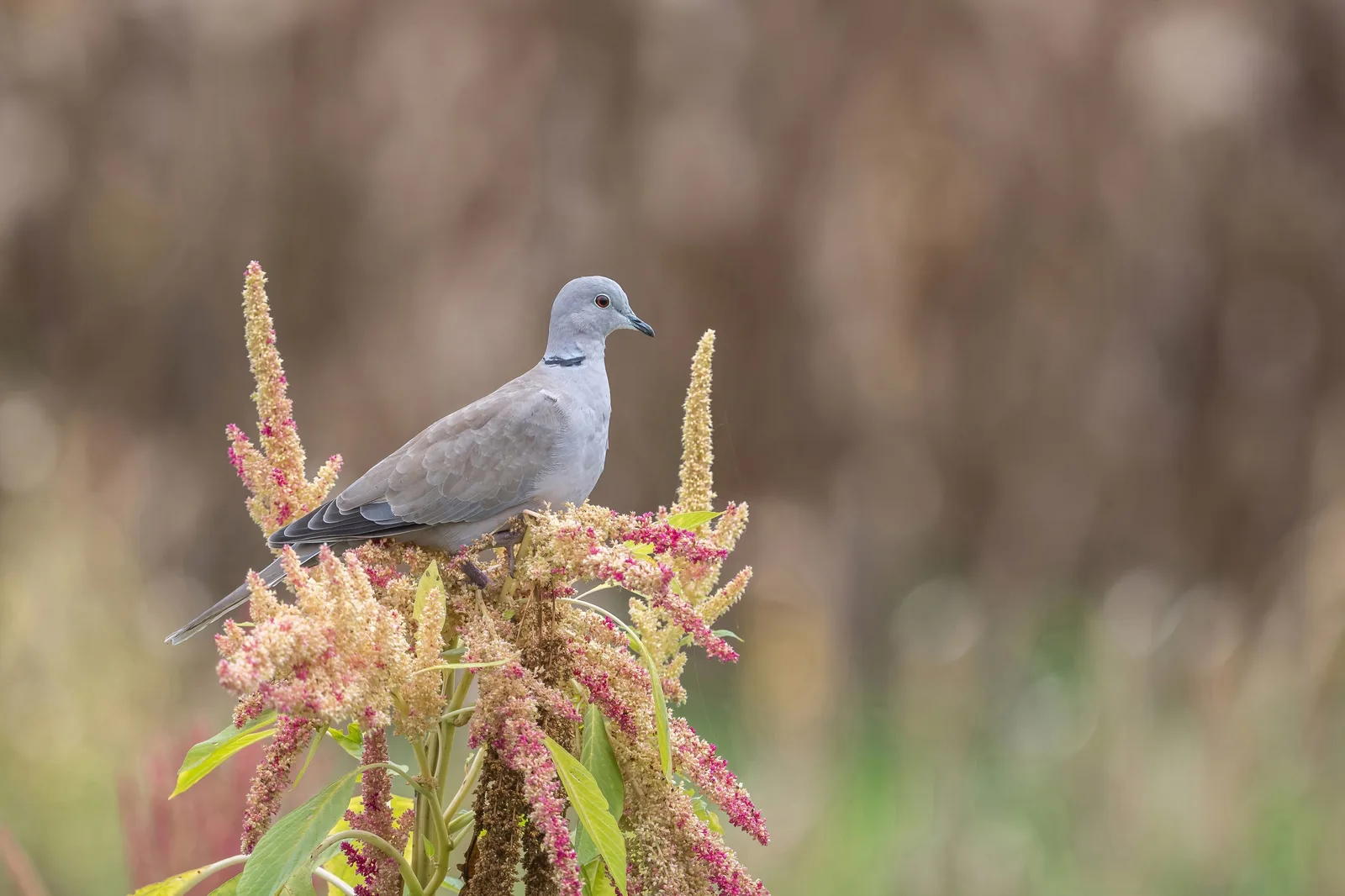

The Dove That Says Eighteen
Listen long enough to a Eurasian Collared-Dove and the bird sounds like it is saying something. Three syllables, stress on the middle one, repeated for as long as the dove feels like it. Scientists named the species after the call. Decaocto is Greek for eighteen, and there is a folk story to explain the choice.
Eighteen, Eighteen, Eighteen
The myth lives in Balkan folklore. A maidservant complained to the gods that her year’s work had earned her only eighteen silver coins, and Zeus answered with a bird. The dove flew up calling de-CA-octo, de-CA-octo, eighteen, eighteen, and never stopped. The complaint had become birdsong. Centuries later, naturalists picked a Latin name that kept the count. Streptopelia decaocto: collared dove, eighteen.
From Bulgaria to Florida in a Lifetime
Most European languages went a different direction. Danish Tyrkerdue, German Türkentaube, French Tourterelle turque, all meaning “Turkish dove.” Through the 1800s the bird’s range stopped at the western edge of the Ottoman Empire, so Europeans named it for where it seemed to come from. The name fit the moment. Within a single century the moment was over.
In 1838 the Hungarian naturalist Imre Frivaldszky put the species into the scientific record from a specimen taken near Plovdiv, Bulgaria. The bird was already common across Asia and the Balkans. What changed over the next century was Europe. By 1945 it had reached Germany. Britain saw its first record in 1953, the first breeding in 1956. Ireland followed in 1959, the Faroe Islands by the early 1970s. By the end of the century the species was nesting from the Arctic Circle in Norway down to the Canaries and Morocco. In a few generations of human time, a bird Europeans had only known from the edge of the Ottoman Empire had taken the whole continent.
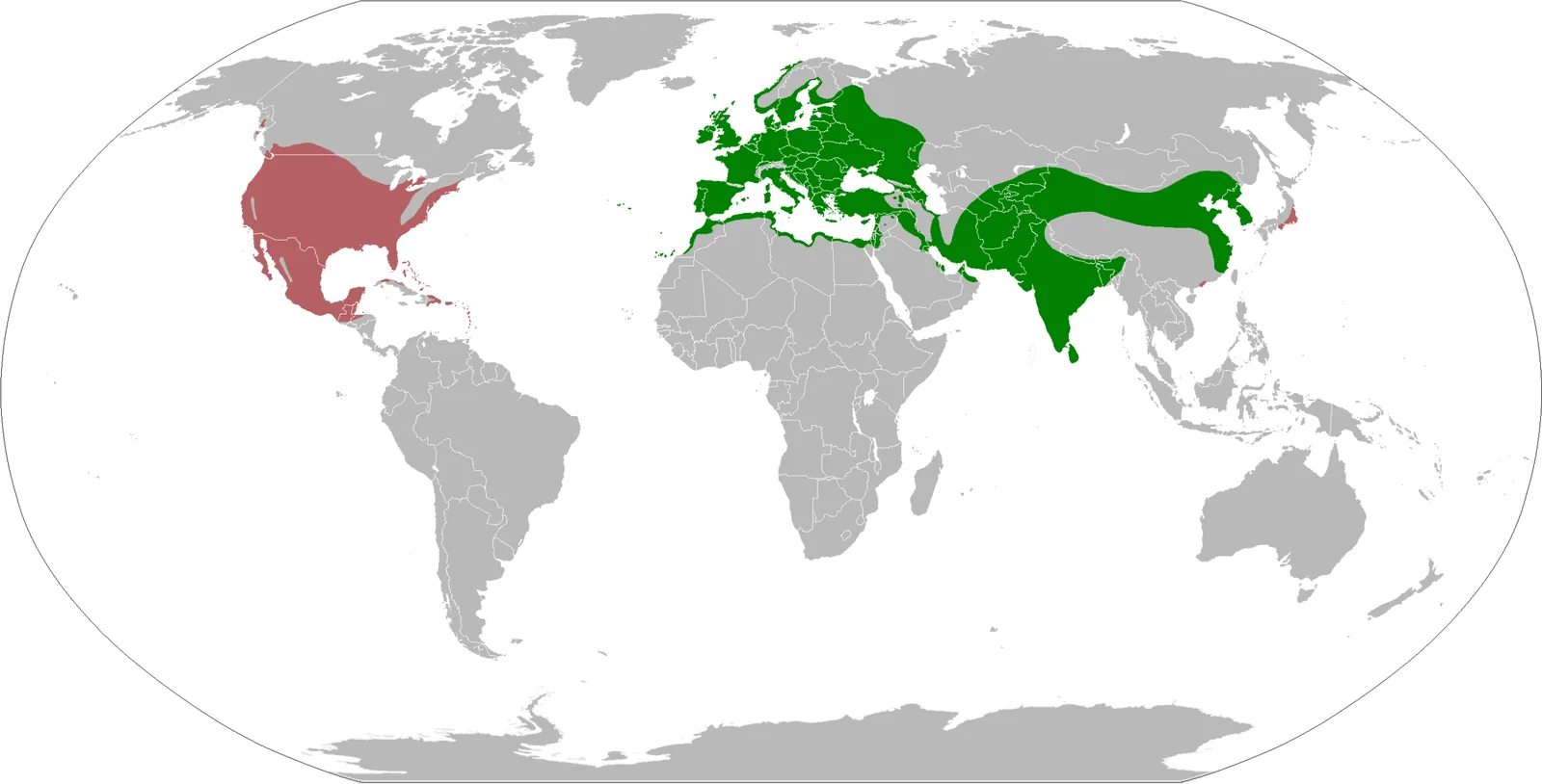
Then came 1974. Fewer than fifty Eurasian Collared-Doves escaped from captivity in Nassau, the Bahamas. Some flew to Florida. From there the species spread across the United States so quickly that ornithologists could clock the rate. In Arkansas the dove crossed five hundred kilometres in five years, about a hundred kilometres per year, more than double the rate it had managed in Europe.
The Three-Note Coo You Already Know
The song is coo-COO-cuk, three notes, the middle one stressed and held. Audubon’s field guide writes it as kuk-kooooo-kuk. The bird also uses a harsher second call, a nasal mewing usually given in flight just before landing, often mistaken for a Gray Catbird. In early spring birders sometimes mistake the cooing for an early-arriving Common Cuckoo.
A pair raises three to four broods a year, sometimes up to six. They build a flat platform of twigs in a tree near a building. The female sits on the eggs at night, the male during the day. About two weeks on the eggs, then two more on the chicks. Then the next clutch starts. A pair settled in a yard can fill almost the whole year with cooing.
Whatever the bird is actually saying, the number eighteen has carried across two and a half millennia of language and a planet’s worth of geography intact. In a Greek village it might still mean a lament. In a Florida suburb it just means there is a dove on the wire.
Sources:
- Wikipedia: Eurasian collared dove
- Wikipedia: Streptopelia (genus etymology)
- BTO: Collared Dove species profile
- RSPB: Collared Dove identification and behaviour
- Audubon: Eurasian Collared-Dove field guide