.jpg)
The Pale Eye Is a No Vacancy Sign
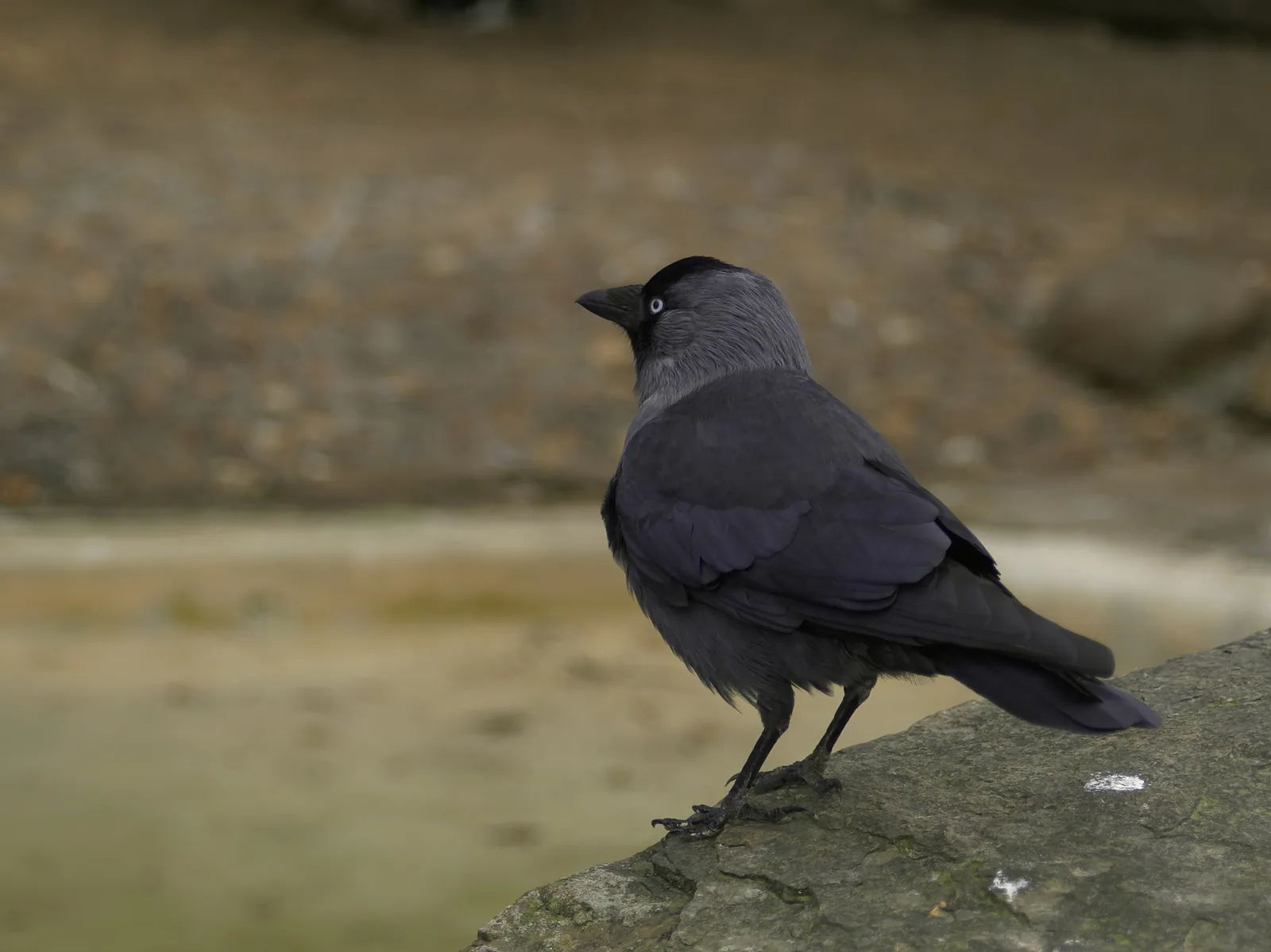
Around 90 percent of perching birds have dark eyes. Jackdaws are in the small minority that doesn’t, and those near-white irides are not decoration. In 2014, Gabrielle Davidson and her Cambridge colleagues mounted photos at the entrances of jackdaw nest cavities: a normal jackdaw face with bright eyes, the same face Photoshopped to dark eyes, and bright eyes alone. Prospecting jackdaws stayed away from the bright-eyed faces and approached the dark-eyed ones freely. The pale iris is a Do Not Enter sign legible only to other jackdaws. It was the first time anyone had shown a non-primate species using its eyes to talk to its own kind.
Married for Life
Look closely at any group of jackdaws on a European rooftop and you’ll notice they come in twos. Each pair sits side by side on the chimney pot. When one takes off, the other follows. They’ve been a couple since they were teenagers. Jackdaws choose a mate in their first year, before they can even breed, and stay together for the rest of their lives. They don’t sleep around. When one of the pair dies, the other often loses its place in the colony and rarely finds a new partner. The Austrian naturalist Konrad Lorenz spent the 1930s on a roof outside Vienna watching a colony of them. The book that came out of it, King Solomon’s Ring, is still the warmest thing ever written about a crow.
The Money-Eater of Rheims
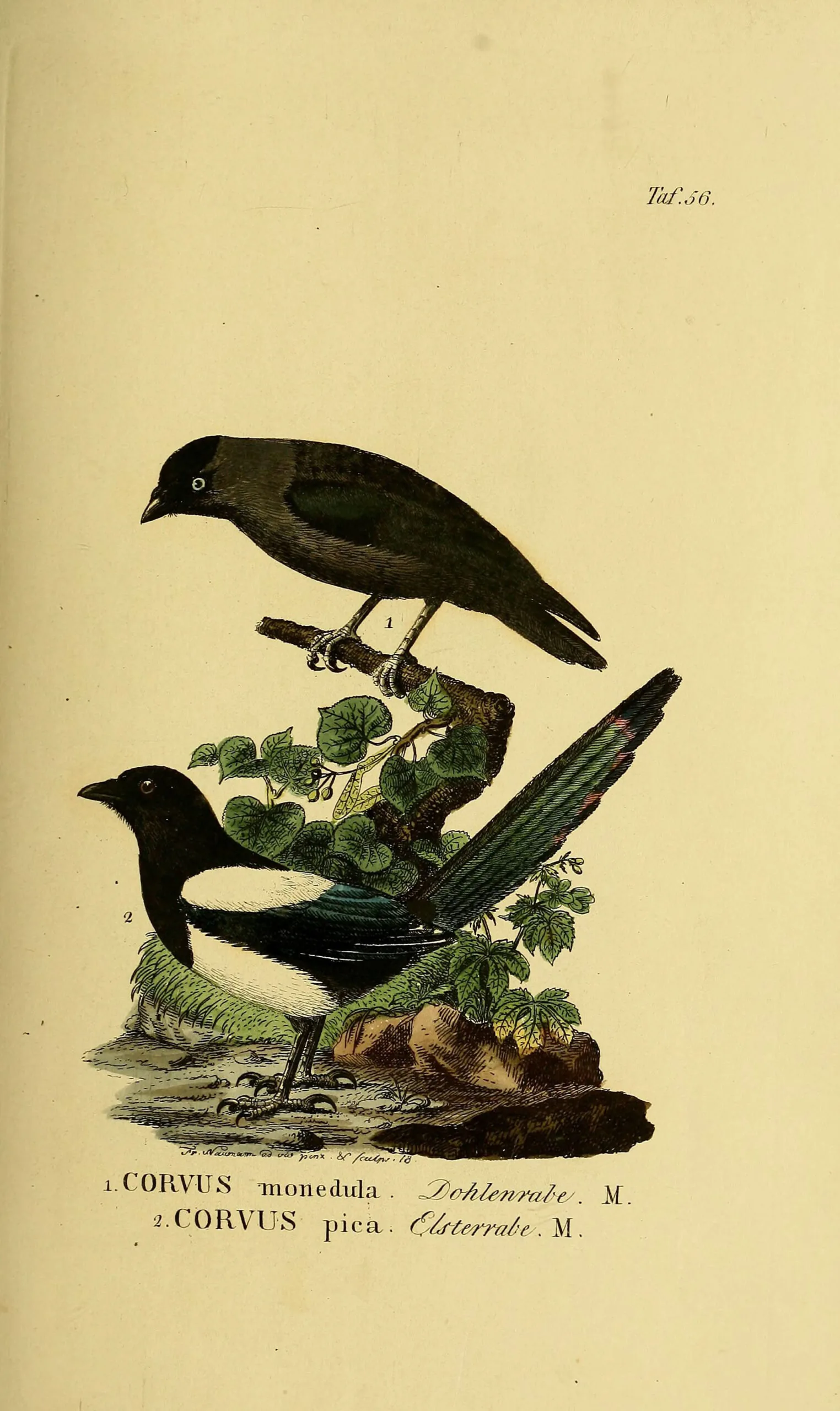
Linnaeus named the species Corvus monedula in 1758, from moneta, the Latin for money, because of an old story that jackdaws steal coins. The same gag runs through the 1840 poem The Jackdaw of Rheims, in which the bird makes off with a cardinal’s ring. The truer reputation is the opposite. In Wales, the bird was sacred for centuries because it nests in church steeples and belfries, and the Devil, so the story went, would not enter a building one had chosen.
The call itself is the etymology hiding in plain sight. Jack is the diminutive (as in jack snipe), and daw, an old English word for the bird, is probably onomatopoeic, the metallic chyak of a bird leaving a roof, repeated by its partner two pots over. Listen for a few seconds and the name explains itself.
Sources:
- Biology Letters: Davidson, Clayton & Thornton (2014). Salient eyes deter conspecific nest intruders in wild jackdaws.
- The Conversation: Davidson, G. (2014). Jackdaws use bright eyes to ward off competitors.
- Wikipedia: Western jackdaw — taxonomy, behaviour, cultural references.
- Representative Poetry Online: Barham, R. H. (1840). The Jackdaw of Rheims.
- The Wildlife Trusts: Jackdaw species profile.
- Etymonline: Jackdaw — etymology of “jack” and “daw”.
- Wiktionary: monedula — Latin etymology.