The Forest's Forgetful Gardener
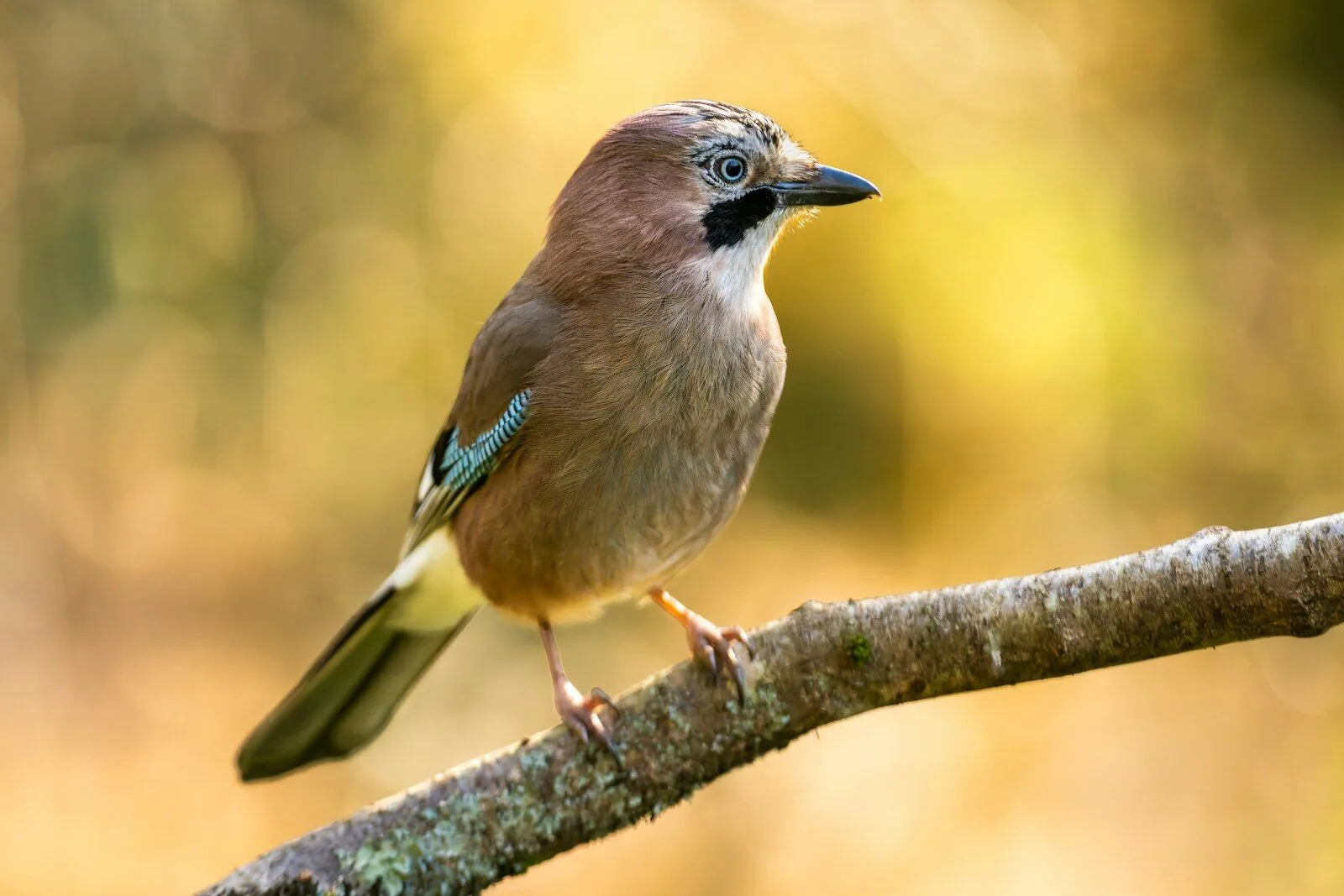
The Eurasian jay is the corvid you almost never see. Pinkish-brown, jackdaw-sized, with a blue-and-black wing patch and a pair of black moustache stripes flanking its white throat, it lives inside the canopies of oak woods across most of Europe, North Africa, and Asia. It is shy, surprisingly loud when found, and spends most of October burying acorns it then forgets to retrieve.
The Chatterer of Acorns
The Latin name for this bird is Garrulus glandarius: chatterer of acorns. German calls it Eichelhäher, the acorn-shrieker. Swedish calls it Nötskrika, the nut-shrieker. The dictionaries agree on what the species does for a living.
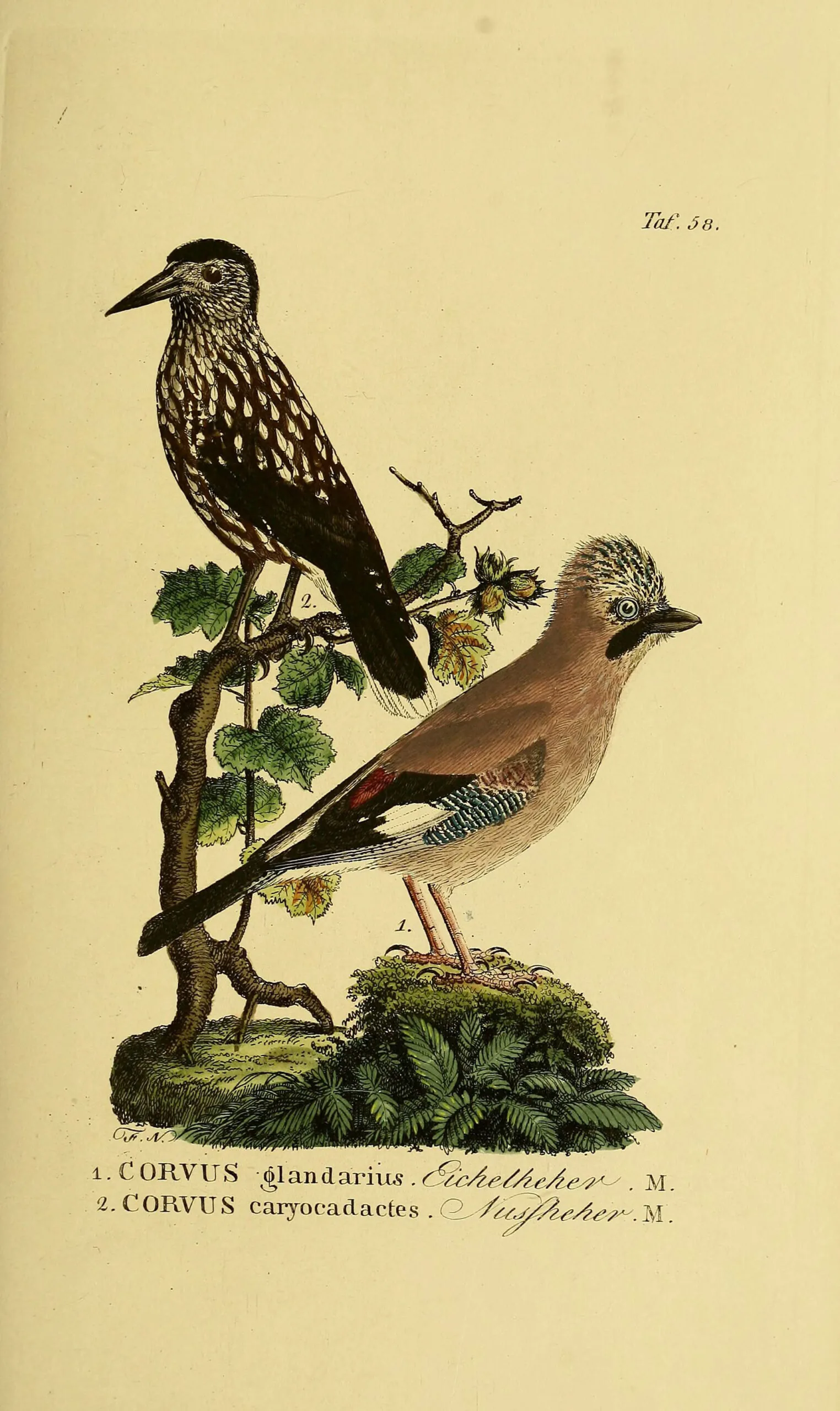
A single jay buries more than a thousand acorns each autumn, and has been recorded carrying single acorns as far as 20 km. It is also slightly forgetful. The acorns it does not retrieve are the ones that grow. A landmark 1982 review credited the jay with the rapid northward spread of oaks across Europe after the last ice age.
The Mate Who Tracks Her Tastes
The same talent for burying acorns puts the jay at the centre of comparative-cognition labs. At Cambridge, the biologist Nicola Clayton has spent two decades testing what jays understand about other minds. In a 2013 paper from her group, the researchers fed a female jay until she was sick of one of two foods (a phenomenon called sensory-specific satiety), then let her partner choose what to bring her as a courtship gift. He had been watching her eat. He preferentially offered the food she had not been pre-fed: he brought her what she still wanted. Males who could not see her eat did not track her preference. The males who could see, the authors argued, may have been responding to her current desire-state in real time. That is the kind of perspective-taking comparative psychologists had been struggling to pin down cleanly in any non-human species.
The Hawk’s Borrowed Voice
Most encounters with this species start with sound. The screech is harsh and rasping, used on sighting any predator and as an advertising call from a moving bird. Jays also imitate. They reproduce the calls of birds of prey, including the common buzzard’s mewing whistle and the Eurasian goshawk’s cackle, and the impressions are accurate enough that an unseen jay is hard to tell from the predator it is impersonating.
If you ever do meet the bird, it will usually be as a flicker of pink and blue between trees, or as a rasp from somewhere you cannot see. It is the alarm of a small, forgetful corvid that has been quietly planting next year’s forest, every autumn, for a hundred centuries.
Sources:
- Wikipedia: Eurasian jay
- The Royal Society for the Protection of Birds: Jay species profile
- British Trust for Ornithology: Jay BirdFacts
- The Wildlife Trusts: Jay species profile
- Britannica: Eurasian jay
- University of Cambridge, Department of Psychology: Professor Nicola Clayton
- PNAS, Ostojić et al. 2013: Evidence suggesting that desire-state attribution may govern food sharing in Eurasian jays
- Wikipedia: Sensory-specific satiety