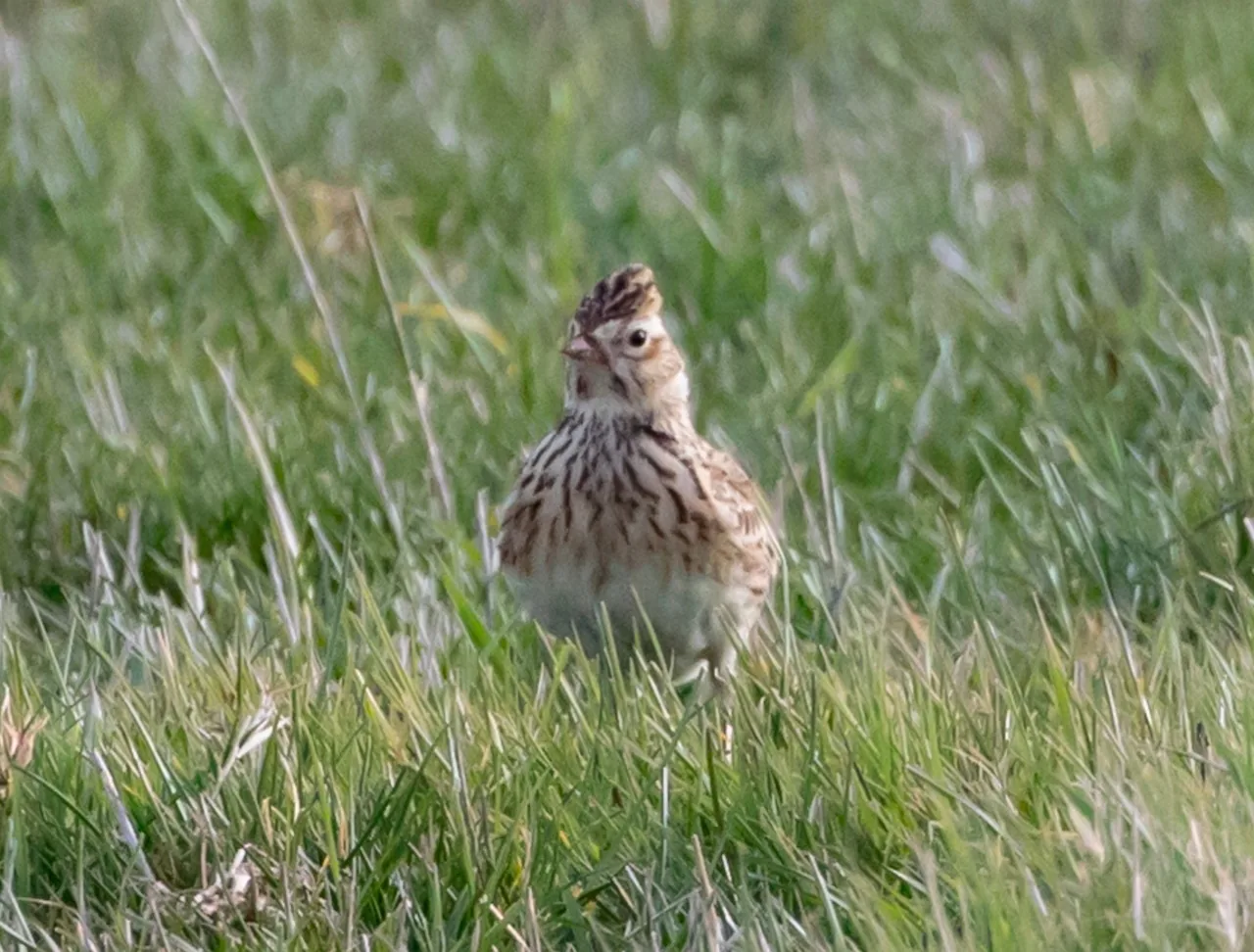
The Eurasian Skylark (Alauda arvensis) is a modest bird with an immodest talent. Dressed in streaked brown feathers that vanish against soil and stubble, it seems built for anonymity—until it rises. From a meadow or a strip of rough pasture, the male launches upward in a widening spiral, climbing until he becomes a trembling dot. From that height pours one of the longest and most sustained songs in the bird world: a bright, unbroken stream of whistles, trills, and liquid notes that can continue for several minutes without pause.
Unlike many songbirds that repeat a few set phrases, the skylark continually reshuffles its repertoire. Phrases flow into one another with improvisatory freedom, giving the impression of a music that composes itself in real time. Human listeners can follow the structure without special equipment; the marvel lies not in impossible speed but in endurance and variety. A single male may remain airborne and singing for ten minutes or more before parachuting back to earth.
A Name Rooted in the Fields
Its scientific name reflects its habitat rather than any mythic title. Alauda is the Latin word for lark, likely borrowed from an ancient Celtic term, while arvensis simply means “of the fields.” The bird is inseparable from open country—farmland, heath, and natural grasslands across Europe and much of Asia. Wherever cereal crops and rough pastures meet the horizon, skylarks have followed.
Culture Written in Song
Few birds have woven themselves so tightly into human imagination. Poets from Shakespeare to Shelley heard in the skylark a symbol of unbounded joy; composers from Vaughan Williams to Messiaen tried to translate its spiraling phrases into orchestral sound. Alfred Tennyson called it “a sightless song,” capturing the strange experience of hearing music that seems to fall from an empty sky.
The relationship has not always been gentle. In nineteenth-century France and Italy, hunters exploited the bird’s attraction to glittering movement with devices known as miroirs aux alouettes—spinning frames set with mirrors that lured skylarks down from their song-flights. Millions were taken for the table in an era when small songbirds were common market fare, a reminder that admiration and appetite often walked together.
Adapting to a Noisier World
Modern landscapes present new challenges. Research has shown that skylarks nesting near wind farms often raise the pitch of their songs to avoid being masked by the low-frequency hum of turbines. Agricultural intensification has reduced suitable nesting habitat across much of Europe, and populations have declined sharply since the mid-twentieth century. Yet where pockets of rough grassland remain, the bird persists with stubborn fidelity to its ancient performance.
The Art of Persistence
To watch a skylark is to witness an athlete of the air. It climbs on fluttering wings, hovers in place, and descends by stages, all while delivering a continuous cascade of sound. The song is not a mechanical torrent but a living dialogue—advertisement to rivals, invitation to mates, declaration that this square of earth belongs to a small brown bird with a boundless voice.
Long after the singer has vanished from sight, the music hangs above the fields like a bright thread. The skylark does not need myths of debts to the sun or impossible speeds to earn its wonder. Its true miracle is simpler: a creature scarcely larger than a sparrow that turns open sky into a concert hall and reminds us, for a few airborne minutes, how much joy can fit inside a pair of wings.