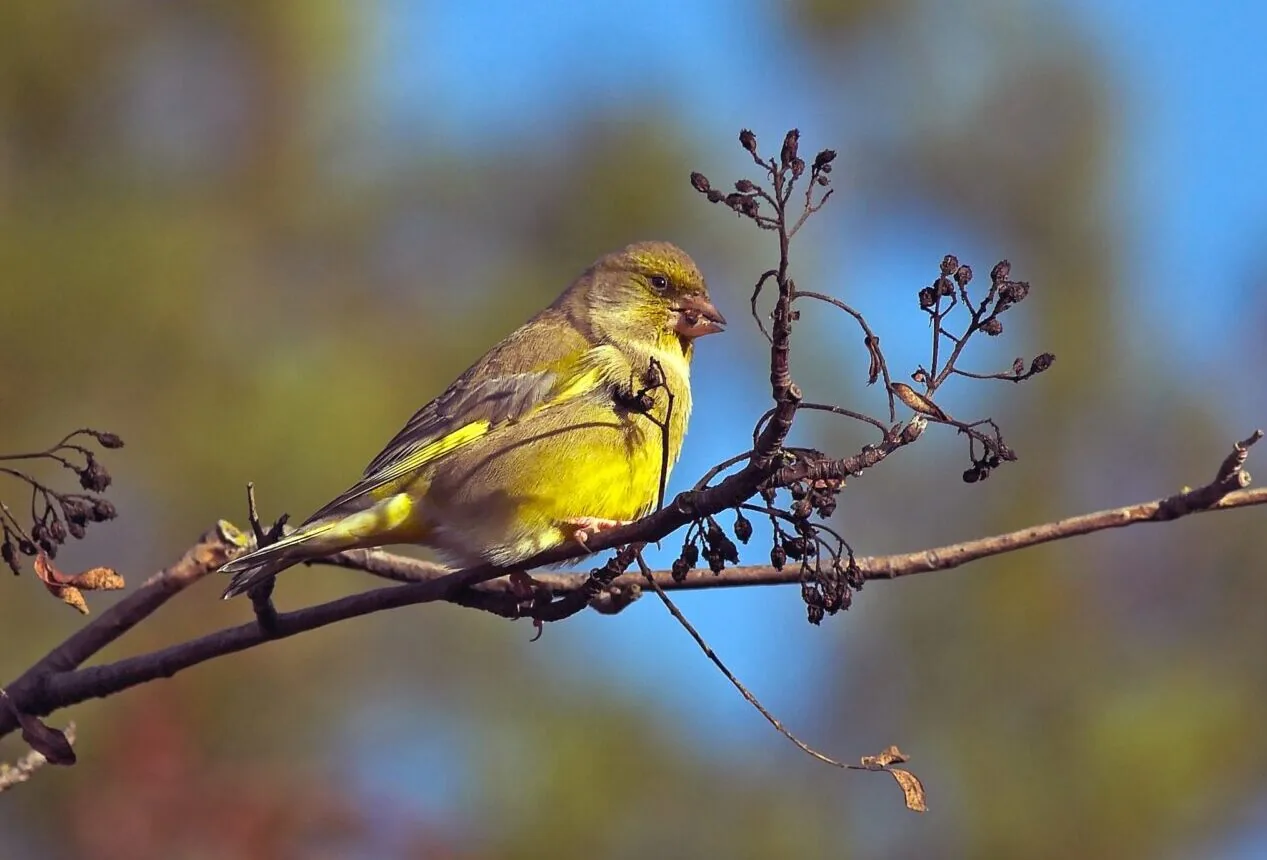
Wordsworth's Vanishing Linnet
Listen for the wheeze. The European Greenfinch packs a quick spring reel of trills and twitters, then drops a long flat dzweee in the middle of it that sounds like a tiny tea kettle giving up. That sigh is the species’ signature note. Once it has been spotted in the song, it is impossible to miss.
The Wheeze in the Flight
The wheeze rings out loudest during a slightly absurd aerial display. In spring, males rise above the territory and circle in slow loops, beating their wings in a loose moth-like rhythm and flashing the bright yellow patches that line the wing edges and tail. Field guides call it the butterfly flight. It pairs the sigh-song with what looks like a deliberate, lazy drift through the air, and for a finch with a stubby seed-cracking beak, it is a surprisingly delicate piece of choreography. The males perch up afterwards on an exposed branch and keep singing from there, which is when the dzweee becomes the easiest to pick out.
The Other Green Linnet
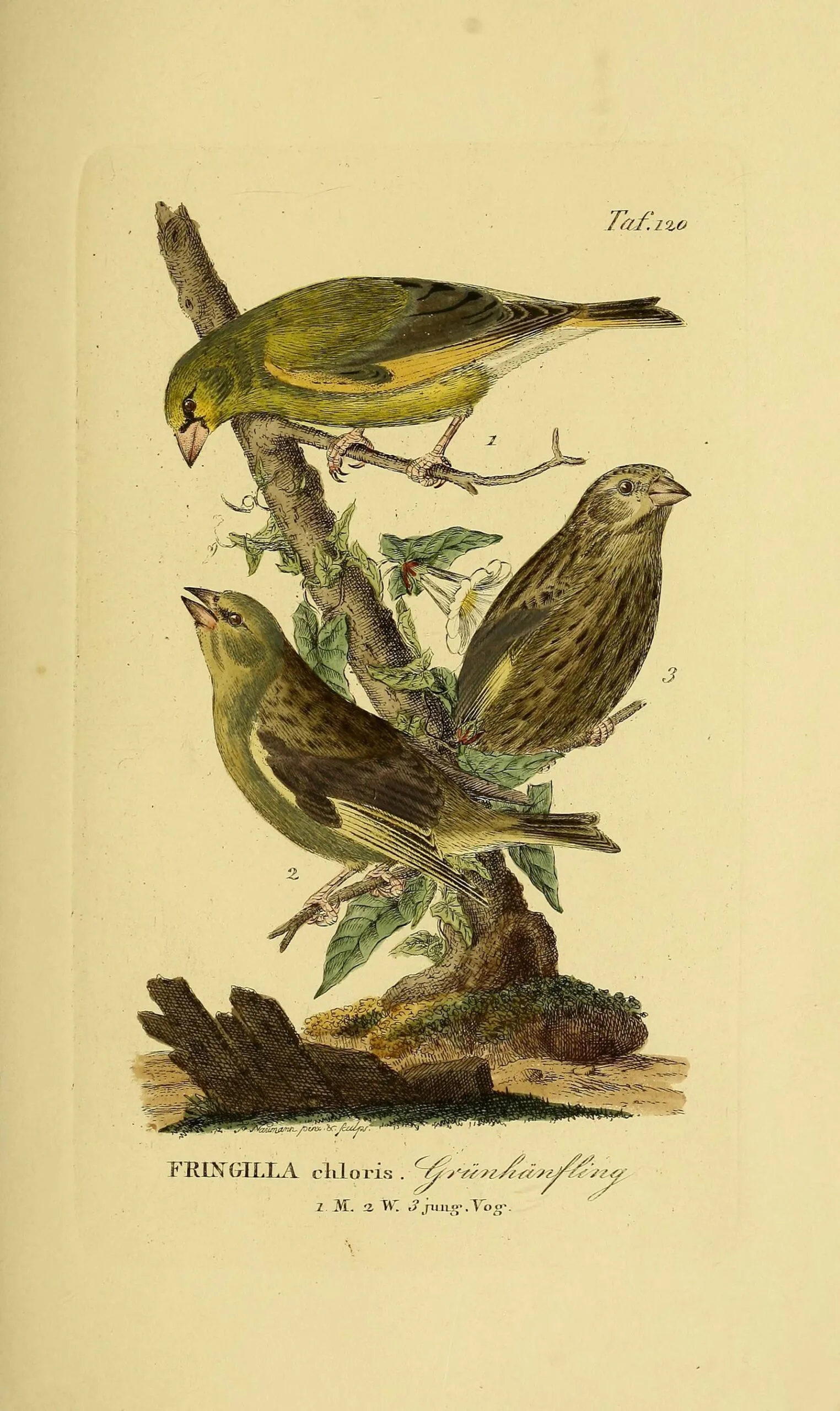
Older British poetry calls this bird the green linnet, and that name is the source of a quiet little muddle. William Wordsworth, the Romantic poet, wrote “The Green Linnet” in 1803, addressing the bird as “the happiest Guest in all this covert of the blest” and crowning it “Presiding Spirit here today” of the May orchard. He meant a Greenfinch, not the brown Common Linnet that shares the family. Decades later in Germany, Johann Andreas Naumann (an early systematic ornithologist) catalogued the same bird in his hand-coloured plates as Grünhänfling, “green linnet,” using the same poetic shorthand his English neighbours used.
From Spring’s Spirit to Red List
The May spirit Wordsworth crowned has had a brutal twenty-first century. Around 2005 a parasite called Trichomonas gallinae jumped from pigeons into garden finches in Britain. Becki Lawson, a wildlife vet at the Zoological Society of London, and her co-authors documented the outbreak in a 2012 paper in the Royal Society’s biology journal, tracing the collapse to dirty bird tables and shared drinking water. The British greenfinch breeding population fell from about 4.3 million to 2.8 million birds. By 2021 the species had been added to the UK Red List of conservation concern.
What the Bird Rise app plays is the same song Wordsworth heard in his orchard, wheeze and all. There are fewer Greenfinches in the world to make it now than there were twenty years ago. For anyone with a feeder in the back garden, the most useful thing is also the most boring: scrub it weekly in hot soapy water and rinse well. And if a sick bird shows up, take the feeder down for two weeks and leave the water dish empty. That is how the wheeze keeps showing up in May.
Sources:
- Wikipedia: European Greenfinch
- British Trust for Ornithology: Greenfinch: Garden BirdWatch profile
- RSPB: Greenfinch
- Lawson et al. (2012): The emergence and spread of finch trichomonosis in the British Isles, Royal Society Phil. Trans. B
- Wordsworth, W. (1807): “The Green Linnet”, Poems, in Two Volumes
- Wikipedia: Genus Chloris (etymology)