
_(25207923537).jpg)
The Five-Gram King of the Pines
A goldcrest weighs about five grams, roughly a teaspoon of sugar. Yet ancient bird-watchers called it a king, and northern European fishermen long refused to believe it could fly the North Sea on its own. Both groups were closer to the truth than they sounded.
The Crown He Wears on Cue
The bird’s Latin name is Regulus regulus, “little king” twice over (regulus is a diminutive of rex). The name fits a gold crest the bird wears down the centre of its head.
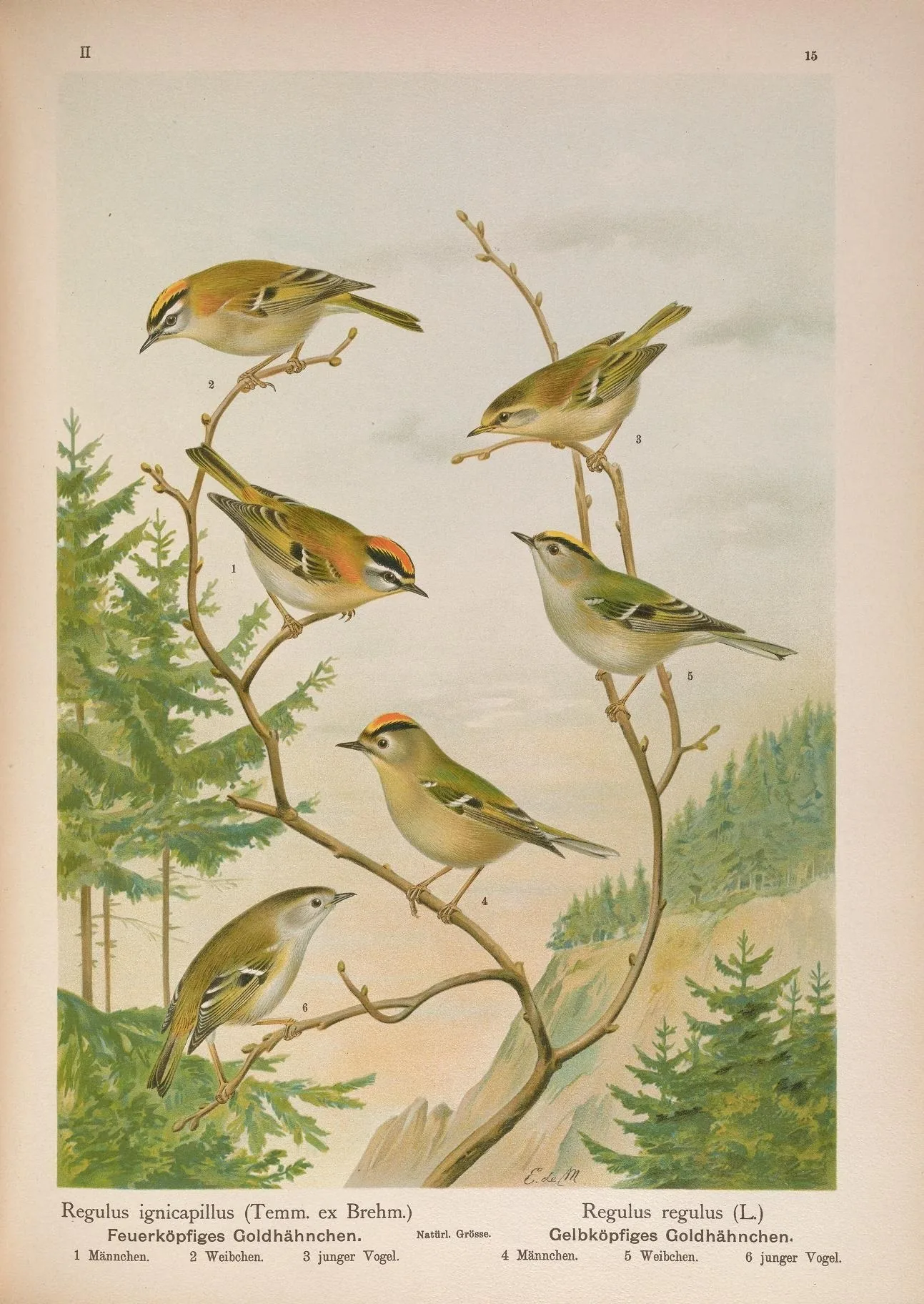
The crown is also a real signalling tool. Both sexes carry a yellow stripe along the top of the head, but the male hides a flash of bright orange beneath it. He flares the orange when he needs to threaten a rival or impress a female. The rest of the time, the crown stays tucked away.
A Voice Older Ears Lose First
A male goldcrest’s song spins around 7 kilohertz. That is well above the highest key on a piano, and one of the first frequencies adult ears stop registering.
The Sound Approach project, which surveys Western Palearctic bird sounds, puts it bluntly: “As I have grown older, I have found it gradually more difficult to hear Goldcrest calls…at a distance.” By their fifties, plenty of birders find goldcrests slipping out of earshot. The bird is still there, working a spruce branch over from the path. The pitch is no longer one older ears are built for.
The Woodcock’s Pilot
Goldcrests breeding in Scandinavia and Russia migrate south for winter, and one route crosses the open North Sea. People watching them land on the east coast of Britain in October refused to believe a five-gram bird could manage it alone. Two folk explanations did the rounds.
The first was the “woodcock pilot.” Goldcrests arrive a day or two ahead of the larger woodcocks, so people assumed they had hitched a ride on the woodcocks’ backs. The second came from Suffolk fishermen, who called the bird “herring spink” or “tot o’er seas,” because exhausted goldcrests dropped onto herring-boat rigging looking for any perch in the open ocean.
In fact, the goldcrest does cross the North Sea on its own, in a single overnight flight. Roughly eight in ten will be dead by spring, lost to winter rather than the sea.
If the Bird Rise app plays a Goldcrest in the morning, younger ears will catch it more crisply than older ones. There is a strange comfort in that. The bird the ancients named for a crown, that British folk tales said could not cross the sea alone, sings at exactly the frequency human hearing loses first. The crown is real, even when the voice begins to go.
Sources:
- Wikipedia: Goldcrest (Regulus regulus)
- British Trust for Ornithology: Goldcrest BirdFacts
- RSPB: Goldcrest species page
- The Sound Approach to Birding (web-book): “I don’t do calls” — on losing high frequencies with age
- BTO video: Bird ID — Goldcrest & Firecrest (YouTube)
- Wikimedia Commons: Naumann plate II.15, Goldhähnchen / Regulus regulus & ignicapillus
- Wikimedia Commons: Featured photo, Goldcrest (female), Lancashire, UK — Francis C. Franklin, CC BY-SA 3.0
_(8090122609).jpg)
