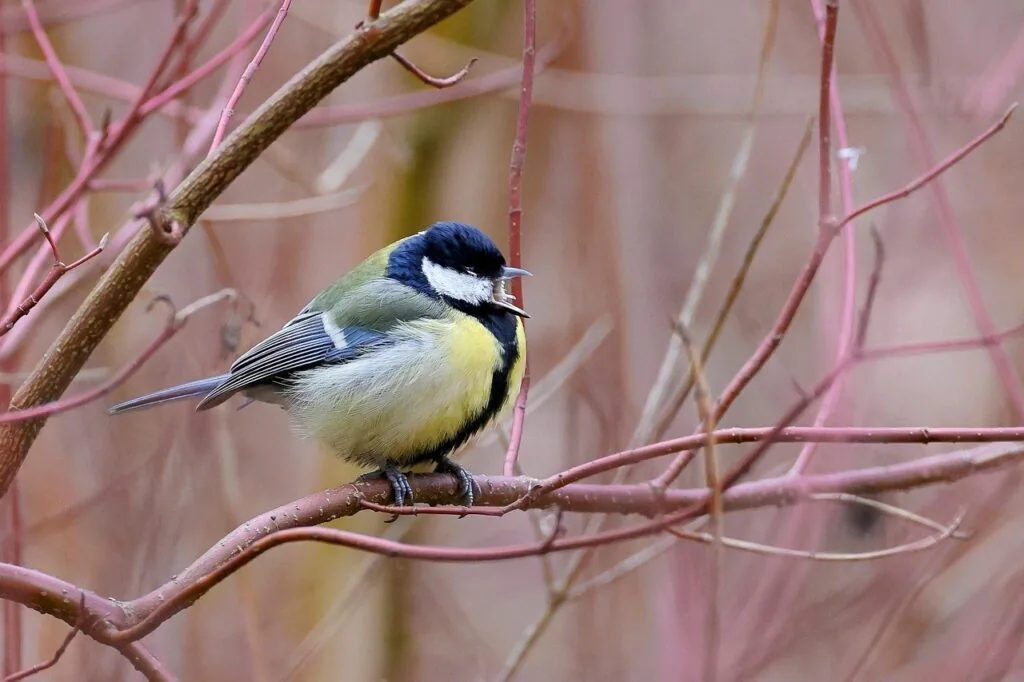
The great tit (*parus major*)is a bold, easy-to-spot songbird with strong black, white, and yellow contrast
We've updated our Terms. If you bought lifetime access in one of our apps, the changes apply to you from October 26, 2026. See what changed

For a birdwatcher in Europe, one of the first songs you learn is a sharp two-note call that sounds like “teacher, teacher” . That’s the great tit announcing itself—fittingly, since this little songbird often has something to teach its peers. The great tit (Parus major) is a common garden bird across Europe and Asia , known for its bold personality (it’s the largest of the tit family and will even boss smaller birds at feeders ). But what truly sets the great tit apart is its inventiveness and capacity for learning new tricks.
One of the most famous great tit capers began in 1920s England. Residents noticed foil caps on their doorstep milk bottles had been pecked through, the cream stolen. The culprits turned out to be great tits that had figured out how to pierce the lids and sip the rich cream . This wasn’t an isolated stunt – soon people across Europe reported the same phenomenon as the habit spread from town to town. Scientists later suspected the birds were learning the trick from each other, a groundbreaking idea at the time.
Decades later, researchers confirmed that these birds indeed pass on innovations socially. In 2015, an experiment in an English forest showed wild great tits learning to open a puzzle-box feeder after watching a trained “tutor” bird do it . A single clever tit could introduce a new feeding technique, and others would copy it to reap the rewards. “Paying attention to what others are doing gives you the chance to see whether a new behavior is beneficial,” explains evolutionary biologist Michael Chimento, whose team studies great tit learning . In other words, a great tit can start a trend – whether it’s opening milk bottles or sliding puzzle doors – and the rest of the flock will fall in line once they see it works.
https://twitter.com/BBCArchive/status/1216057184678596609
Great tits don’t just rely on bird feeders and milk thievery. Their ingenuity shows in more grisly ways when times get tough. In one Hungarian cave during winter, scientists observed hungry great tits hunting hibernating bats – a behavior few would expect from a cute 5-inch songbird. The tits flew slowly along the cave walls, listening for the faint squeaks of bats waking up, then pounced while the bats were still groggy . Lacking the talons of a hawk, a great tit can still bite and dismember a tiny bat with its stout beak . This macabre tactic is a last resort for extra protein, but it shows how opportunistic and adaptive these birds are. Remarkably, the behavior was documented in multiple individuals over years, hinting that the skill of bat-hunting might have been learned and passed on locally – a sort of dark folk knowledge within that cave’s great tit population .
Back in more ordinary settings, great tits demonstrate their opportunism in friendlier ways. They readily take to artificial nest boxes provided by humans and even adjust their songs in noisy cities to make sure they’re heard. Their signature “teacher, teacher” song can vary regionally; in fact, great tits from Asia don’t always recognize the calls of their European cousins . Each population develops its own tweaks and tricks, whether in vocal dialects or foraging behaviors, showing a capacity for local culture uncommon in most backyard birds.
The great tit (*parus major*)is a bold, easy-to-spot songbird with strong black, white, and yellow contrast
The name great tit reflects size and history rather than modern meaning. “Great” refers to it being the largest member of the tit family in Europe. The word “tit” comes from Old English, where it meant something small and was commonly used in bird names. At the time the name developed, it had no association with human anatomy. The scientific name Parus major carries the same meaning, with major meaning “larger” in Latin.
Sources: