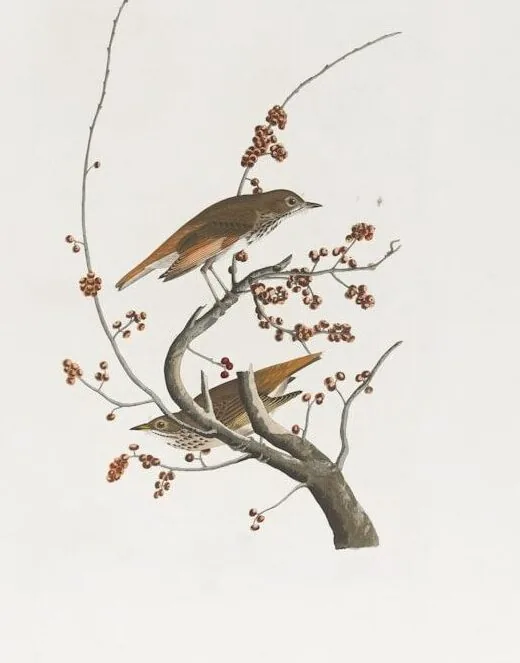
In the folklore of the Haudenosaunee (Iroquois) and Oneida peoples, the Great Spirit, Rawenní:yo, held a contest to see which bird could fly highest to earn the most beautiful song. The tiny Hermit Thrush cleverly hid within the Eagle’s thick feathers as he soared upward. When the Eagle finally grew exhausted, the thrush emerged and flew even higher, reaching the Spirit World where it heard the most exquisite, heavenly melody in existence. However, realizing it had reached those heights on the strength of another, the bird was moved by a profound sense of humility rather than pride. Because it felt its great gift was unearned, the thrush now stays within the shaded undergrowth of the deep woods, singing its sacred, flute-like music from the shadows where it remains modest and unseen.
The Tactical Tremor and the Migration Paradox
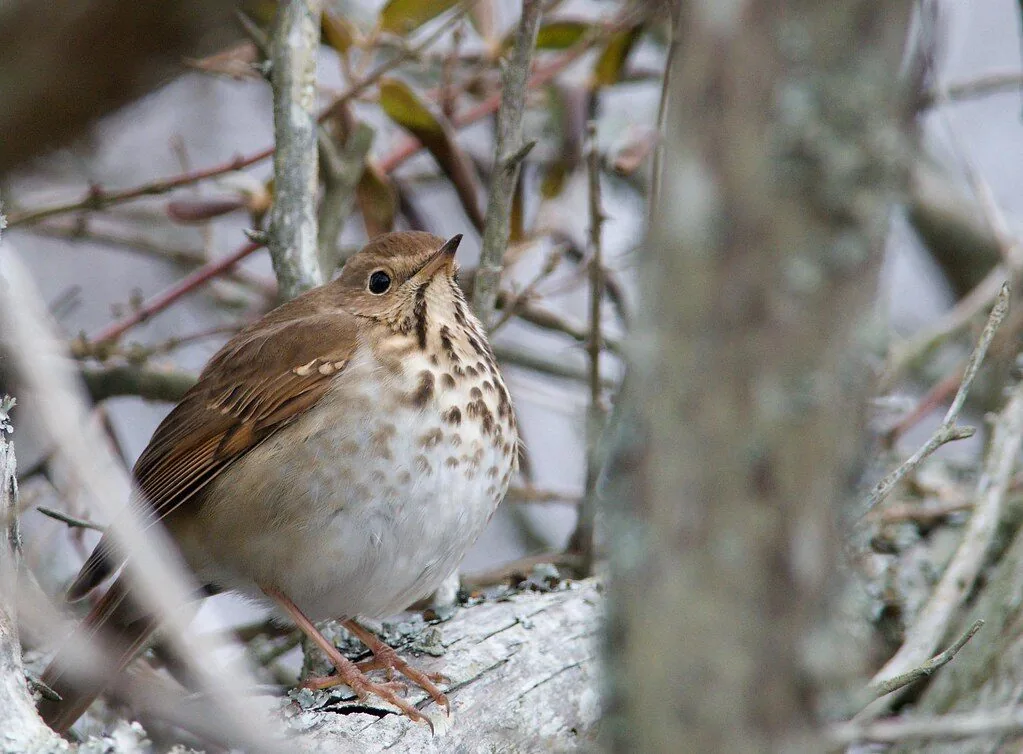
The Hermit Thrush is a master of the forest floor, a realm where visibility is low and prey is hidden. To survive, it has developed a specialized foraging behavior known as “foot-trembling” or “foot-quivering”. If you were to observe this bird in its native habitat, you might see it stand perfectly still and then suddenly vibrate one leg with such intensity that its entire body seems to shake. This is not a sign of fear or a neurological glitch; it is a tactical maneuver designed to startle insects into movement, making them visible to the bird’s keen eyes.
Beyond its physical hunting methods, the Hermit Thrush is famous among logicians for its dietary shift. Most of the year, it consumes protein-rich insects. But as autumn approaches and the bird prepares for its migration to Central America, its diet shifts almost exclusively to wild berries. This creates a biological puzzle: why switch to lower-calorie berries when you need massive energy for a long flight? The answer lies in the economy of energy. While insects are calorie-dense, catching them requires a massive expenditure of effort—chasing, pouncing, and wrestling. Berries are stationary. By consuming berries, the thrush achieves a higher net gain of calories because it spends almost no energy “hunting” its food.
Mathematical Music for a Mourning Soul
The most remarkable aspect of the Hermit Thrush is undoubtedly its song. To the human ear, it sounds “ethereal,” but to a musicologist, it is a mathematical marvel. Analysis of its vocalizations has shown that it sings using simple integer pitch ratios, meaning its melodies are constructed from the same “overtone series” that forms the basis of Western musical scales. This is a rare convergence between animal instinct and human art.
This “spirit world” music has left a permanent mark on human culture. In the American literary canon, the bird became a symbol of national mourning and spiritual depth. Walt Whitman, in his elegy for Abraham Lincoln, uses the Hermit Thrush as a representation of death and the soul’s reconciliation with loss. He calls it a “shy and hidden bird,” whose song “out of the dusk” provides the only comfort in a world torn apart by war. Whether you hear it in a mountain glade in Vermont or through the Bird Rise app in a city that never sleeps, the Hermit Thrush remains a reminder of the mathematical beauty and hidden depth of the natural world.
Sources:
- All About Birds: Hermit Thrush Life History
- National Library of Medicine (PMC): Climate Change and Hermit Thrush Migration Phenology
- Oneida Indian Nation: The Legend of the Hermit Thrush
- Geography Realm: The Foot-Trembling Bird Gets the Worm
- GMAT Club: Hermit Thrush Diet and Foraging Habits
- Audubon: Hermit Thrush Field Guide