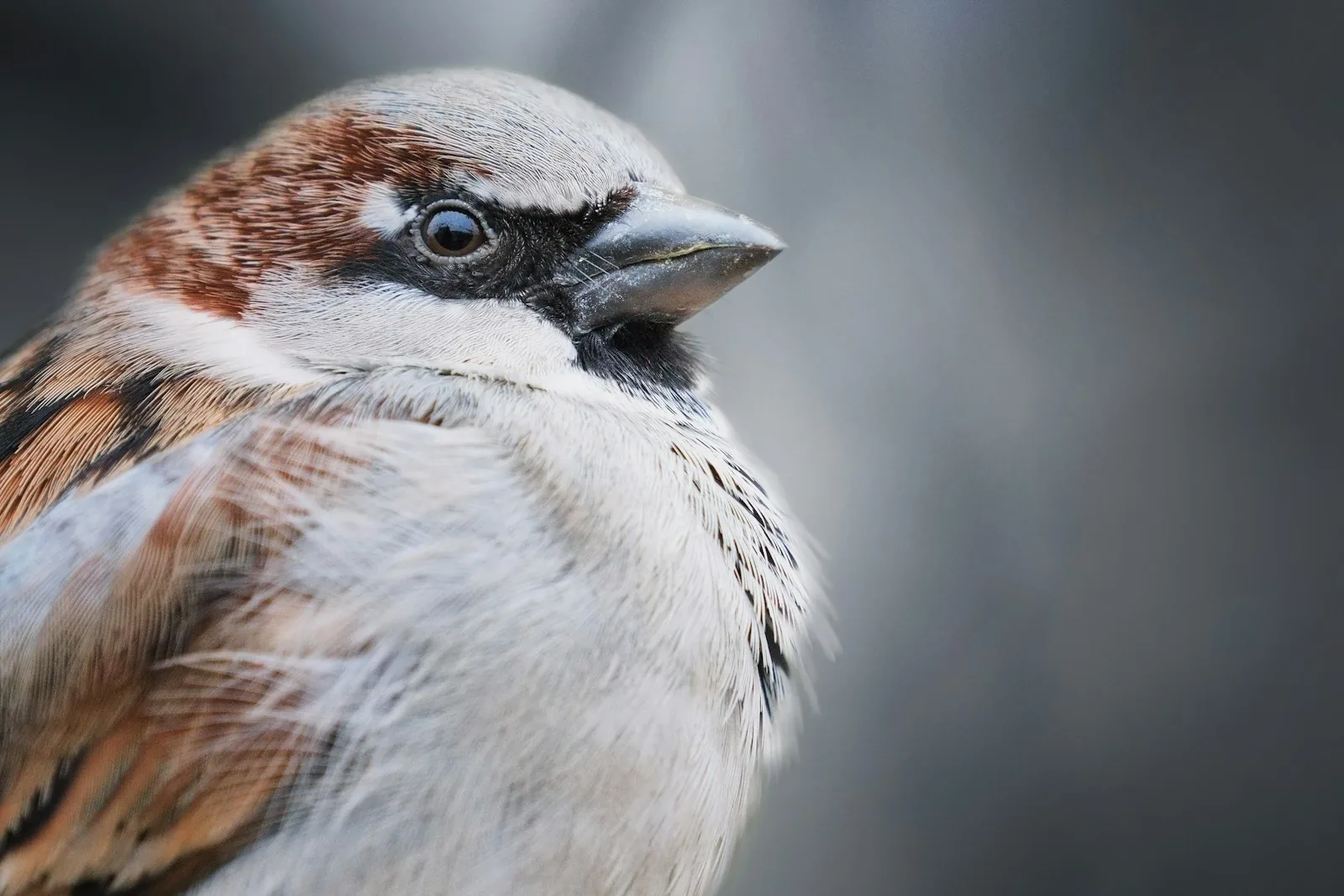
Wake up in almost any crowded city—Mumbai, Cairo, Brooklyn—and beneath the engines and footsteps you will likely hear a thin, restless chatter. It belongs to the House Sparrow, a bird that has not merely endured human expansion but has woven itself into the fabric of our streets. While many species retreat when cities rise, this one followed us indoors and across oceans, learning to read our habits the way a roommate learns the creak of the stairs.
Its scientific name, Passer domesticus, means “the sparrow of the house,” an unusually honest label in the world of Latin taxonomy. For thousands of years the bird has lived close enough to earn nicknames everywhere it landed. In parts of northern China it has been called something like “the old house thief,” a playful accusation aimed at its talent for sampling unattended grain. Even language bears its footprint: the Spanish word pájaro, now meaning any bird at all, traces its roots back to the Latin word for sparrow, as if this small brown creature once stood in for the entire idea of wings.
Up close, the sparrow is more complicated than its drab colors suggest. Males wear a black bib on the chest, and biologists have found that the size of this patch often corresponds to social standing within the flock. The birds bicker, form alliances, and wait their turn at a food source with a discipline that can look oddly bureaucratic. Their hygiene is just as methodical. Groups will throw themselves into loose soil, wriggling with theatrical enthusiasm; the dust absorbs old oils and helps dislodge parasites, a practical ritual disguised as play.
Our relationship with sparrows has never been simple. Ancient Egyptians used the image of a small bird as a writing symbol for things that were tiny or undesirable, a reflection of how often sparrows raided precious grain stores. Centuries later the same species rode sailing ships to new continents and found the rafters of warehouses, train stations, and supermarkets perfectly acceptable substitutes for cliffs. They have even been seen nesting in the awkward corners of structures meant to exclude birds, a quiet reminder that persistence often defeats design.
Today the House Sparrow is one of the most widely distributed birds on Earth, not because it conquered wilderness but because it learned to live beside us. It feeds on the crumbs of our diets, shelters in the geometry of our buildings, and measures its days by the rhythm of our cities. If people were to abandon a place, the sparrows would likely fade with it, searching for the next human horizon.
They are, in a sense, our longest-running neighbors—noisy, argumentative, endlessly adaptable. In the middle of concrete and traffic, their chatter suggests that civilization has always had a shadow made of feathers, and that shadow has decided to stay.
Sources
- Cornell Lab of Ornithology: House Sparrow Identification and Life History
- Audubon: House Sparrow Range and Conservation Status
- Nature: Genetic Adaptation of House Sparrows to Human Environments
- ScienceDirect: The Role of Human-Commensal Behavior in Sparrow Success
- Encyclopedia of Life (EOL): Passer domesticus - Global Distribution and Habitat
- Royal Society for the Protection of Birds (RSPB): Causes of Urban Sparrow Population Declines
- CAB International (CABI): Invasive Species Compendium: House Sparrow Impact
- American Ornithological Society: History of Sparrow Introduction in North America
- Journal of Animal Ecology: Dietary Requirements and Nestling Survival in Urban Sparrows
- Plos One: Impact of Light Pollution on House Sparrow Nesting Cycles
- British Trust for Ornithology (BTO): Garden Bird Trends and Population Mapping
- Smithsonian Magazine: The Evolutionary Success of the Common Sparrow