
Genius With a Criminal Record
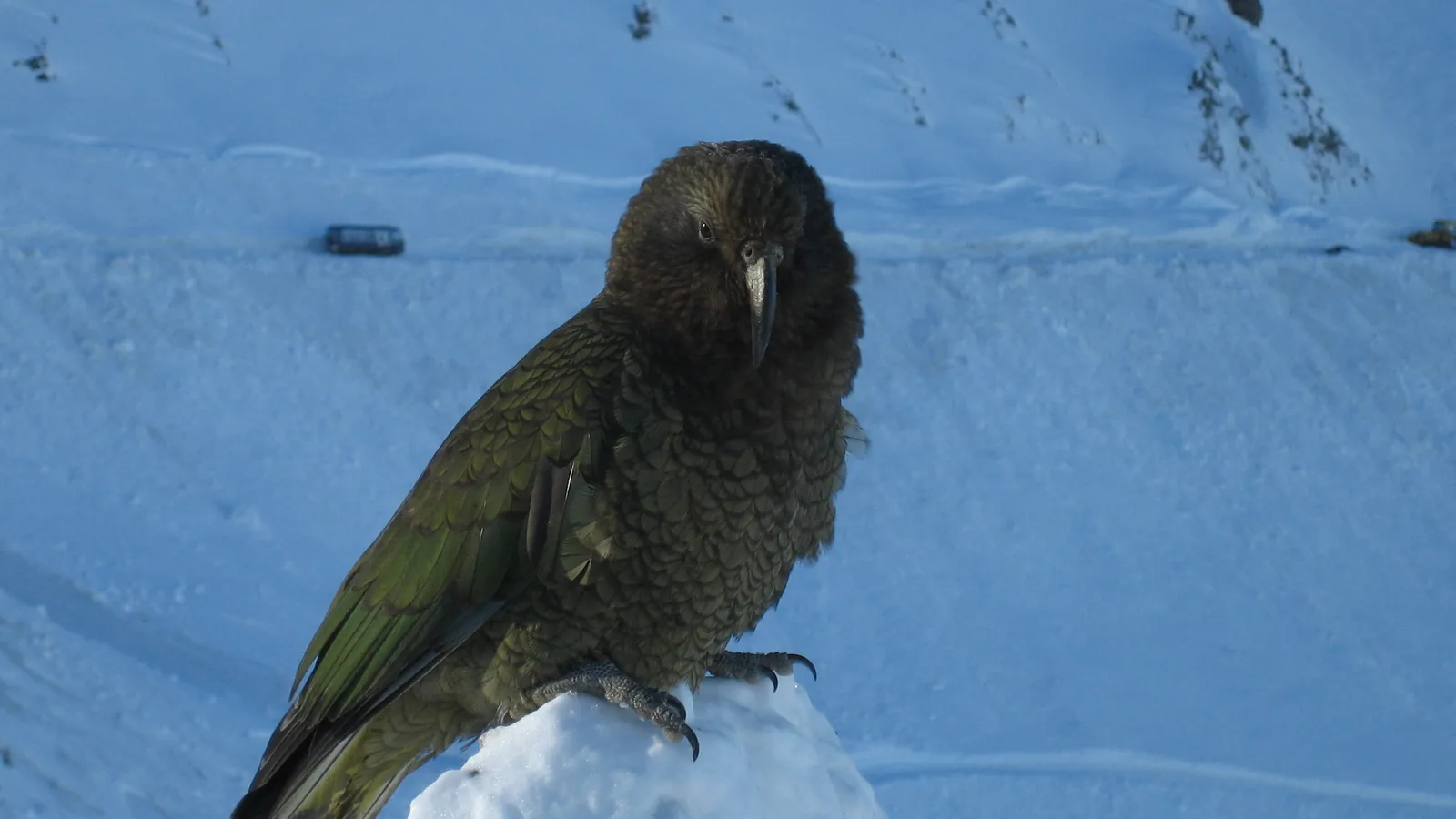
Picture a parrot that lives where parrots have no business living: above the snowline, in the wind-scoured passes of New Zealand’s Southern Alps. The kea is one of the few parrots on Earth that ranges above the treeline, and it is also, by reputation, a menace. Park a car near Arthur’s Pass and a kea may strip the rubber from your windscreen wipers. This is not malice. It is curiosity, at a level that has unsettled scientists for a century.
The Clown With a Toolkit
New Zealanders call it the clown of the mountains, and the slapstick is real: kea raid backpacks and fly off with whatever isn’t bolted down, from passports to pinecones. But the clowning hides a formidable mind. In 2020, the Auckland researchers Amalia Bastos and Alex Taylor showed that kea can reason about probability, weighing odds and even a human’s bias to predict which way a gamble would fall. Their paper called it “true statistical inference,” something previously documented only in great apes.
Then there is Bruce, a wild kea who lost the top half of his beak, probably to a pest trap. Researchers watched him pick up pebbles of a particular size, hold them between his tongue and lower beak, and use them to preen feathers his broken beak couldn’t reach. He invented a tool because he needed one.
A Call That Spreads Like Laughter
The name is the sound. “Kea” is Māori, an imitation of the bird’s ringing flight call, a drawn-out “keee-aaa” that carries for miles. But the call that made headlines is a different one. Kea have a distinct warbling play call, and in 2017 a team led by the behavioural ecologist Raoul Schwing did something clever: they played a recording of it to wild kea. Birds that heard it broke off and started to play, tossing objects and tumbling through the air, with no other bird inviting them. It worked like a laugh in a crowded room. The researchers concluded the call acts as a positive emotional contagion, making the kea the first non-mammal known to have one.
The Bird They Put a Price On
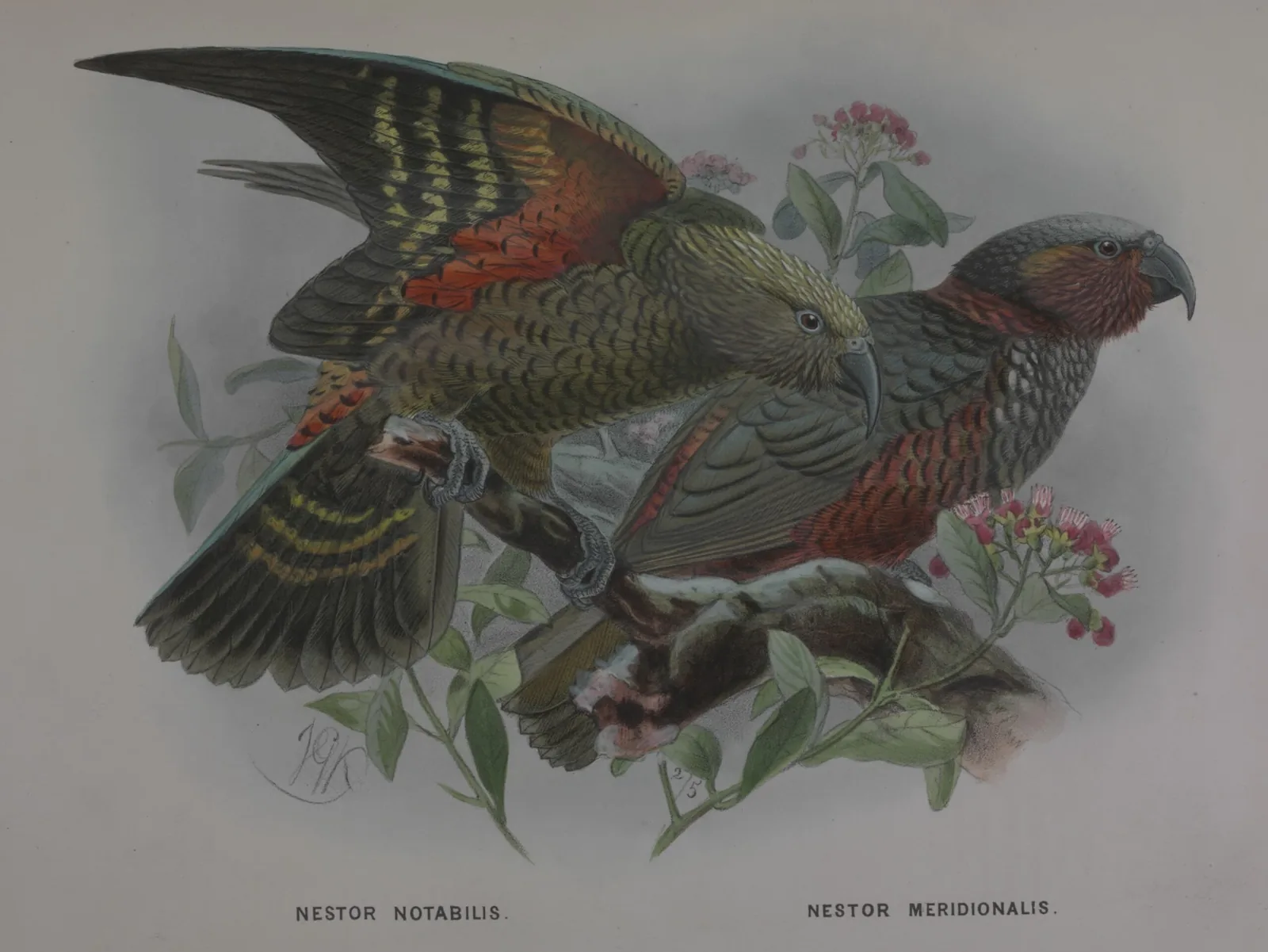
That same brilliance once made the kea a marked bird. In the 1860s, sheep farmers pushing into the high country reported a gruesome new habit: kea landing on the backs of live sheep and tearing through wool and skin to feed on the fat around the kidneys. Whether the birds learned this or were simply blamed for it, the response was ruthless. A bounty went on the kea’s head, as much as ten shillings a beak, and it ran for decades. At least 150,000 kea were shot or poisoned. The bounty was not lifted until 1970, and full protection did not arrive until 1986, after a century of killing.
Fewer than seven thousand wild kea remain, and they are listed as endangered. The cruel irony is that the very trait that doomed them, that restless need to take the world apart and see how it works, is also what makes them remarkable. We are only now learning to be glad of it.
Sources:
- Wikipedia: Kea
- Current Biology (2017): Positive emotional contagion in a New Zealand parrot (Schwing et al.)
- Nature Communications (2020): Kea show three signatures of domain-general statistical inference (Bastos & Taylor)
- Scientific Reports (2021): Self-care tooling innovation in a disabled kea (Bastos et al.)
- Te Papa Tongarewa: Kea and sheep
- NZ Department of Conservation: Kea
- New Zealand Birds Online: Kea
- Kea Conservation Trust: keaconservation.co.nz