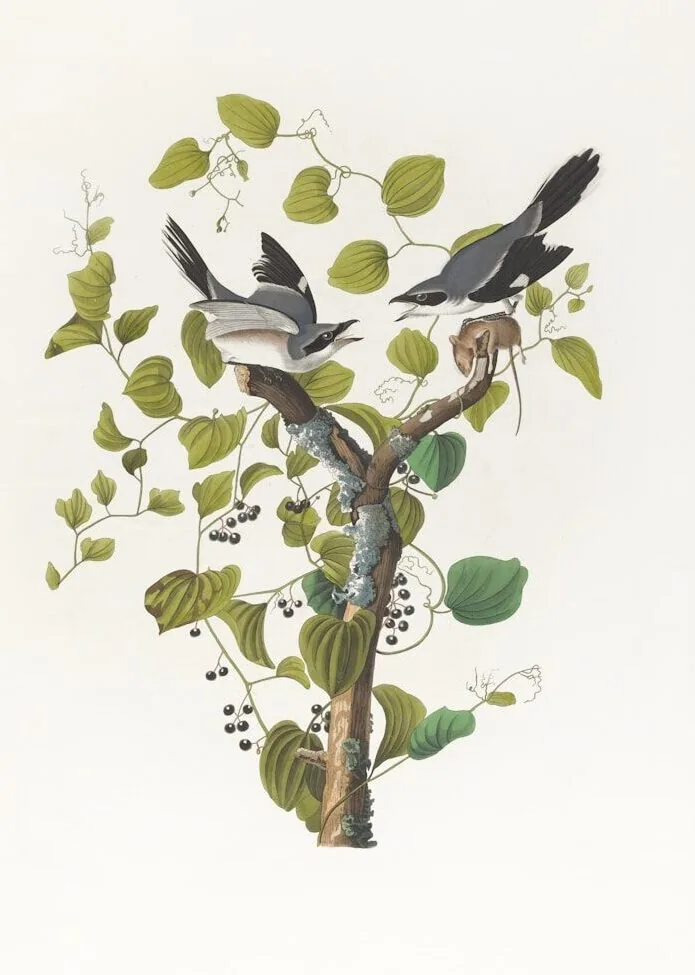
Most songbirds spend their mornings warbling for mates or wrestling with stubborn worms. The Loggerhead Shrike spends its morning practicing a “drop-and-twist” maneuver designed to sever the spinal cord of a lizard. If you find yourself waking up near a scrubby pasture in the American Southwest or a sun-bleached fence line in Mexico, you might spot this bird: a dapper, medium-sized singer in a gray suit and a black bandit mask. But don’t let the soft plumage fool you. This is a bird that has essentially evolved into a raptor while trapped in the body of a sparrow.
Thorns of Justice
The name “Loggerhead” isn’t a compliment; it is an old colonial term for “blockhead,” referring to the bird’s disproportionately massive skull. This heavy-headed anatomy is a functional requirement for the crushing force needed to kill vertebrate prey. Its scientific name, Lanius ludovicianus, literally translates to the “Butcher of Louisiana,” a nod to the first specimen studied by European zoologists in the 18th century.
Across different cultures, the names for this bird reflect a shared sense of dread and respect. In Mexico, it is the Verdugo Americano—the American Executioner. In the Mojave Desert, folklore takes a more spiritual turn: legends speak of the shrike as a bringer of cosmic justice that hunts “bad souls” disguised as birds and pins them to cacti as a warning to others.
The Science of the “Meat-Hook”
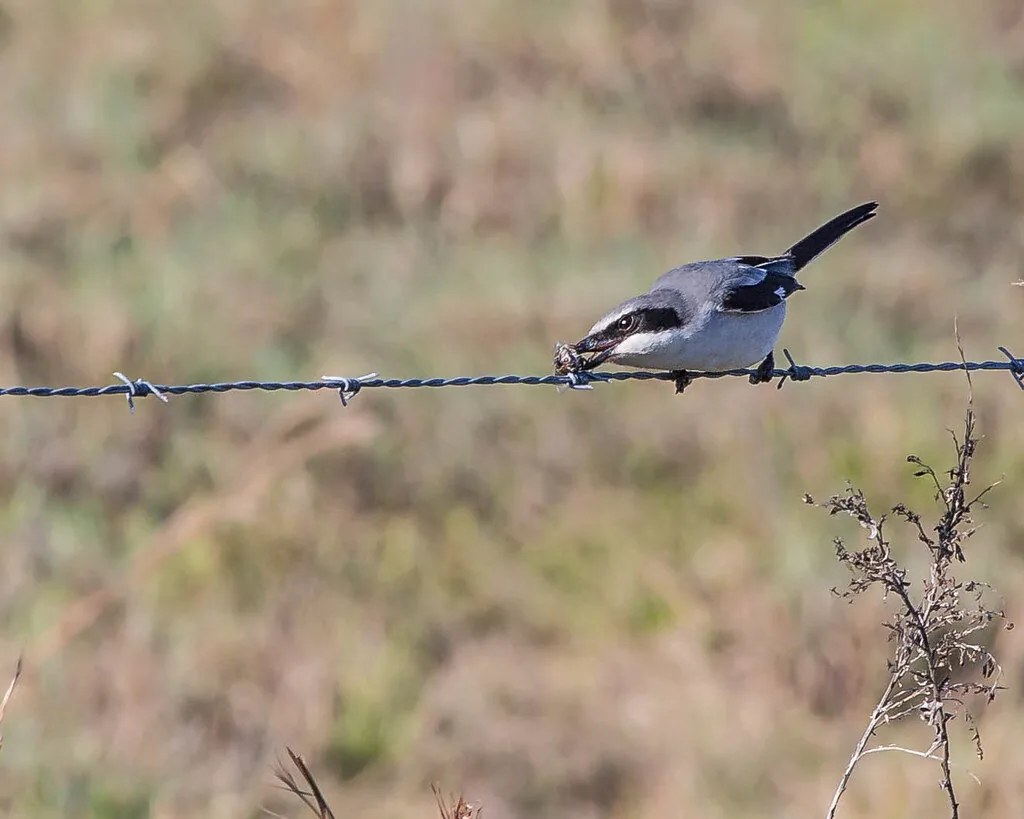
The shrike is an evolutionary outlier. While it possesses a “tomial tooth”—a sharp, triangular notch on its upper beak also found in falcons—it lacks the powerful, taloned feet of a hawk. Because its songbird feet are too weak to hold down a thrashing mouse, it has developed the macabre habit of using environmental “tools” to finish the job. It drags its prey to a thorn bush or a barbed-wire fence and skewers the carcass to create an external anchor, essentially using the fence as a third hand to help it tear off bite-sized pieces.
This “larder” is also a chemical processing lab. When a shrike catches a toxic Monarch butterfly or a noxious eastern narrow-mouthed toad, it doesn’t eat it immediately. Instead, it impales the prey and lets it sit in the sun for up to three days. This waiting period allows the toxins to break down, turning a poisonous snack into a safe meal. It is a cold, calculated approach to survival that makes its vocalizations—which sound less like a melody and more like a series of harsh, mechanical clicks and “bzeek” rasps—seem perfectly appropriate.
The Loggerhead Shrike is a reminder that nature doesn’t care about our categories. It is a perching songbird that lives the life of a merciless hunter, proving that a mask and a hook can turn a robin-sized bird into a desert legend. Whether it is being memed on Reddit as a “murdery chickadee” or respected by Mojave elders as the “Guardian of the Brush,” the shrike remains one of the most charismatic—and chilling—residents of the open grasslands.
Sources:
- U.S. Fish & Wildlife Service: Loggerhead Shrikes: Tales From the Larder
- All About Birds: Loggerhead Shrike Life History
- Desert Gazette: Loggerhead Shrike Profile
- Compleat Birder: The Waryangle (Loggerhead Shrike)
- Audubon: The Loggerhead Shrike