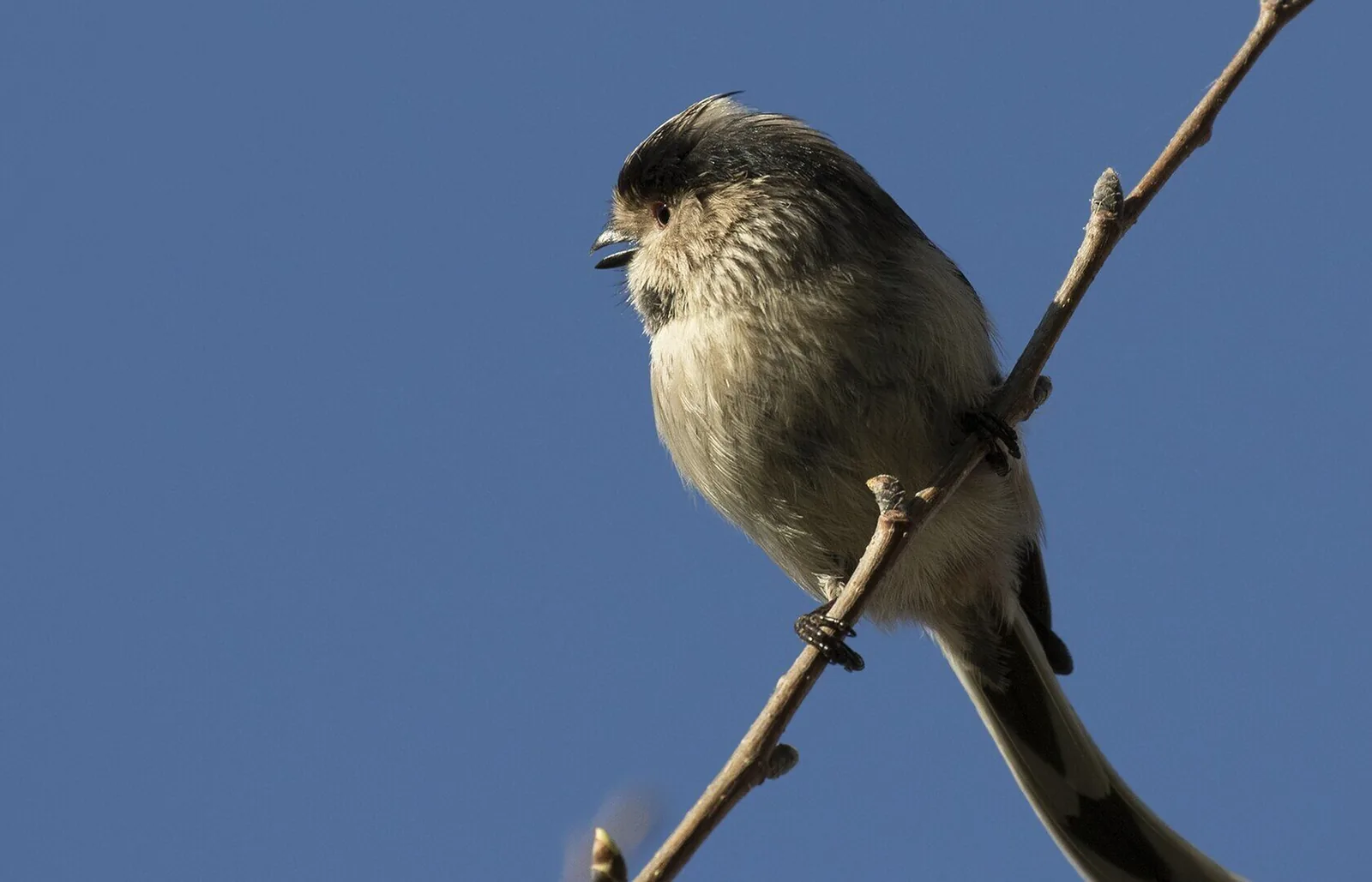

A Family Stitched in Spider Silk
If you wake up in a Kent hedgerow or a German oak wood to a fast, high tsee-tsee-tsee trickling out of a thicket, what you are hearing is almost certainly a family unit. Long-tailed tits move in tight groups of six to seventeen birds, and the ones bouncing past your window in February most likely hatched together last spring.
Aristotle’s Pompom
They look like cotton wool with a stick taped on. Black, white, dusty pink, around eight grams, with a tail longer than the body. The genus name Aegithalos comes from a word the Greek philosopher Aristotle used for some European tits. The species isn’t really a tit at all. Long-tailed tits sit in their own family, Aegithalidae, closer to the American bushtits than to a blue tit on a peanut feeder. The “tit” part stuck because country people had been calling small fluffy birds tits for centuries before scientists got involved.
An older English nickname was blunter still. The long-tailed tit was sometimes called a “bum-towel,” from the shape of its tail.
Six Thousand Pieces
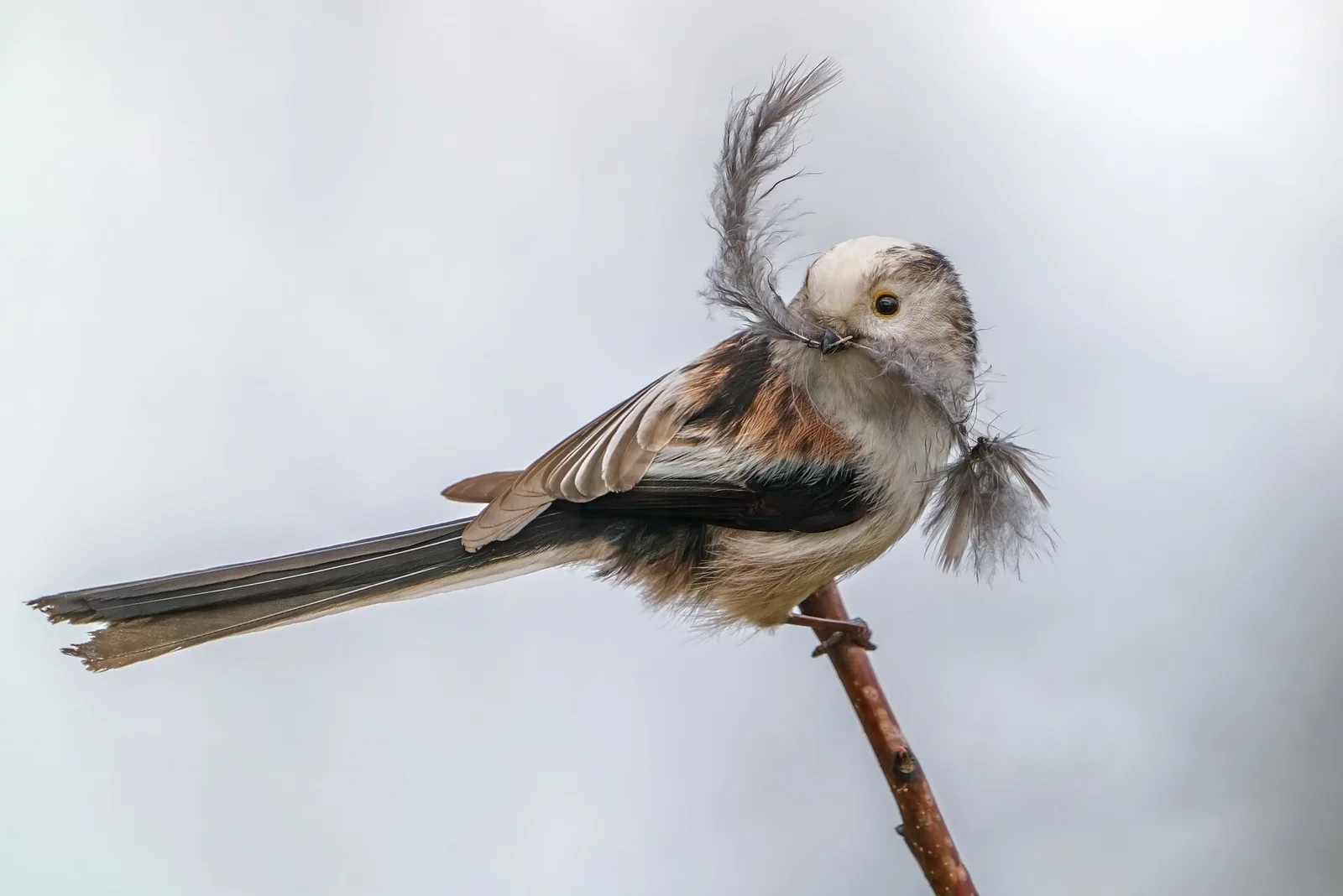
Here is the part that strains belief. A long-tailed tit nest is built from over six thousand pieces of material, mostly lichen, moss, feathers, and spider egg cocoons. The trick is mechanical. The tiny moss leaves act as hooks, and the spider silk provides the loops, a natural form of velcro. As the chicks grow, the soft sphere stretches around them. Up to 1,500 feathers line the inside. Only about 17% of nests survive predation. A jay finds the dome and weeks of stitching are gone in an afternoon.
That is where the family kicks in.
The Vocal Family Code
When a pair loses its nest after the beginning of May, the failed breeders do not start over. They go and help their relatives feed someone else’s chicks. Roughly half of all long-tailed tit nests end up with at least one extra adult bringing caterpillars. The trick is recognition. Sheffield evolutionary ecologist Ben Hatchwell and his team have followed a Rivelin Valley population since 1994. In a 2005 Nature paper, they showed that long-tailed tits learn their contact calls from the parents that feed them in the nest, and rely on those calls later to sort close relatives from non-kin. The trills rolling through the hedge are a family password.
In winter the same family huddles. They roost in a row along a branch, packed shoulder to shoulder, and the dominant birds claim the warm middle. A hard cold snap can wipe out the lot. The huddle is the only insurance.
A long-tailed tit is almost never alone. A flock of them is really one family, recognising each other by calls learned in the nest, sticking together as long as they can.
Sources:
- Wikipedia: Long-tailed tit, including helpers, 6,000-piece nest, and “bum-towel” folk name
- Wikipedia: Aegithalos genus and Aristotle’s term for European tits
- BTO BirdFacts: Long-tailed Tit population, breeding, and 1,500-feather nest lining
- Animal Diversity Web: Aegithalos caudatus — communal roosting, dominance, and winter mortality
- Wikipedia: Helpers at the nest — long-tailed tit cooperative breeding survival data
- Nature (2005): Sharp, McGowan, Wood & Hatchwell, “Learned kin recognition cues in a social bird”
- The Conversation: Ben Hatchwell, University of Sheffield — studying long-tailed tit cooperative breeding since 1994
- Bird Sounds and Songs (YouTube): “tsee-tsee-tsee” contact call recording