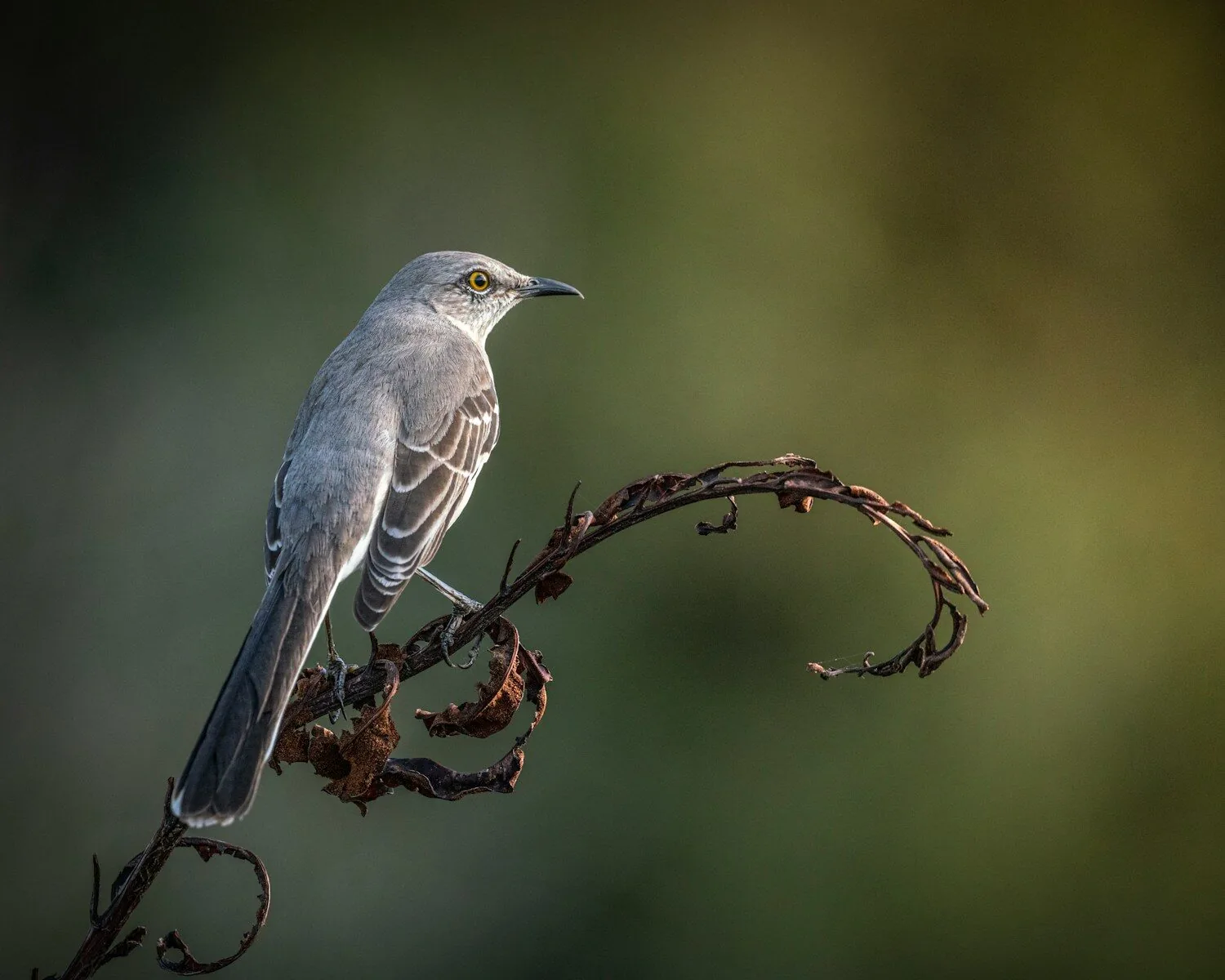
Imagine an alarm clock that doesn’t just beep; it remixes. At 2:00 a.m., under the artificial glow of a streetlamp, you might hear the trill of a cardinal, the croak of a toad, and the rhythmic pulse of a neighbor’s car alarm—all coming from a single throat. You haven’t found a glitch in the world; you’ve encountered the Northern Mockingbird, a bird that has turned the entire soundscape into its personal, chaotic playlist.
A Living Library of Four Hundred Voices
The mockingbird doesn’t just “mimic”; it archives. Its scientific name, Mimus Polyglottos, translates to the “many-tongued mimic.” However, the most poetic observation comes from the Aztecs. In Classical Nahuatl, the bird is known as centzontlahtōleh, or “the possessor of four hundred words.”
To the Aztecs, “four hundred” was a placeholder for infinity. They saw the bird as a living library of every sound encountered. It doesn’t distinguish between “nature” and “noise.” It will replicate a digital ringtone with the same earnestness it uses for a hawk’s cry, purely because the pitch fits its impressive vocal range.
The Neighbor Who Remembers Your Face
Beyond its voice lies an unsettling intelligence. If you decide to get too close to a mockingbird’s nest in a local park, don’t expect it to forget the encounter. Research from the University of Florida has shown that mockingbirds can recognize individual human faces after only sixty seconds of exposure.
While we might think all gray birds look the same, they definitely don’t think all humans are equal. They can pick a “threatening” person out of a crowd of thousands, ignoring everyone else while specifically dive-bombing the individual who bothered them the day before. This cognitive mapping makes them the undisputed kings of the urban jungle.
This intelligence extends to their social lives through the “Boundary Dance.” When two mockingbirds dispute territory, they face off on the ground, hopping side-to-side in a mirrored standoff that looks like a feathered version of a Western duel.
The Desperate Midnight Setlist
If you hear a mockingbird performing a solo concert in the dead of night, it’s usually for a bittersweet reason: he’s single. Unmated males are the primary nocturnal singers, putting on exhaustive shows to broadcast their fitness. In the quiet of the night, their songs travel further without the interference of traffic, theoretically boosting their mating chances.
Even their relationship with predators is complex. While they are known for their aggression, they also deal with “mafia” tactics from parasitic birds like cowbirds. While mockingbirds often try to eject foreign eggs, they sometimes tolerate them to avoid “retaliatory” attacks from the cowbirds or to use the extra eggs as decoys against other nest predators.
The mockingbird is more than a singer; it is a dedicated observer of humanity. As Thomas Jefferson—who famously kept a pet mockingbird named “Dick” in the White House—noted, they are among the finest creatures in the natural world. They reflect our own sounds back to us with a talent for plagiarism that would make a ghostwriter blush.
Sources
- Audubon:10 Fun Facts About the Northern Mockingbird
- University of Florida:Mockingbirds Recognize a Face in a Crowd
- ScienceDaily:‘Alien’ eggs benefit mockingbirds
- Mexicolore:The Aztec name for the mockingbird
- Wiktionary:Etymology of Cenzontle