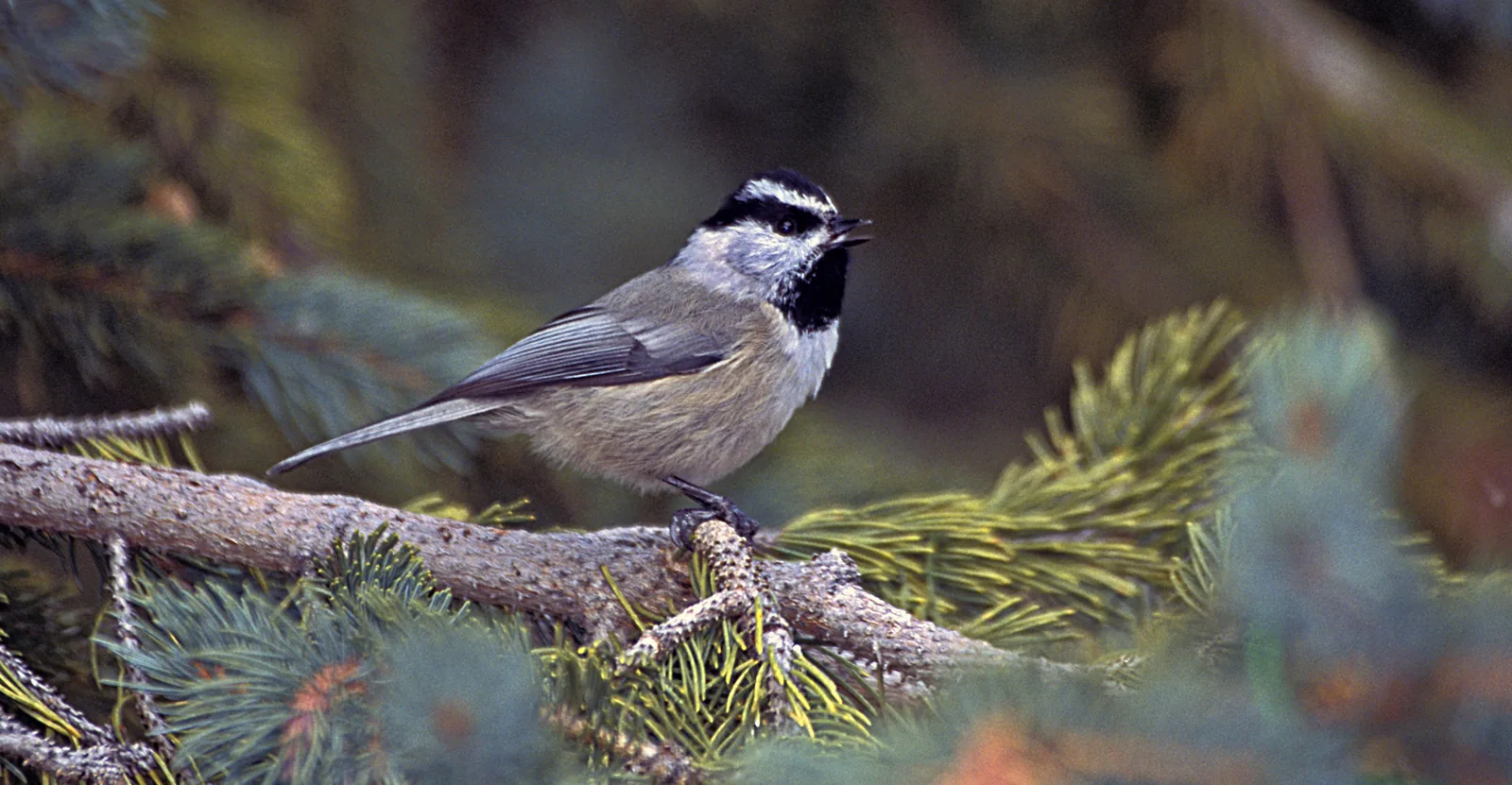

The Mountain's Memory Champion
Somewhere above 7,000 feet in a Western pine forest, a small grey bird is taking a memory test, and the price of failing is winter. Mountain Chickadees cache thousands of conifer seeds in autumn and try to find them again in February, when most of the food in the forest is buried under snow. Most of the bird’s first-year cohort doesn’t make it through. The ones that do, on average, scored higher on a spatial-memory task months earlier. Cognition, in this species, is graded by death.
Black Cap, White Eyebrow, Strict Rule
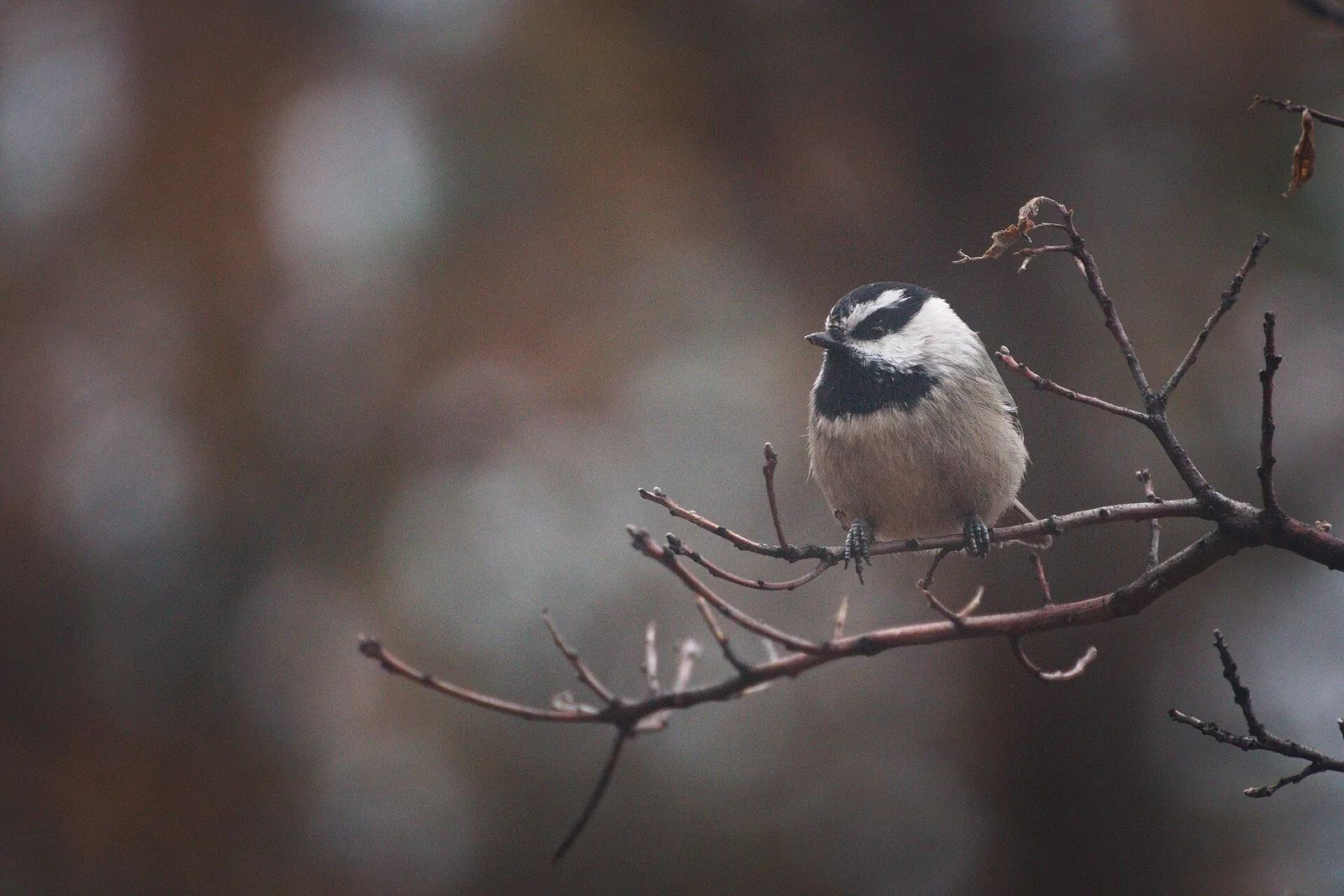
The Mountain Chickadee looks almost identical to a Black-capped Chickadee, with one giveaway: a clean white stripe over each eye, splitting the black cap from the black eye-line. No other North American chickadee carries it. The bird lives in the higher conifer forests of the Mountain West, from southern Yukon down through the Sierras and the Rocky Mountain States. The genus name Poecile comes from the Greek poikilos, meaning spotted or patterned, a passable description for a head striped like a small badge.
Survival, Graded On Memory
In autumn, a Mountain Chickadee hides thousands of conifer seeds across its territory, one at a time, tucked into bark crevices and pine-needle clusters. There is no central pantry. Each seed is a separate location the bird must recover in February, when snow buries the forest floor and food has otherwise run out. Vladimir Pravosudov, a Russian-born behavioral ecologist who has worked on the species for two decades at the University of Nevada Reno, ran the experiment that pinned this down. In 2019, his lab tracked a wild population at the Sagehen Creek field site in the Sierra Nevada and gave juvenile chickadees a spatial-learning task. Months later, the juveniles that had survived their first winter had scored significantly higher on the task than the ones that had not. The chickadees that remembered better were the chickadees that lived. Earlier work from the same lab found that birds a few hundred meters higher up the slope, where winters are harsher, are routinely sharper on memory tasks than birds lower down on the same mountain.
A Doomed Naturalist And A Mountain Dialect
The species name gambeli honors William Gambel, a Philadelphia naturalist who in 1841 became the first botanist to cross overland from the eastern United States into California. He collected the bird that now bears his name during his Western expeditions, and died at twenty-six in a Gold Rush mining camp on the Yuba River, having caught typhoid while treating sick miners through an epidemic. In the time since, the species has developed regional accents. Carrie Branch, an American behavioral ecologist who trained in Pravosudov’s lab, recorded male Mountain Chickadee songs from high and low elevations on two separate Sierra mountains in 2015. The standard fee-bee-bee whistle, the one birders write down as cheese-bur-ger, came out structurally different at different elevations. Birds living at different elevations on the same mountain, in continuous forest, were singing in measurably different ways. There are dialects in this bird, and they track the slope.
At a feeder, the Mountain Chickadee mostly reads as the small grey bird that keeps eye contact and doesn’t fly off. That small grey bird is keeping a mental map of several thousand individual hiding spots, refreshed every autumn, audited every winter. Every seed it tucks behind a piece of bark in October is a question its February self will be quizzed on, and the curve is set by the wind.
Sources:
- Wikipedia: Mountain Chickadee
- Wikipedia: William Gambel
- Sonnenberg et al. 2019, Current Biology: Natural Selection and Spatial Cognition in Wild Food-Caching Mountain Chickadees
- Branch & Pravosudov 2015, Royal Society Open Science: Mountain chickadees from different elevations sing different songs
- Branch et al. 2017, Royal Society Open Science: Absence of population structure across elevational gradients despite large phenotypic variation in mountain chickadees
- Audubon Field Guide: Mountain Chickadee