_(25936816473).jpg)
The Insomniac Bachelor's Aria
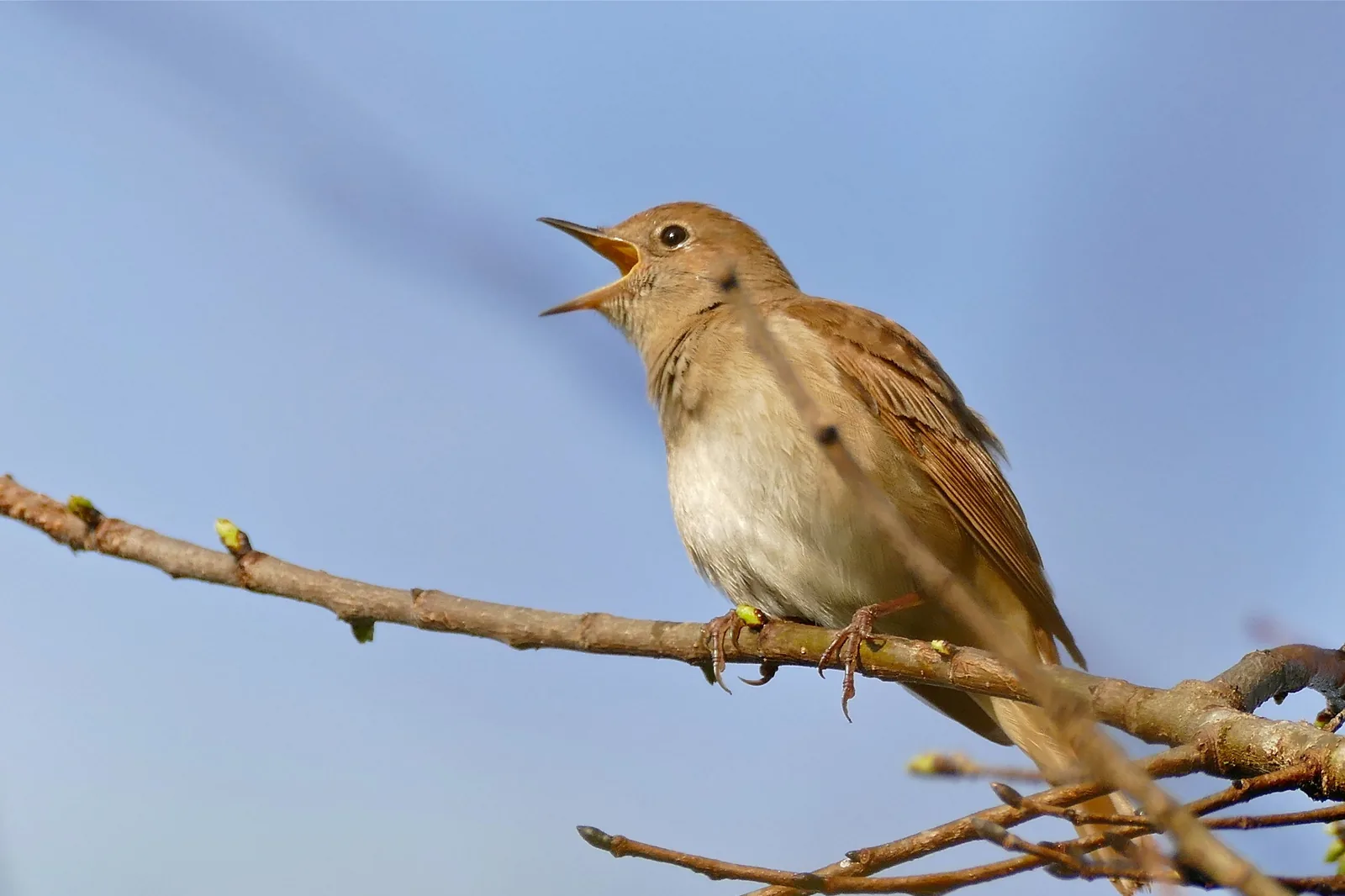
The Common Nightingale is the size of a robin, brown all over, easy to overlook. The voice has been famous since Homer. A wild male carries a repertoire of around 190 songs and works through it at midnight from a hedgerow. He is singing because no female has answered him.
The Cellist and the Bombers
In the spring of 1924, cellist Beatrice Harrison practiced in the garden of her family’s house at Oxted, Surrey. The local nightingales joined in, night after night. She telephoned John Reith, the general manager of the BBC, and asked him to put the duet on the radio. He was dubious; he relented. On 19 May 1924 the BBC ran its first live outdoor broadcast. Around a million people stayed up to listen, and roughly fifty thousand of them mailed Harrison fan letters. Reith wrote in the Radio Times that the bird “has swept the country… with a wave of something closely akin to emotionalism.”
The broadcast became an annual May ritual. On the night of 19 May 1942, BBC engineers in Harrison’s garden were ready to put another nightingale duet on the air live. Overhead, 197 RAF heavy bombers, mostly Wellingtons, were flying east toward Mannheim, a German industrial city. A technician cut the live feed before listeners at home could hear the formation pass and work out where it was going. The microphones kept recording. The same tape later caught the bombers coming back, twelve aircraft fewer than had set out. The BBC retired the broadcast after that night.
He Sings Because He Is Alone
Only unpaired males sing regularly at night. Once a female answers, he stops after dark. Daytime song carries on either way, but the midnight aria is strictly bachelor work.

Each male carries a working repertoire of between 180 and 260 distinct song types, depending on his age and where he learned. He cycles through the catalogue, repeating favorites and rotating the rest. Every audience, from Homer to Beatrice Harrison’s million radio listeners, has been hearing a bachelor’s audition tape.
Louder in Berlin
In the spring of 2001, the behavioural ecologist Henrik Brumm walked into Berlin parks with a tape recorder and a sound-pressure meter. He found a male nightingale, measured how loud he sang, then measured the local traffic noise, and moved on to the next territory. He came back the following spring and did it again. Birds in the noisiest territories, he found, sang 5.2 decibels louder than birds in the quietest.
His paper, in the Journal of Animal Ecology in 2004, was the first demonstration of the Lombard effect (the reflex that makes a person raise their voice in a loud bar) in a wild bird. What the Bird Rise app plays is the song in a quiet meadow. The same male over a Berlin tram line would be five decibels louder.
If the Bird Rise app plays a Common Nightingale, the recording is one bird somewhere between Spain and Mongolia in spring, awake when nothing else is. He is broadcasting a résumé to whichever female ear happens to be within reach. Once she answers, the hedgerow goes quiet.
Sources:
- Wikipedia: Common nightingale
- Cornell Lab, Birds of the World: Common Nightingale: Sounds and Vocal Behavior
- Brumm, H. (2004), Journal of Animal Ecology: The impact of environmental noise on song amplitude in a territorial bird
- National Science and Media Museum: Broadcasting sounds of nature: From Beatrice Harrison to David Attenborough
- National Science and Media Museum blog: From Nightingale to Narcissus
- Legion Magazine: The bombers and the nightingales
- Wikipedia: Bombing of Mannheim in World War II
- Wikipedia: Beatrice Harrison