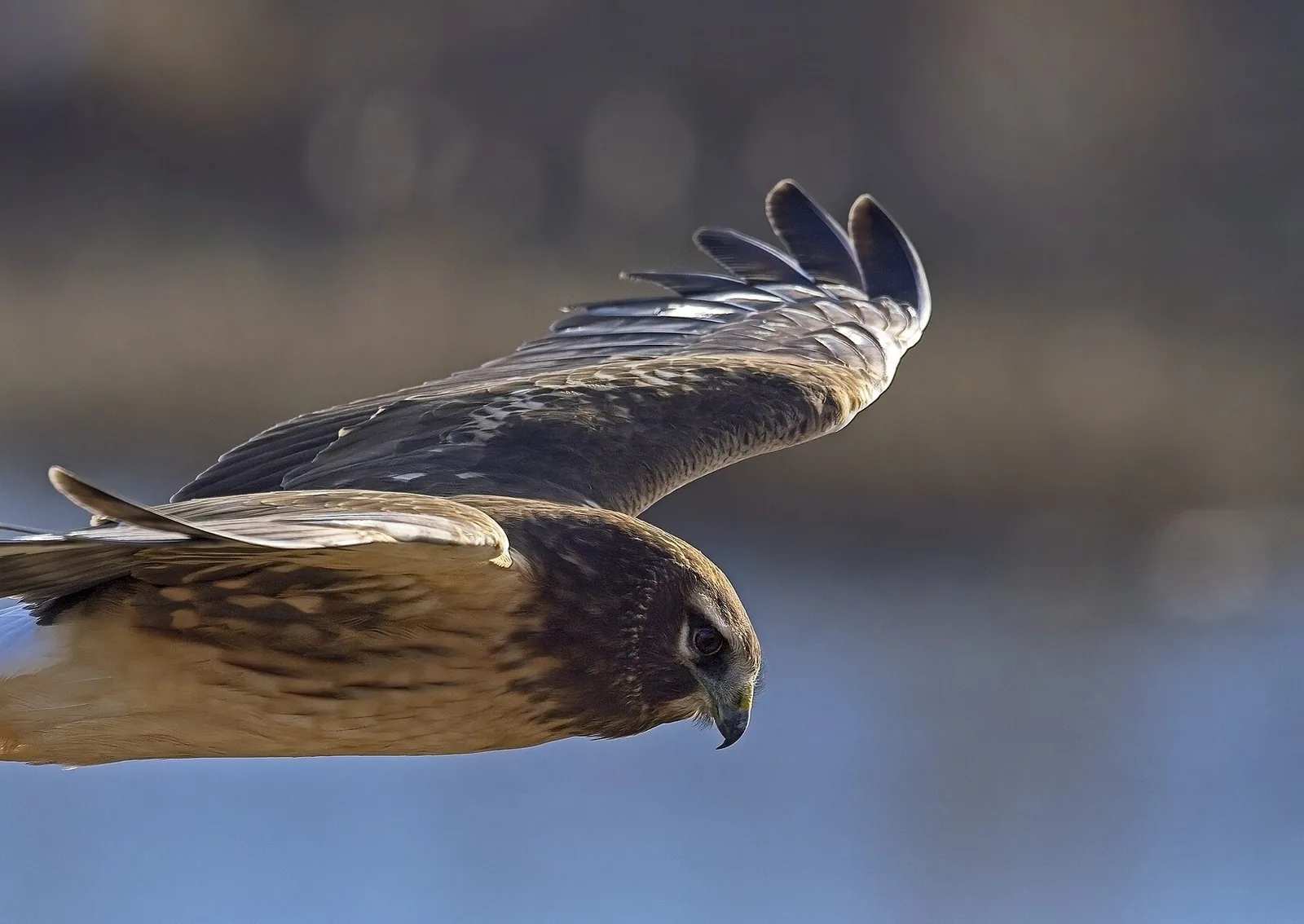

The Grey Ghost of the Marsh
The Northern Harrier flies like a hawk but listens like an owl. Across the marshes and grasslands of North America the pale grey male tilts low over the cattails while the chocolate-brown female works the same field beneath him. Both birds keep an unusual face turned toward the ground. The face is the trick.
A Hawk That Hunts By Ear
Most hawks live by their eyes. Harriers live by their ears as well. Each face is rimmed by a stiff ring of feathers called a facial disc, the parabolic shape an owl uses to listen in the dark. Nothing else among the world’s diurnal raptors carries one.
In 1982 the American biologist William Rice asked a strange question: can a hawk hunt with its eyes shut? In the lab he showed that captive Marsh Hawks (the old North-American name) could orient on a vole squeak played from a hidden speaker. Then he went outside. He played the same recordings over open fields and watched wild harriers break off their slow low search flight to strike a speaker hidden in the grass. Their horizontal aim landed within about two degrees of each squeak, the precision a Barn Owl uses in pitch darkness. The harriers could also place the sound vertically, knowing whether it came from above or below eye level. No other daytime hawk appears to share that vertical trick.
It pays. Microtus voles make up between seventy and ninety-three percent of a wintering Northern Harrier’s diet. The bird does not need to see the rodent. It needs to hear it move.
The Sky Dance and the Grey Ghost
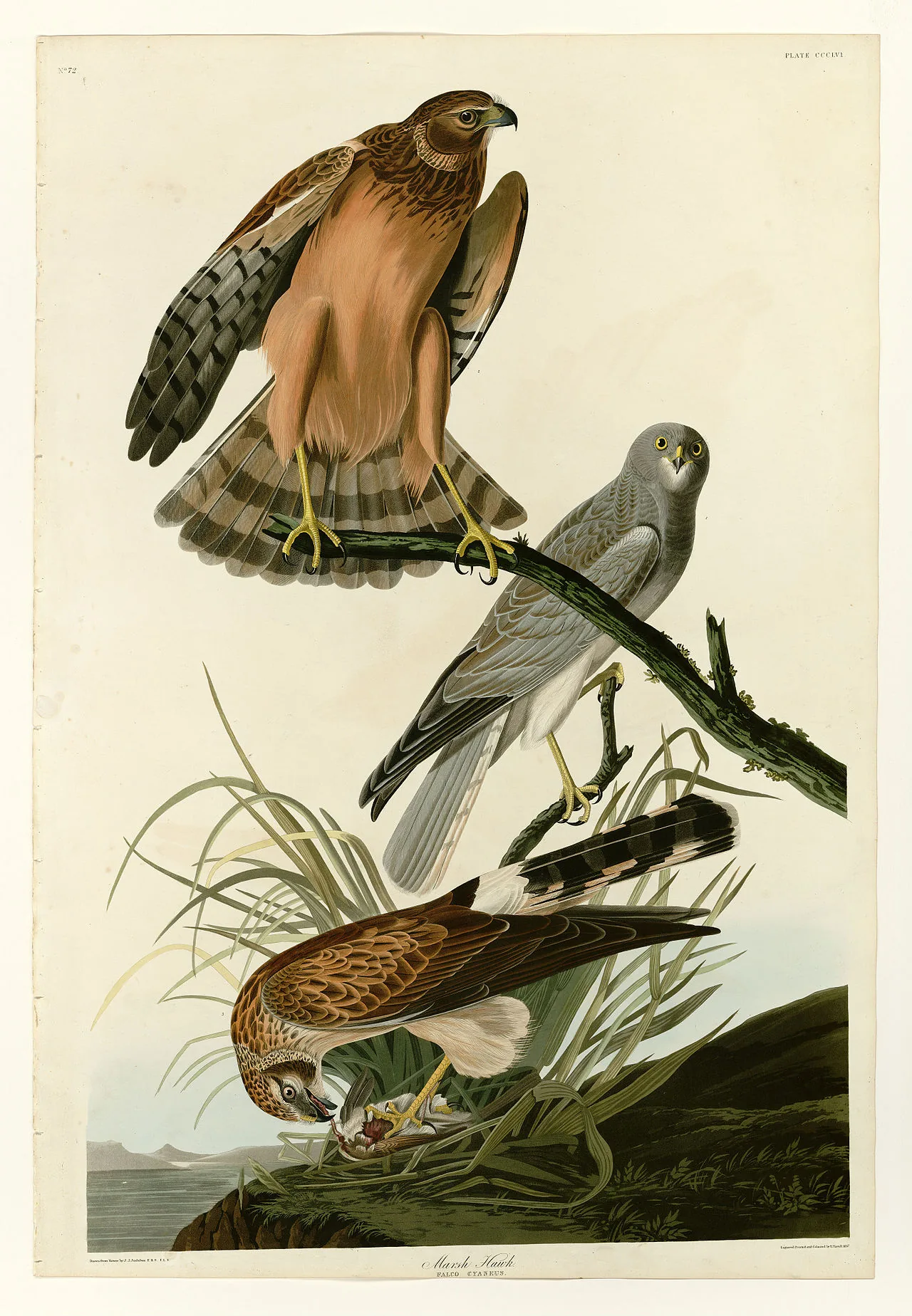
In April the male takes the air and turns ridiculous. He climbs into a stall and falls into a U-shaped dive. He pulls up and does it again. A single courtship bout can run to dozens of these roller-coaster loops, sometimes climbing as high as three hundred metres. Females watch from the grass. The display has a name in the field guides: the sky-dance.
It earns him more than one mate. Northern Harriers are one of the few raptors that practise polygyny, with the strongest males provisioning two or three females in a season; one male was recorded feeding five nests at once. The cost falls on him. He runs food deliveries between several ground nests in the same marsh while each female does most of the incubation.
The plumage tells you which bird you are looking at. First-year birds and adult females wear chocolate brown above with a banded tail, and have been called ringtails for centuries. The mature male trades that brown for a soft pearl-grey upperpart and a white belly. American birders have long called him the Grey Ghost.
For two centuries the Hen Harrier on a Yorkshire moor and the Marsh Hawk on a New Jersey saltmarsh were the same official species. In 2016 a genomics paper showed the two had been separating for a long time, and in 2017 the American Ornithological Society made the split formal. The bird tilting low over a North American field is now Circus hudsonius, named after a Hudson Bay specimen and listening for voles you cannot hear.
Sources
- Wikipedia: Northern harrier (Circus hudsonius)
- Cornell Lab of Ornithology: Northern Harrier life history
- William R. Rice 1982, The Auk: Acoustical Location of Prey by the Marsh Hawk: Adaptation to Concealed Prey
- Hawk Mountain Sanctuary: Northern Harrier (summarising MacWhirter and Bildstein 1996)
- ScienceDaily, November 2016: Genomics reveals Hen Harrier is two distinct species