.jpg)
From Moth-Eater to Seed-Eater
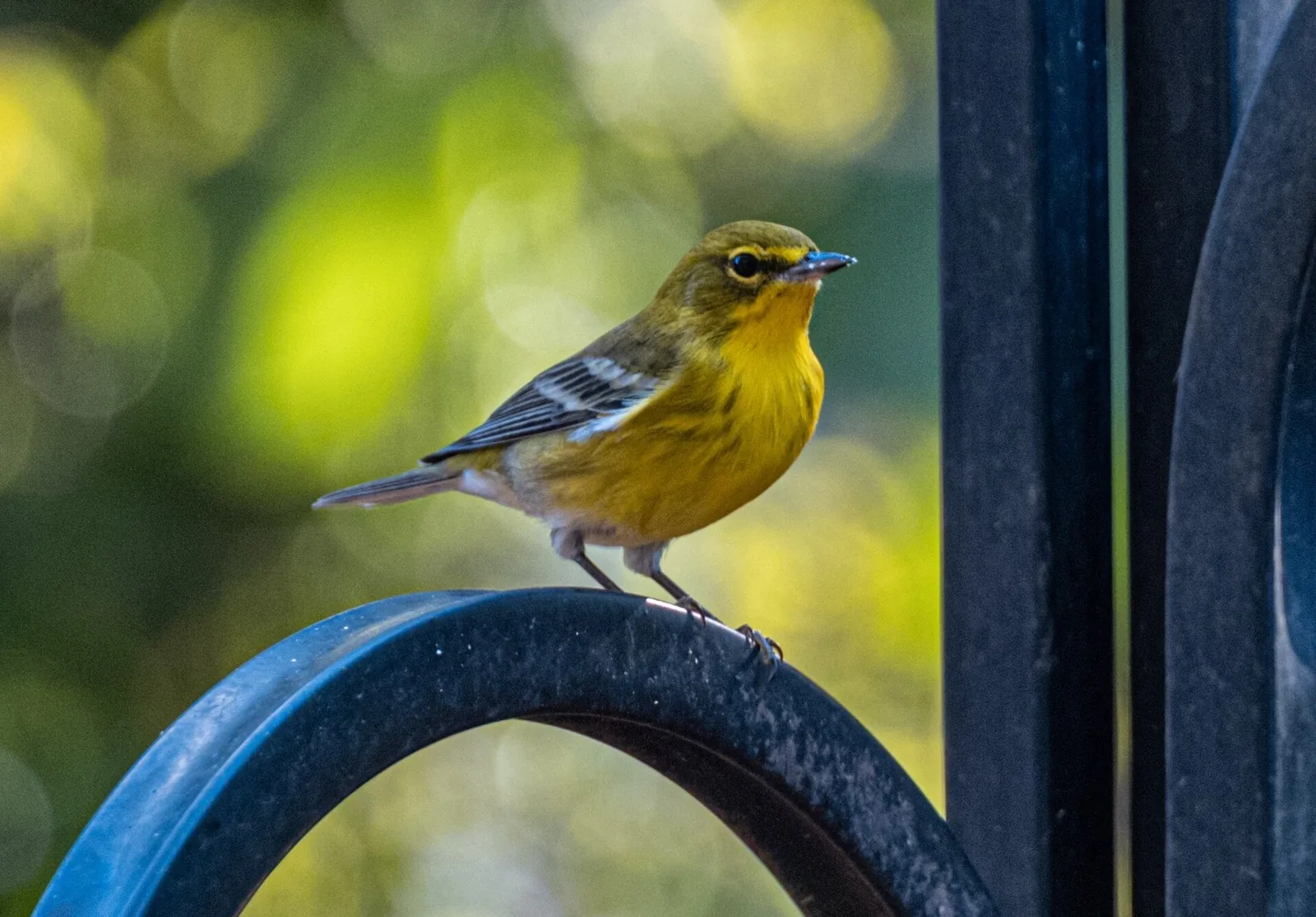
Of all the warblers, this is the one that shows up at the suet block. While the rest of the family chases caterpillars through the canopy or flies to Costa Rica for winter, the Pine Warbler queues behind a tufted titmouse for shelled peanuts. The genus name Setophaga means “moth-eater” in Greek. The bird ignores it.
A Name That Lies
The bird’s two names quarrel with each other. Latin pinus anchors it to one tree, the eastern pine forests where it nests and almost never strays. But Greek σής (sēs, moth) and -φάγος (-phagos, eating) belong to the rest of its genus, the warblers that live on insects. Cornell’s Birds of the World calls Pine Warblers “the only wood-warbler known to regularly consume seeds (often pine seeds or seeds at bird feeders) in any significant amount.” The same Cornell account adds that the species “undergoes seasonal physiological changes in the digestive system to allow for digestion of seeds.”
That last part deserves a pause. Most birds either eat seeds or they don’t. Pine Warblers reconfigure twice a year.
The Suet Block Holdout
Most warblers ride in on a wave of insects in late spring and ride out on the same wave in autumn. Pine Warblers refuse to play along. In the southeastern United States they don’t migrate at all, and farther north they show up in late March or early April, before any caterpillar dares hatch. They make do.
That is the reason they end up at backyard feeders, the only warbler many people will ever see at one. Audubon notes the bird “will visit bird feeders for suet and other items” and consumes pine seeds when insects are scarce. In the cold months, while a Yellow-rumped Warbler is out gleaning bayberries on a coastal dune, this one is in the yard.
Audubon’s Phantom Warbler
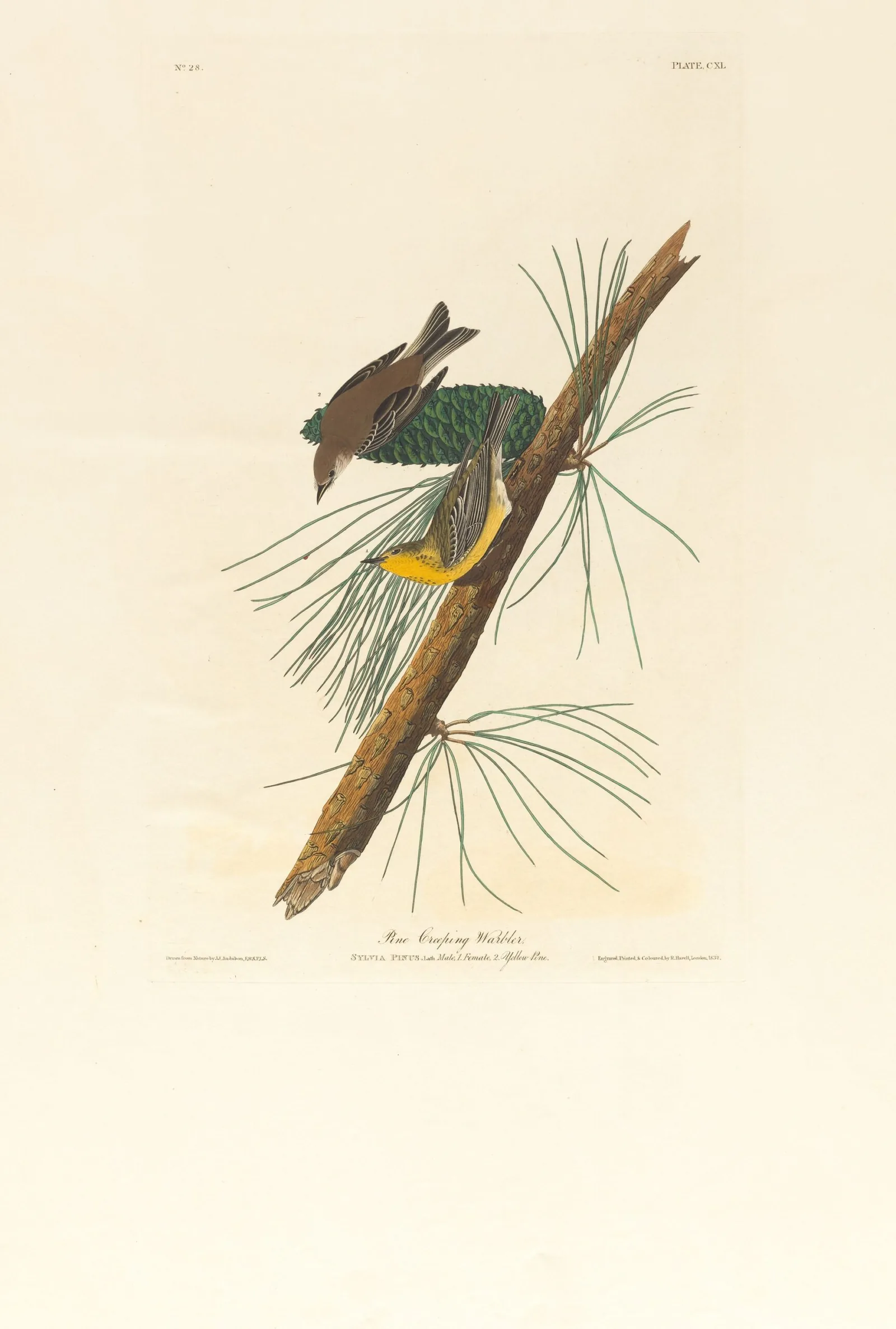
The species also has a strange double life in the historical record. John James Audubon painted it correctly as the Pine Creeping Warbler in Plate 140 of The Birds of America, with a male and female on a yellow pine branch beside a green cone. Earlier in the same work, he painted what he was sure was a brand-new species. A single odd warbler had turned up at his Pennsylvania farm Mill Grove back in May 1812. He painted it, never saw another, and named the bird Sylvia vigorsii on Plate 30 “in honour of a naturalist whose merits are so well known to the learned world,” meaning Nicholas Aylward Vigors, the Irish zoologist who co-founded the Zoological Society of London. Later ornithologists worked out the truth. Vigors’s Warbler was an immature Pine Warbler. The phantom species and the real one had been perched on the same branch the whole time.
.jpg)
.jpg)
So the song, when it does come down through the pines in early spring, is a soft, sweet trill, easily confused with a Chipping Sparrow or a Dark-eyed Junco. Once you’ve placed it in the canopy, the contradictions stop mattering. The genus name was wrong, and the suet block is empty by lunchtime.
Sources:
- Wikipedia: Pine warbler
- Wikipedia: Setophaga (genus)
- Wikipedia: Nicholas Aylward Vigors
- Cornell Lab, Birds of the World: Pine Warbler, Introduction
- National Audubon Society: Pine Warbler field guide
- Sibley Guides: Trilled Songs of Eastern Birds
- Audubon, Ornithological Biography vol. 1, via Wikisource: Vigors’s Warbler
- Wikimedia Commons: Audubon, Pine Creeping Warbler, Plate 140
- Wikimedia Commons: Audubon, Vigor’s Warbler, Plate 30
- Macaulay Library, Cornell Lab: Pine Warbler singing (ML #469483, video)