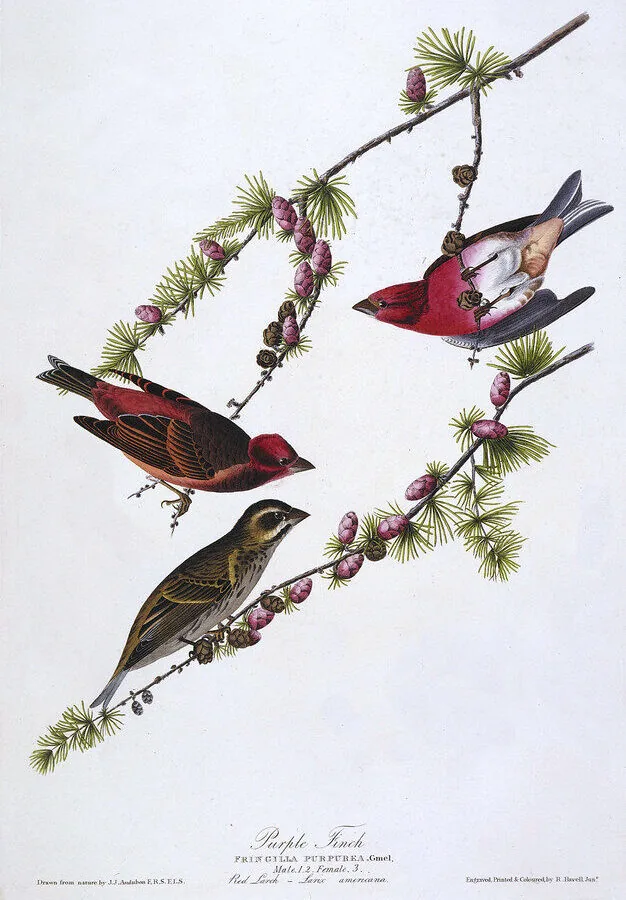
The Raspberry Ranger’s Identity Crisis
The first thing to understand about the Purple Finch is that it is the victim of a significant linguistic misunderstanding. It is not, by any modern definition, purple. Instead, it looks as though it has been involved in a minor accident in a fruit processing plant. The legendary ornithologist Roger Tory Peterson famously described the male as a “sparrow dipped in raspberry juice”.
A Masterclass in Misnaming
To name a bird “purple” when it is clearly the color of a ripe berry is a relic of a time when the English language was less precise about the visible spectrum. The scientific name, Haemorhous purpureus, reveals a more literal—if slightly gruesome—perspective.
- The Genus Name: Haemorhous is derived from the Ancient Greek roots haimo (blood) and orrhos (rump).
- The Reality: This “blood-rumped” designation is far more accurate than the common name, as the male’s most vibrant coloration is often concentrated on the lower back and tail base.
Long before European naturalists were debating Latin color terms, the bird was recognized by indigenous populations in the southern reaches of its range. In the 18th century, it was linked to the name “chiantototl,” a Nahuatl term translating to “chia seed bird.” This was an astute observation of the bird’s primary ecological role. Unlike many birds that disperse seeds by eating fruit and passing the pits, the Purple Finch is a “seed predator.” It uses a powerful, conical bill to crush seeds and extract the fat, effectively ending the plant’s reproductive line rather than helping it spread.
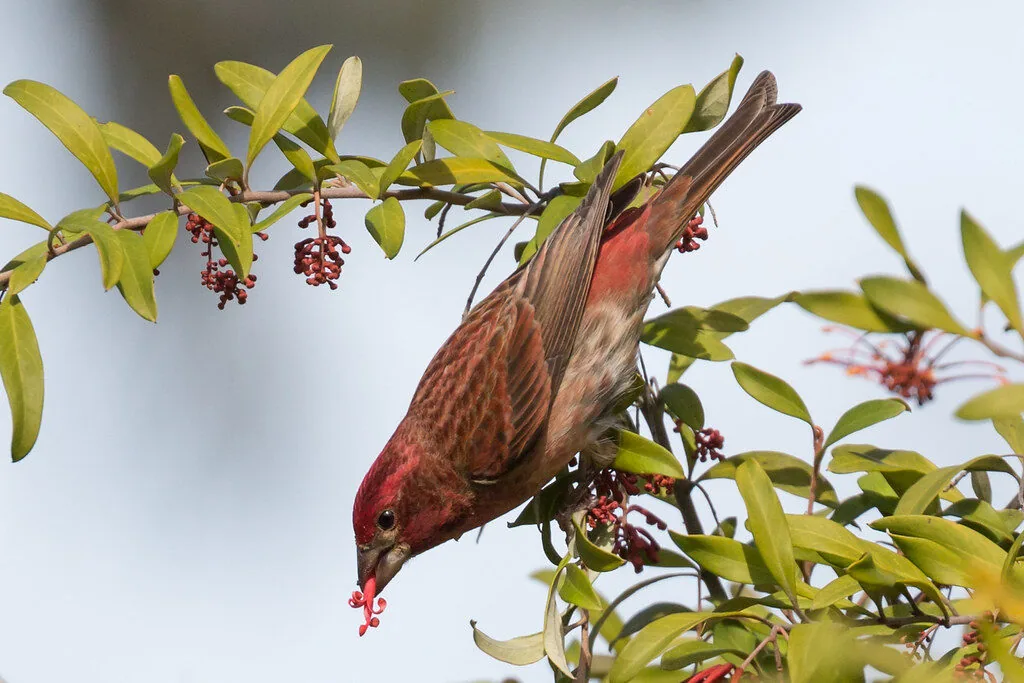
Vocal Thieves and Salt Addicts
In its native coniferous haunts, the Purple Finch produces a song that observers often liken to a “gently boiling teakettle”—a sweet, bubbling warble that once made it a popular choice for a caged pet. However, the “informed observer” should look closer at the bird’s vocal repertoire.
- Sophisticated Mimicry: It is a talented interspecific mimic, frequently incorporating the calls of other birds into its performance.
- The Deception: Bizarrely, it often mimics the Brown-headed Cowbird, a brood parasite that represents its own biological enemy.
Beyond its vocal deception, the Purple Finch struggles with a dangerous physiological craving for salt. Because its seed-heavy diet is naturally high in potassium but low in sodium, the bird will seek out mineral sources with a desperation that can be fatal. In its winter range, this often leads “tremblings” of finches to gather on road surfaces to consume de-icing salt. This “fatal attraction” can impair their coordination, making them vulnerable to traffic and sometimes leading to direct salt toxicity.
The Purple Finch remains a resilient symbol of the northern woods, even as it is increasingly pushed out of urban areas by the more aggressive House Finch. Its legacy is preserved in diverse cultural corners, from being the state bird of New Hampshire—where it famously beat out a domestic chicken for the title—to the wistful poetry of E.E. Cummings, who saw its “eagerly sweet carolling” as a persistent “yes” to existence. It is a creature of deep forest edges and erratic winter travels, a raspberry-stained ranger that reminds us that nature rarely fits into the simple categories we create for it.
Sources:
- Nature Anywhere:Bird of the Week: The Purple Finch
- Wikipedia:Purple Finch Overview and Taxonomy
- All About Birds (Cornell Lab of Ornithology):Purple Finch Life History
- Sibley Guides:Bird Name Changes and Taxonomic Updates
- Door County Pulse:The Purple Finch: A Deep Dive
- Poetry Dispatch:Literary and Poetic Reflections on the Purple Finch