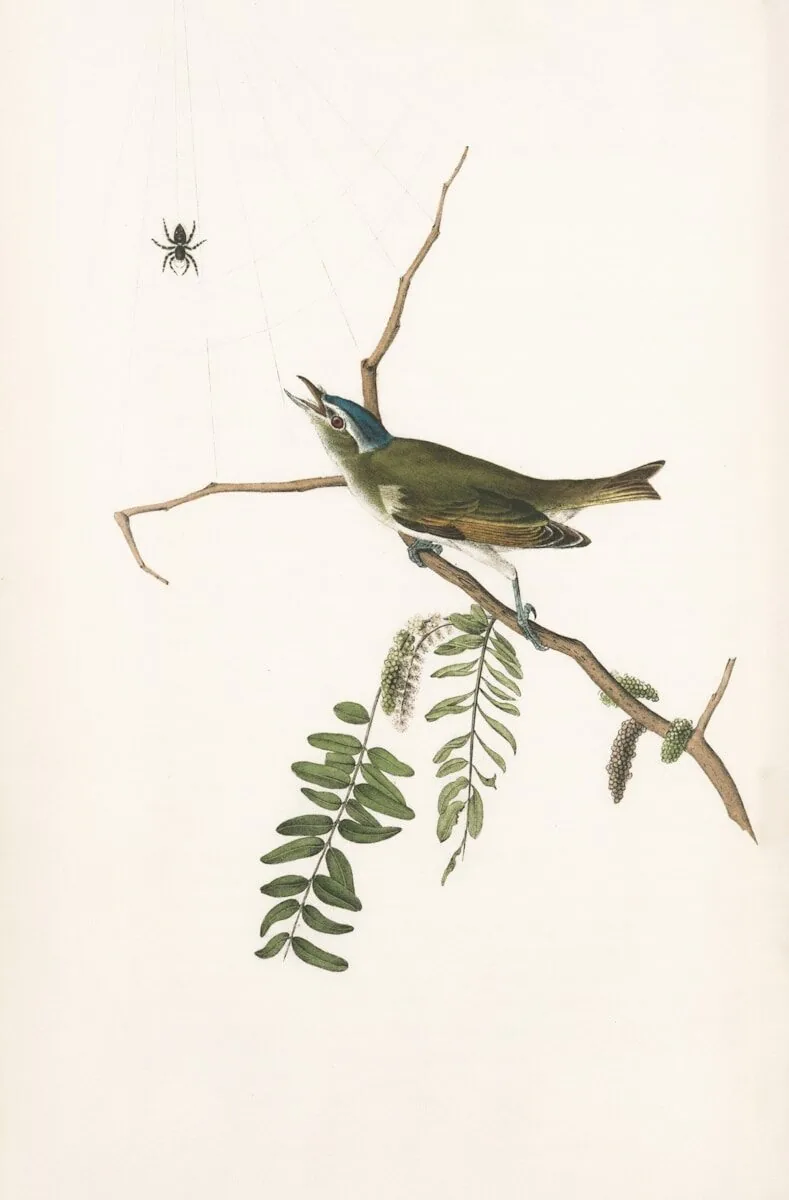
While most birds treat singing as a morning ritual, the Red-eyed Vireo (Vireo olivaceus) treats it like a career. In 1952, a single male in Ontario was famously recorded delivering 22,197 song phrases over a single day. That averages out to roughly one song every two seconds, sustained from dawn until sunset. This level of vocal stamina makes most other songbirds seem like hobbyists by comparison.
While its olive-green plumage acts as perfect camouflage in the high canopy, its voice is impossible to miss—whether you are standing in a North American deciduous forest in July or wandering the Amazon basin during the northern winter.
The Preacher’s Script and the Composer’s Error
The name Vireo is a direct Latin translation for “I am green.” It is a literalist’s name for a bird that blends seamlessly into the foliage. In Brazil, the Tupi-Guarani call it Juruviara, a name derived from the specific rhythmic cadence of its call. To English speakers in the 19th century, this bird was better known as the “Preacher Bird.” Naturalist Wilson Flagg famously transcribed its repetitive, question-and-answer style as: “You see it! You know it! Do you hear me? Do you believe it?”
This relentless “sermon” even managed to trick the famous composer Antonín Dvořák. While visiting Spillville, Iowa, in 1893, Dvořák incorporated a high, repetitive bird song into the third movement of his “American” String Quartet. For over a century, musicologists insisted he was imitating a Scarlet Tanager because Dvořák’s notes mentioned seeing a “red bird.” However, modern ornithologists have pointed out that the melody in the quartet perfectly matches the Red-eyed Vireo’s syntax and rhythm, not the tanager’s. It seems the “Preacher” was singing so loudly that the composer simply attributed the sound to the flashiest bird in his line of sight.

Quantum Navigation and Architectural Warfare
The Red-eyed Vireo is a creature of radical physiological shifts. During the summer breeding season, it is a dedicated insectivore, with caterpillars making up the bulk of its diet. Once it migrates to South America, it undergoes a total metabolic pivot, becoming almost entirely frugivorous (fruit-eating) to survive the tropical winter.
Getting to those wintering grounds involves a biological feat that mirrors science fiction. These birds navigate using an internal “inclination compass”—a quantum-level sensitivity to the Earth’s magnetic field. Interestingly, their travel route is a calculated risk based on their own body fat. Research shows that “fat” vireos with high energy reserves will fly directly across the open waters of the Gulf of Mexico, while “lean” vireos choose the safer, longer route hugging the coastline.
Even at home, life is a battle of wits. The Red-eyed Vireo is a frequent target of the Brown-headed Cowbird, a brood parasite that sneaks its eggs into other birds’ nests. While many birds are fooled, the vireo has developed a specific architectural defense: it will sometimes build a “second floor” onto its nest. By weaving a new layer of spider silk and bark over the intruder’s egg, the vireo entombs the cowbird egg, preventing it from hatching and effectively resetting its own nesting cycle.
Sources:
- All About Birds (Cornell Lab of Ornithology):Red-eyed Vireo Overview
- Smithsonian’s National Zoo:Red-eyed Vireo Facts
- Nineteenth-Century Music Review:The Iowa Bird that Inspired Dvořák
- Audubon Field Guide:Red-eyed Vireo (Vireo olivaceus)
- Frontiers in Physiology:Quantum Compass and Cryptochromes
- ResearchGate:Migratory orientation of Red-eyed Vireos in relation to energetic condition