.jpg)
The Moor's Stubborn Redcoat
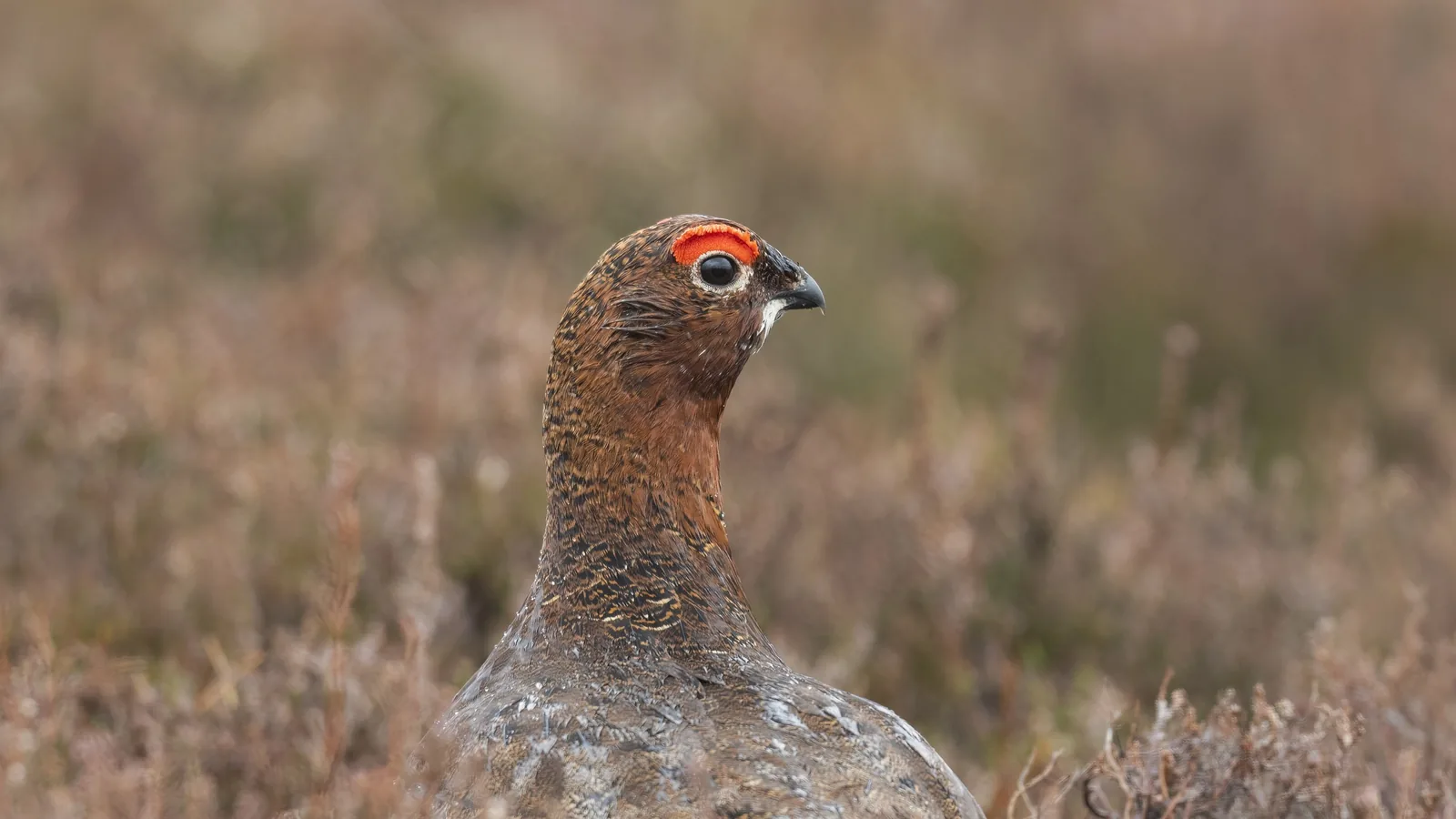
Every other bird in its family has the sense to turn white for winter. The Red Grouse refuses. While its Arctic cousins the ptarmigans turn snow-white and vanish into the drifts, this one stays the colour of dried heather all year, out on the upland moors of Britain and Ireland. If you wake somewhere near that kind of country, you may hear it before you see it: a low, indignant “go-back, go-back, go-back” like the moor itself telling you to turn around.
The Hare-Foot That Stayed Brown
Its scientific name is Lagopus scotica. The first half is ancient Greek, lagos for hare and pous for foot, after the feathers that run right down its legs and over its toes. The second half just means “of Scotland.”
For a century it was called the only bird found nowhere on Earth but Britain and Ireland. (The Scottish Crossbill has since muscled in to share the honour.) It evolved in isolation from the willow grouse of the north, then dropped the family habit of turning white. A white bird on a brown, snowless moor is not hidden. It is a billboard. So it kept its reddish-brown coat. Country people called it the moorcock.
Go Back, Go Back
The Red Grouse has a whole repertoire of calls, but only one that nobody forgets. As it blasts up out of the heather on fast, whirring wings, it flings back a rapid “go-back, go-back, go-back,” usually trailing off into a dry chuckle. It makes a strange alarm clock: not a song, more a feathered grumble at being disturbed. Picture a plump, red-browed bird the size of a small hen, telling the whole world to clear off.
The Worm, the Painter, and the Pole
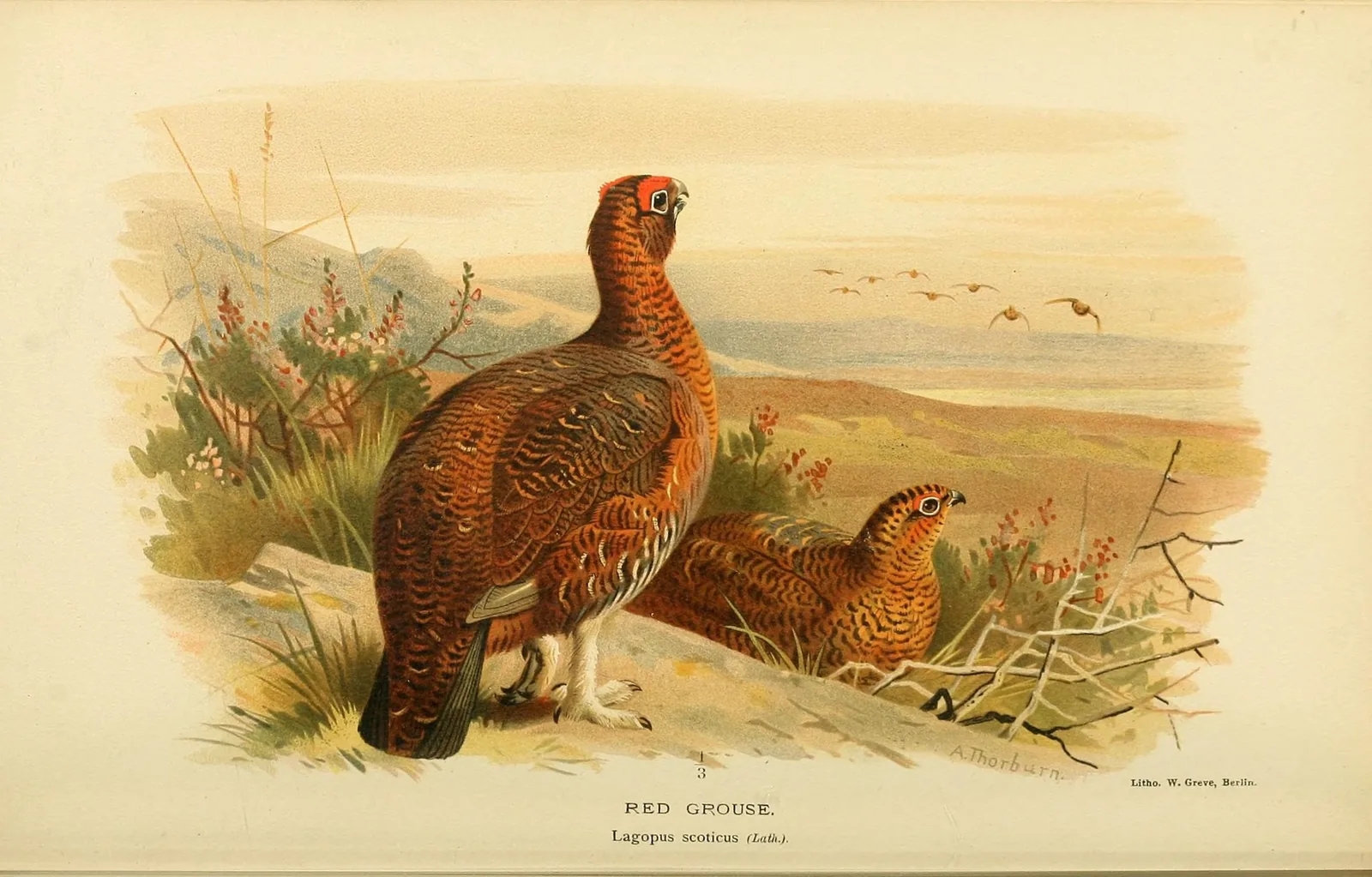
Here the Red Grouse stops being just a bird. It is the face on the Famous Grouse whisky label and the reason the season still opens each year on the “Glorious Twelfth” of August. For generations one riddle haunted those shooting estates: grouse numbers rose and crashed in cycles regular enough to wipe out a season’s income, and nobody knew why.
In 1905 a committee set out to find the answer, chaired by Lord Lovat, a Highland aristocrat. Its 1911 report examined the bird as no wild animal had been before, finding it “almost impossible to find a normal Grouse, i.e., one free from parasites.” Most of that grim work fell to Edward Adrian Wilson, a doctor and wildlife artist who carried out more than two thousand grouse post-mortems and pinned the crashes on a threadworm the birds swallow with their heather. Wilson then sailed south with the explorer Captain Scott, and died on the ice returning from the South Pole in 1912.
It took until 1998 to prove him right. Researchers cleared that worm from wild populations, and the famous crashes simply stopped.
So an ordinary brown bird on a hillside carries more history than it has any right to. There is the whisky label. There is also a dead polar explorer, and a worm that showed ecologists how populations rise and fall. Not bad for something that mostly just wants you to go back.
Sources:
- Wikipedia: Red grouse
- Wikipedia: Lagopus (genus etymology)
- British Trust for Ornithology: Red Grouse
- Committee of Inquiry on Grouse Disease (1911): The Grouse in Health and in Disease, Introduction
- Edward Wilson of the Antarctic: The Grouse Disease Inquiry, 1905 to 1910
- Hudson, Dobson & Newborn (1998), Science: Prevention of population cycles by parasite removal