

The Crown It Rarely Shows
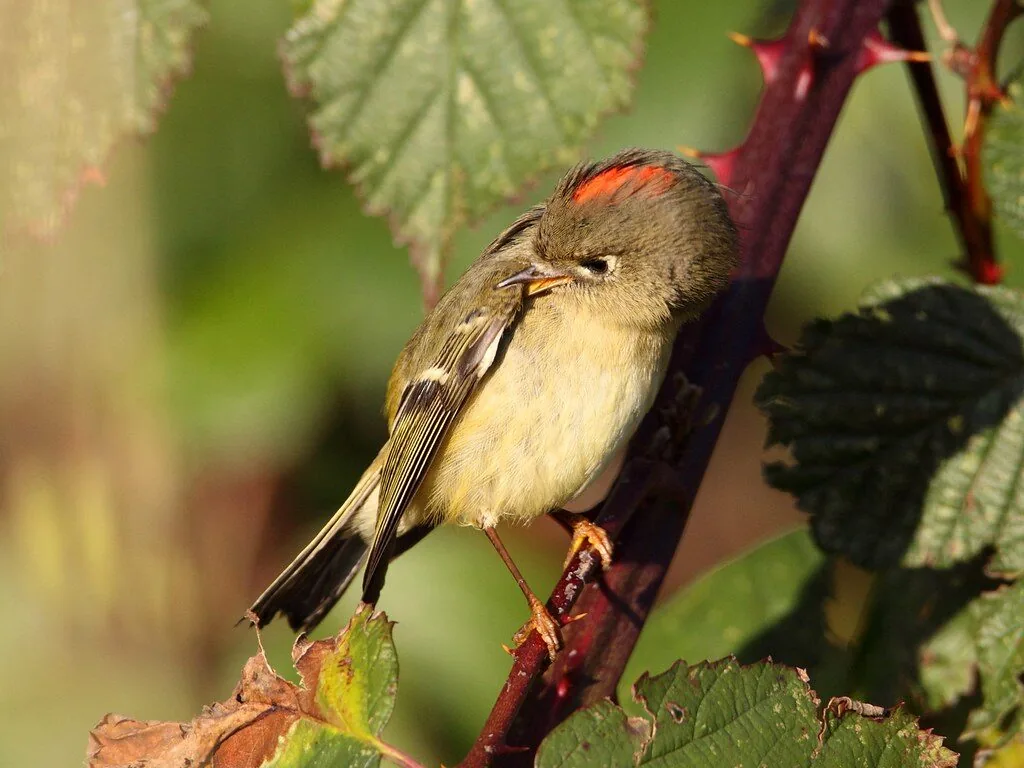
The Ruby-crowned Kinglet is named for something most people never see. The male does carry a scarlet patch on his head, but it spends nearly all its time tucked under plain olive feathers. If you are near a northern spruce forest in spring, you may well hear it before you see it, because its song is far too big for something smaller than a chickadee.
A Crown Kept Out of Sight
Cornell’s field guide is almost apologetic about it. The male’s ruby crown “usually stays hidden,” and your best chance is “to find an excited male singing in spring or summer.” He raises it when agitated or showing off. The rest of the time he looks like a small gray-green bird with a white eye-ring and not much else.
The better clue is the fidgeting. Kinglets flick their wings nearly constantly as they move through the foliage, and Cornell calls that habit a useful aid to identifying them.
Loud Because It Is Cheaper
The song usually opens with a few thin, high notes, then drops into lower trills and a galloping repeated phrase. One section is often written down as “liberty, liberty, liberty.” Plenty of songs leave out one part or another, so do not expect the full version every time.
The volume has a practical reason. Cornell says kinglets use their “long, bubbly, and amazingly loud songs” to establish territories, because singing uses less energy than chasing a rival and is less dangerous than fighting one. For a bird that weighs between 5 and 10 grams, a song that carries is a far better deal than a scuffle.
Twelve Eggs and a Lost Title
For its size, the Ruby-crowned Kinglet lays the largest clutch of any North American perching bird, sometimes as many as 12 eggs. Each egg weighs about a fiftieth of an ounce. Put together, a full clutch can weigh as much as the female who laid it.
Then there is the name. Kinglets belong to the genus Regulus, Latin for “little king,” after their bright crests. In 2021 the American Ornithological Society moved this species out of it and into a genus of its own, Corthylio, because it had turned out to be too different from the other kinglets to share it. The Golden-crowned Kinglet stayed behind.
So the bird lost its royal genus and kept the crown anyway. Most mornings it leaves the crown hidden and lets the song do the talking.
Sources:
- Cornell Lab of Ornithology: Ruby-crowned Kinglet overview, All About Birds
- Cornell Lab of Ornithology: Ruby-crowned Kinglet identification, All About Birds
- Cornell Lab of Ornithology: Ruby-crowned Kinglet life history, All About Birds
- Seattle Audubon, BirdWeb: Ruby-crowned Kinglet
- Laura Erickson: Ruby-crowned Kinglet
- BirdNote: The Ruby-crowned Kinglet Tunes Up
- American Birding Association: The 2021 AOS Supplement is out!
- Wikipedia: Regulus (bird)
- Wikipedia: Ruby-crowned kinglet