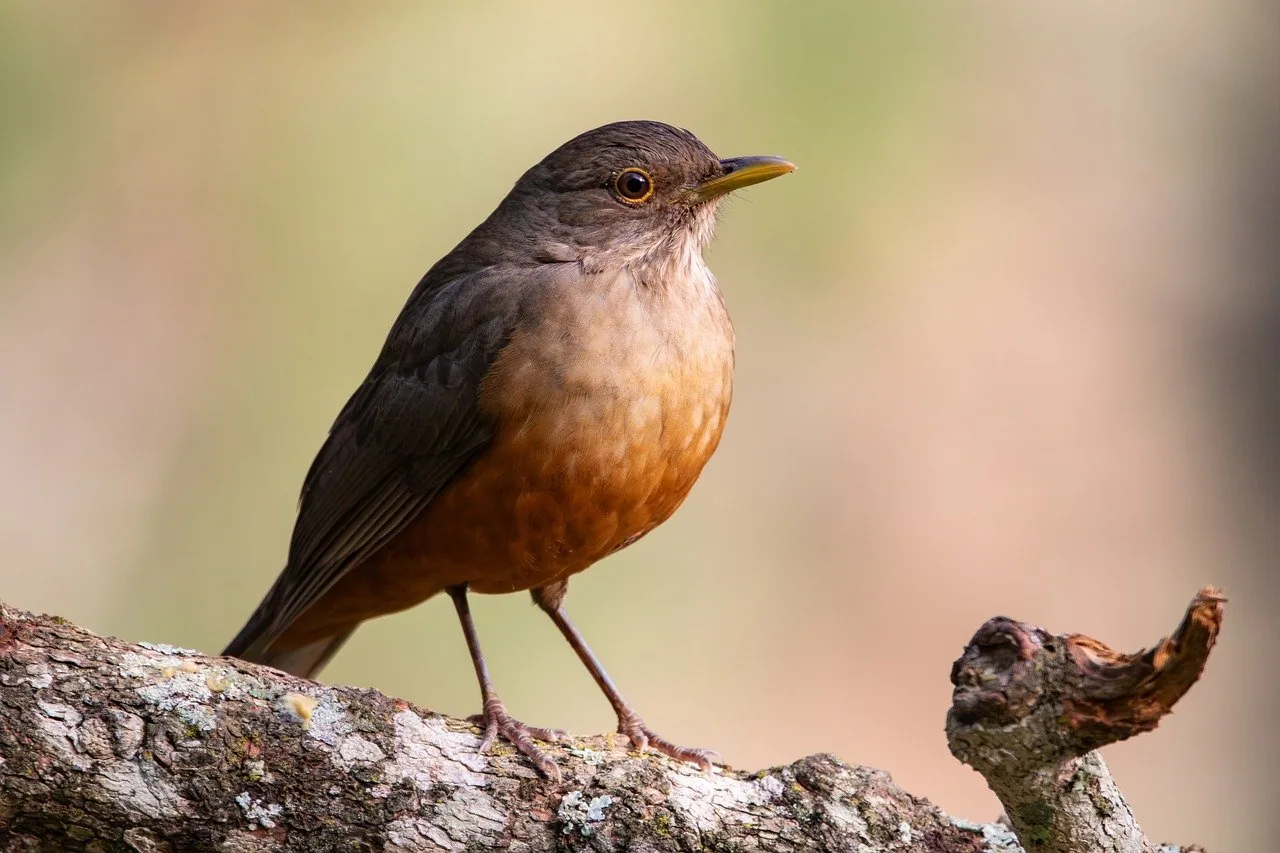
If you are waking up to this sound in London, Tokyo, or New York, you are hearing a digital recording of a pleasant tropical dawn. If you are in São Paulo or Rio de Janeiro, you likely didn’t need the alarm. The Rufous-bellied Thrush (Turdus rufiventris) has probably been shouting outside your window since 3:00 AM.
This is the Sabiá-laranjeira, Brazil’s National Bird. While it is often romanticized as a symbol of nature, the modern Sabiá is a gritty urban survivor. It has adapted to the concrete jungle by fundamentally altering its own biology to outsmart the city.
The 3 AM Shift
In a pristine forest, this thrush waits for the sun. In the city, it sings in the middle of the night. This isn’t an accident; it is a calculation.
The Sabiá has learned to exploit a “temporal niche.” During the day, the low-frequency rumble of buses, trucks, and construction masks the bird’s flute-like song. Research shows that by shifting its chorus to the dead of night, the Sabiá improves its signal transmission. It sings when the humans are quiet. However, this adaptation comes at a cost: artificial light suppresses the bird’s melatonin, creating a cycle of sleeplessness that mirrors the insomnia of the city itself.
The Marmoset Hunter
Do not let the orange belly and melodious voice fool you. The Sabiá is highly territorial and aggressive, especially when it comes to protecting its nest.
In the Atlantic Forest, its nemesis is the marmoset (Callithrix species), a small primate that raids nests for eggs. The Sabiá does not retreat. It executes high-speed “overflights”—diving at the predator and pulling up inches before impact. It is psychological warfare. Ornithologists have observed that Sabiás are tactically astute, launching more frequent attacks when marmosets are in groups rather than alone.
Know more
- Dorado-Correa, A. M., Zollinger, S. A., & Brumm, H. (2016). Artificial light at night and dawn chorus timing in a tropical bird. Philosophical Transactions of the Royal Society B.
- Zaluar, M. T., & Vale, M. M. (2021). Stay Gathered Rather than Scattered: Strategies of Common Marmosets during Agonistic Interactions with Birds. ResearchGate.
- Viaro, M. E. (n.d.). História das Palavras: Etimologia. Museu da Língua Portuguesa.
- Warbler Watch. (n.d.). Bird Memory Phrases. WarblerWatch.com.
- Wikiwand. Rufous-bellied thrush: Cultural Significance. Wikiwand / Wikipedia.