
The Holy Bird's Hard Head
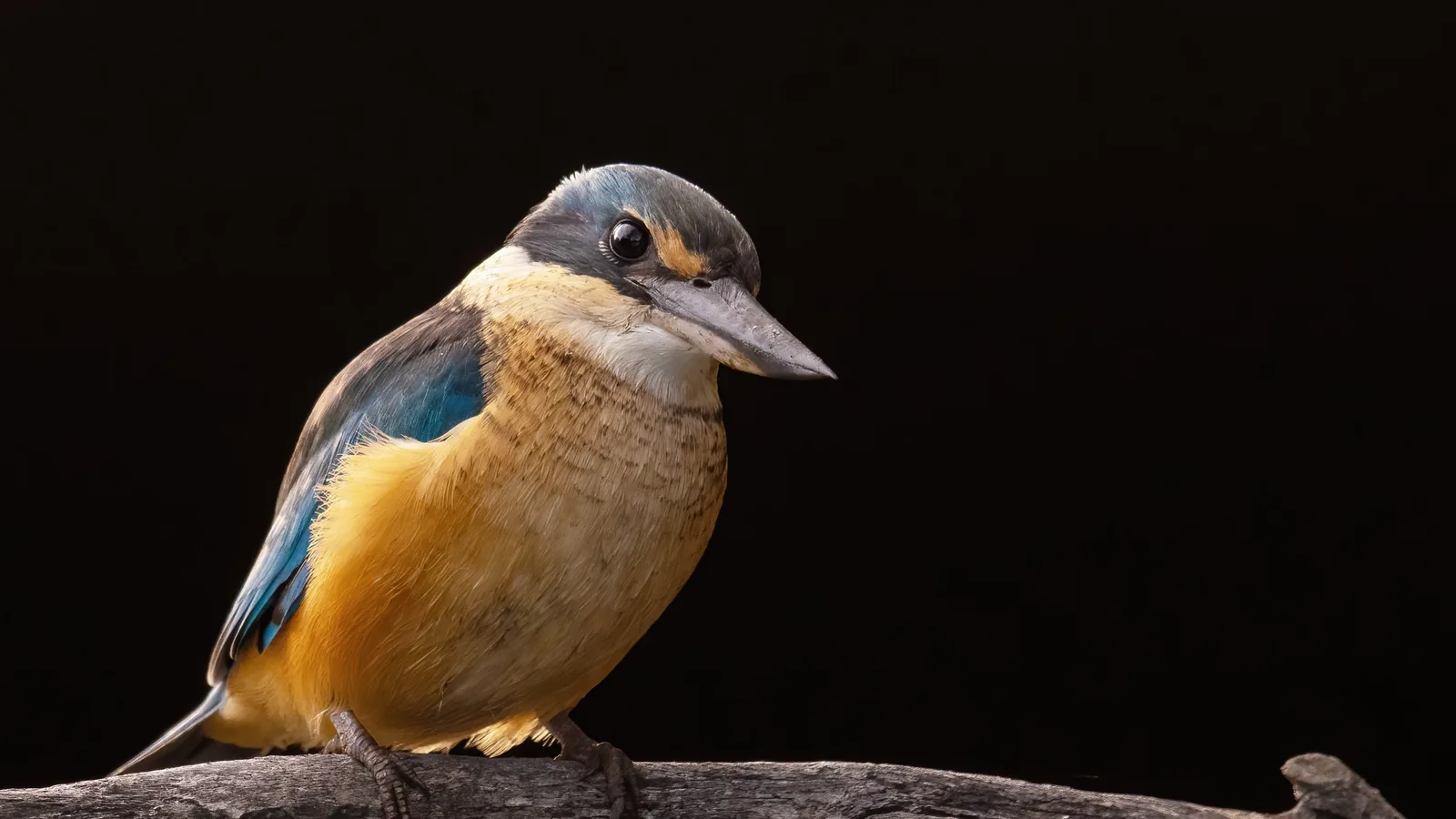
Here is a bird that people once treated as a minor sea god. On some Pacific islands you were forbidden to kill it, and Polynesian tradition credited it with power over the waves. If you wake near a mangrove creek in Queensland or a riverbank in New Zealand, the small blue-and-orange bird watching the water from a wire carries all of that history, plus one stranger habit.
A Bird You Weren’t Allowed to Kill
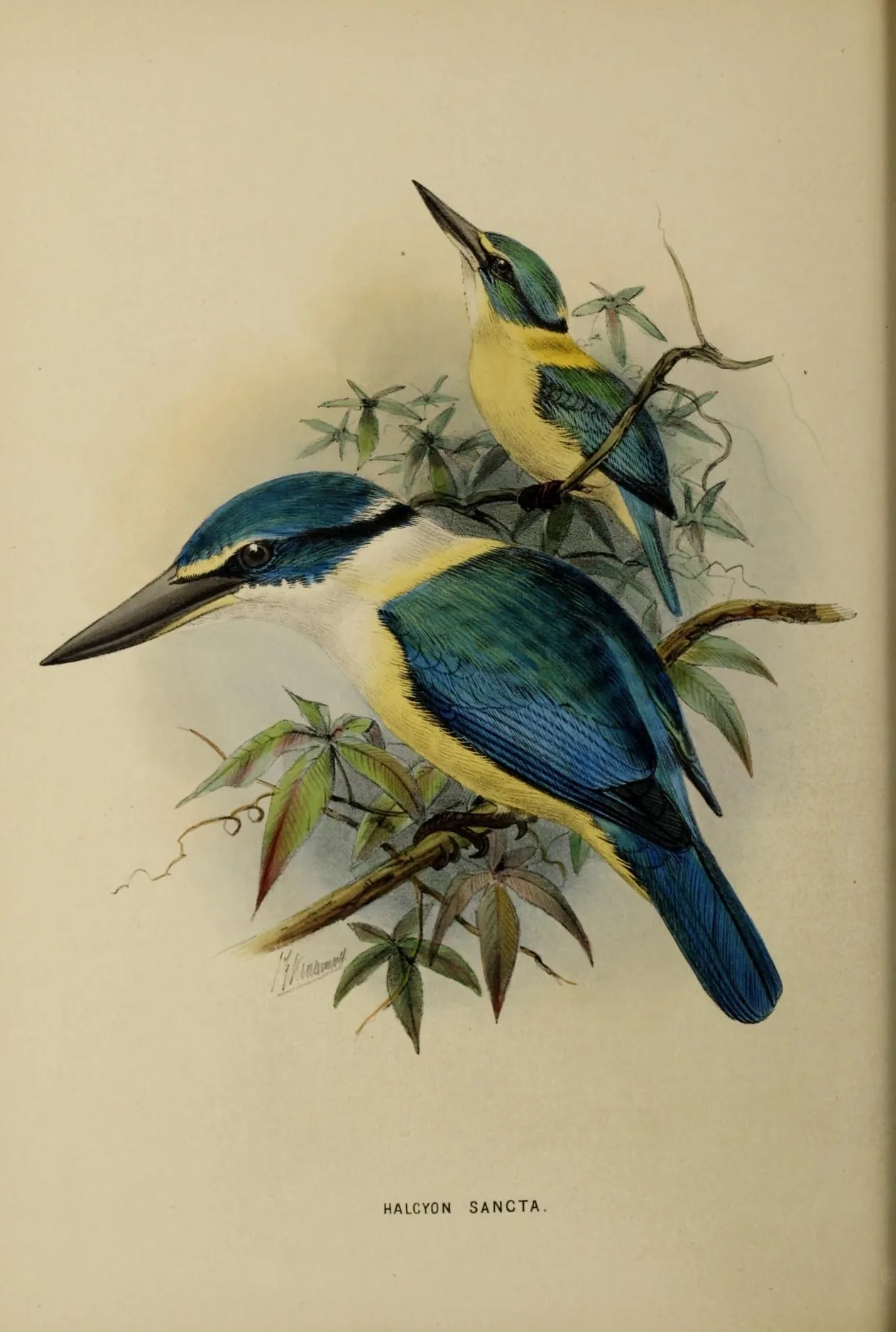
The reverence is built into the name. Its two-part scientific name is Todiramphus sanctus. The first word, Todiramphus, means roughly “tody-billed,” after the todies, unrelated insect-eaters of the Caribbean, an ocean away from this kingfisher. The second, sanctus, is Latin for “sacred,” and that is the half that carries the story. When the English ornithologist John Latham catalogued the Pacific kingfishers in 1782, working partly from the journals of Sydney Parkinson, the artist on Captain Cook’s first voyage, he found that islanders treated them with “superstitious veneration.” The birds settled around marae (sacred meeting grounds) and burial sites, and no one was to harm them. Some accounts go further, crediting the kingfisher with power over the waves themselves. In New Zealand it still answers to its Māori name, kōtare.
It Builds Its House Headfirst
For all that reverence, the Sacred Kingfisher is not much of a fisher. It will drop into water for a tadpole or a crab, but most of its hunting happens on dry land, from a low perch: insects, small lizards, sometimes a mouse. The genuinely odd part is the nursery. To raise a brood, a pair needs a tunnel, and they dig it by flying straight at the target, usually a riverbank or a termite mound, and stabbing it with the bill on impact. They repeat the run until the hole is deep enough to grip, then dig out the chamber. It is as reckless as it sounds. As one account of the kingfisher family puts it, “the bird may fly at the chosen site with considerable force, and birds have injured themselves fatally while doing this.” A holy bird that sometimes kills itself hammering out its own front door.
The Sentry on the Wire
That patience on the perch left a mark on human language. Māori admired the kōtare for sitting motionless for long stretches, scanning the ground, and they gave its name to the raised lookout platform inside a pā (a fortified Māori village). The kōtare was the watchtower. The sound is less dignified. The territorial call is a flat, staccato “kek-kek-kek-kek,” closer to a car alarm than a song, usually fired off by the male to stake out his patch. If you wake to that rattle somewhere between Perth and the Bay of Islands, that is a male kingfisher telling the neighbourhood where his boundary runs.
It is a strange resume: sea god, untouchable, namesake of a watchtower, and a creature that builds its home by headbutting the earth hard enough to occasionally die of it. The Sacred Kingfisher wears the reverence lightly. Mostly it just wants a good perch and a soft enough bank.
Sources:
- Wikipedia: Sacred kingfisher
- Wikipedia: Kingfisher (family), breeding and burrow excavation
- New Zealand Birds Online: Sacred kingfisher | Kōtare
- New Zealand Geographic: The sacred kingfisher
- Te Ara Kākāriki: Kōtare | Sacred Kingfisher
- Xeno-canto: Sacred Kingfisher call recordings
- Wikimedia Commons: A Monograph of the Alcedinidae (Sharpe, 1868-71), “Halcyon Sancta” plate
.jpg)