
The Blue Collector's Long Game
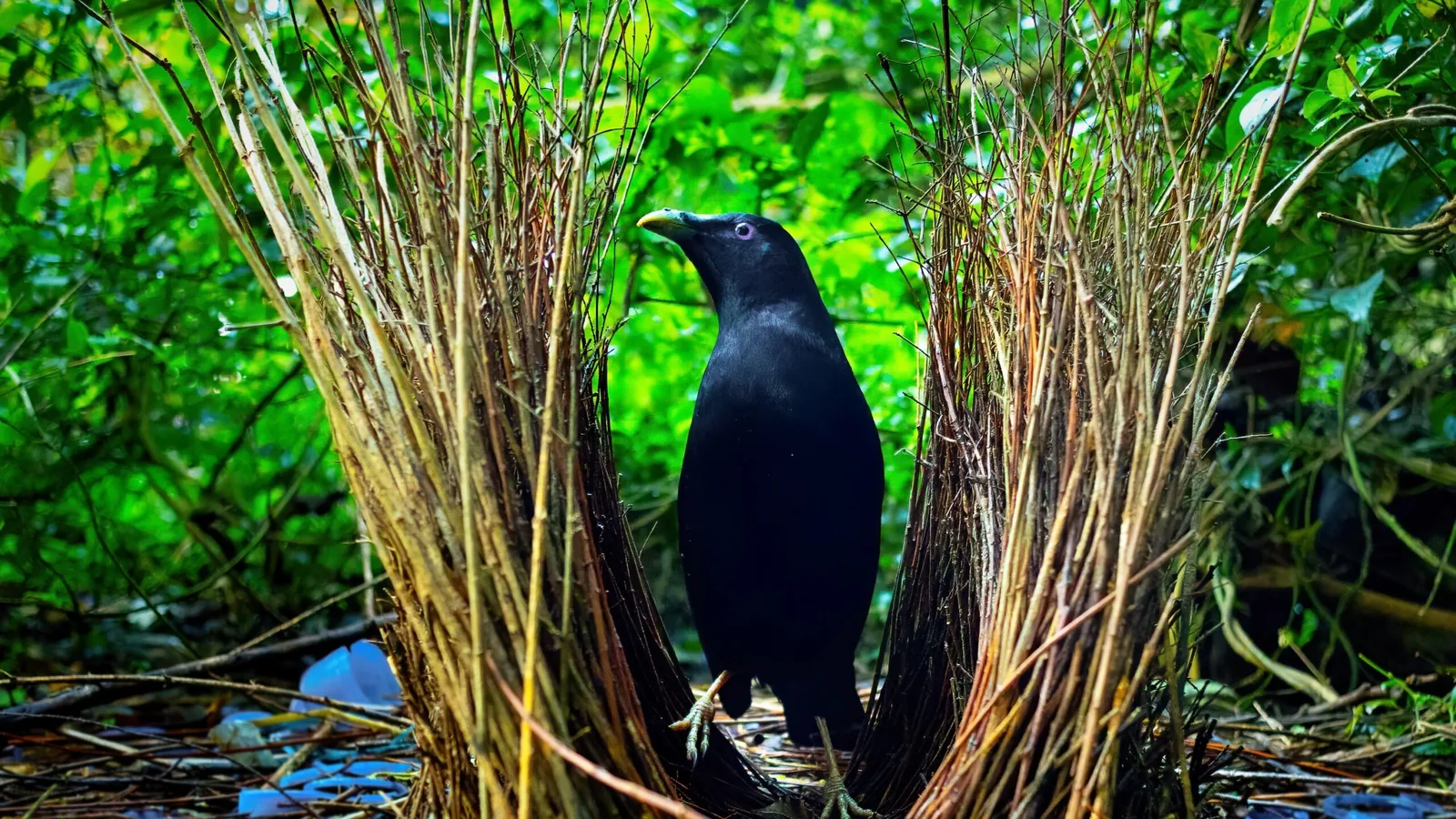
Somewhere in an Australian rainforest, a jet-black bird with a violet eye is rearranging a pile of blue drinking straws. He stole most of them. He built the avenue of twigs they sit in, and not to raise a family. The Satin Bowerbird’s bower is a stage, and everything on it was chosen to make one female look twice.
Seven Years to Turn Blue
His scientific name is Ptilonorhynchus violaceus, which stitches together the Greek for “feather” and “bill” with the Latin for “violet.” The violet belongs to those startling lilac eyes, because the plumage is not really blue at all. It is black feathers with a surface that scatters light into a deep satin sheen. That colour is hard won. A young male is indistinguishable from a female, olive-green and scalloped, for years. He will not moult into full blue-black until he is roughly seven. Females are ready to breed at two or three, so a male spends most of a decade as an apprentice before he earns a stage of his own.
A Stage Made of Stolen Blue
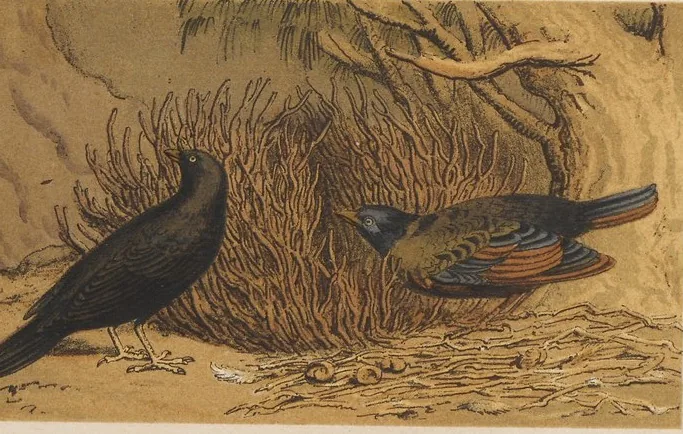
Blue is the whole point, and blue is rare in the Australian bush. Blue flowers are few and blue feathers fewer, so a male who assembles a glittering blue collection is advertising how far he ranged to find it. Today’s males have upgraded to blue clothes pegs and drinking straws. He even paints the walls, using a mixture of chewed vegetable matter and saliva. And because good blue is scarce, theft is rife. Neighbouring birds “pilfer decorations from each other and even attempt to trash nearby bowers,” as the scientists who have watched them for decades put it. Charles Darwin saw all this as evidence that an animal could have taste. Birds, he wrote in 1871, “appear to be the most æsthetic of all animals, excepting of course man.”
The Art of Not Trying Too Hard
When a female finally steps onto the stage, the male explodes. He struts and bows with his wings quivering, throwing out a soundtrack of mechanical buzzes and rattles spliced with dead-on impressions of other birds. If you live near a rainforest edge in New South Wales, that whirring racket at dawn is a male rehearsing. Here is the part that surprises even birdwatchers. A big display can be too much. Using robotic females wired to crouch on cue, researchers found that males do not simply perform at full blast. The successful ones “modulate their displays in response to signals from females,” easing off the moment she looks startled and cranking it back up when she settles. The winning male is not the loudest one. He is the one paying attention.
He spends seven years learning, builds a gallery, steals the rarest colour he can find, then reads his audience well enough to know when to ease off. For a bird that never manages a pretty dawn song, that is its own strange kind of artistry.
Sources:
- Wikipedia: Satin bowerbird
- Australian Museum: Satin Bowerbird
- Nature (2002): Patricelli, Uy, Walsh & Borgia, Male displays adjusted to female’s response
- Borgia Lab, University of Maryland: Bowerbirds and sexual selection
- Charles Darwin: The Descent of Man (1871), Chapter XIII