.jpg)
The Forest's Quick-Change Artist
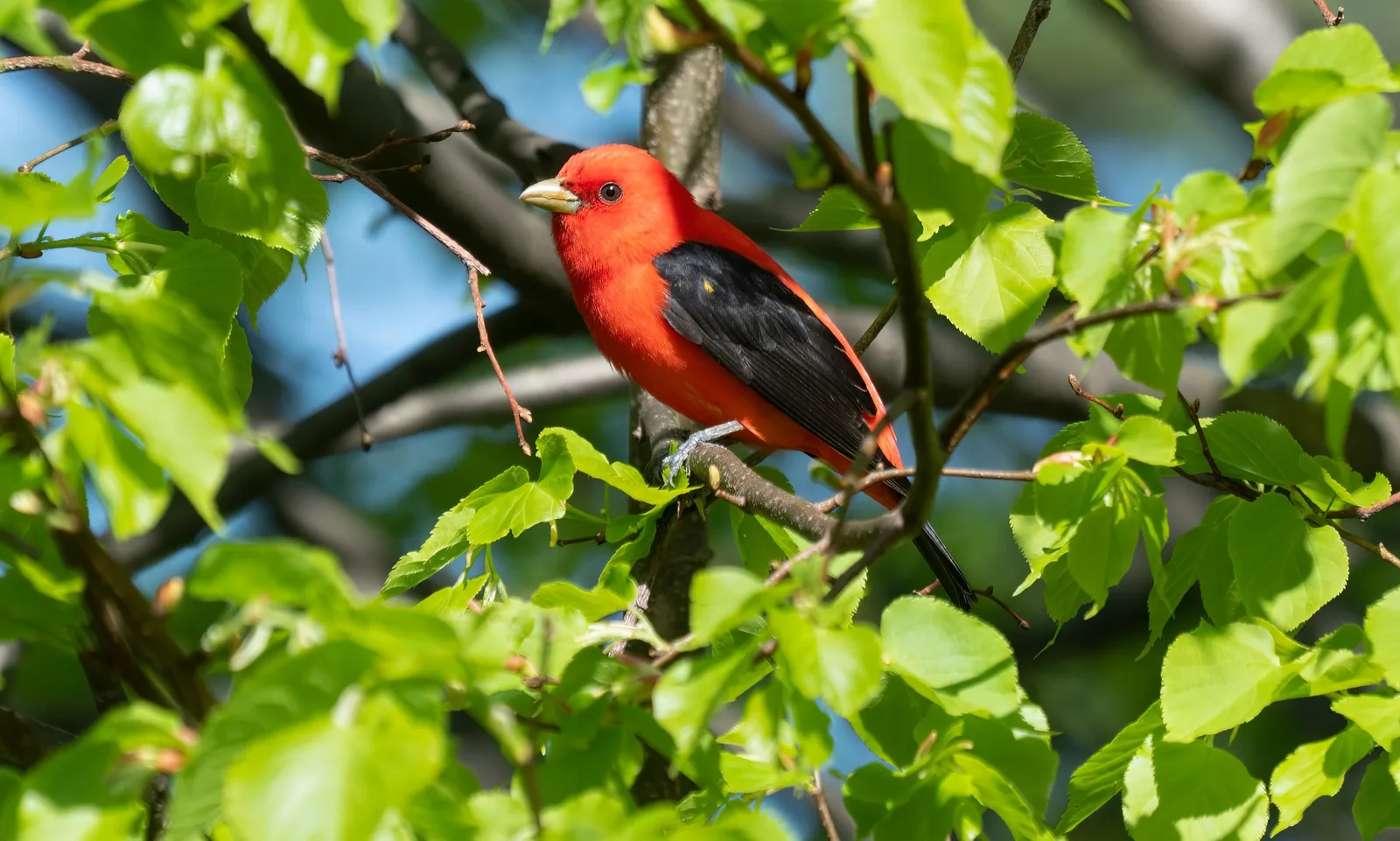
The Scarlet Tanager carries a name that contradicts itself in two languages. Piranga is Old Tupi for “red.” olivacea is Latin for “olive-green.” Both halves are accurate. The male is brilliant scarlet for the breeding months and olive-yellow the rest of the year, indistinguishable from his mate. The full binomial covers both seasons of his life; the common name only describes the showy half.
A Tupi Name and an Olive Mistake
The two halves were attached by different people, decades apart. The German naturalist Johann Friedrich Gmelin formally described the species in 1789, in his expanded edition of Linnaeus’s Systema Naturae. The specimen Gmelin worked from was in olive-yellow plumage, a female or an immature, so he reached for olivacea. Nineteen years later, in 1808, the French ornithologist Louis Pierre Vieillot coined the genus Piranga for a group of mostly-red American birds, taking the word from Old Tupi, the classical indigenous language of coastal Brazil. Gmelin’s olive-named species was moved into Vieillot’s red-named genus, and the contradiction has been the bird’s official label ever since.
Up in the Oaks, Wiping Stingers
In summer the Scarlet Tanager perches high in oaks and waits. When an insect flies by, the bird launches out and grabs it midair before returning to the perch. Birders call this hunting style sallying. The catch matters here. Along with caterpillars and beetles, tanagers eat bees, wasps, and hornets, which they handle by raking the insect against a branch until the stinger comes off. Then they swallow.
The song is a hurried, burry, repetitive warble that birders famously call “a robin with a sore throat”. The contact call is sharper, a two-note chip-burr that picks the bird out of the canopy when it is hidden in the leaves.
Two Birds in One Year
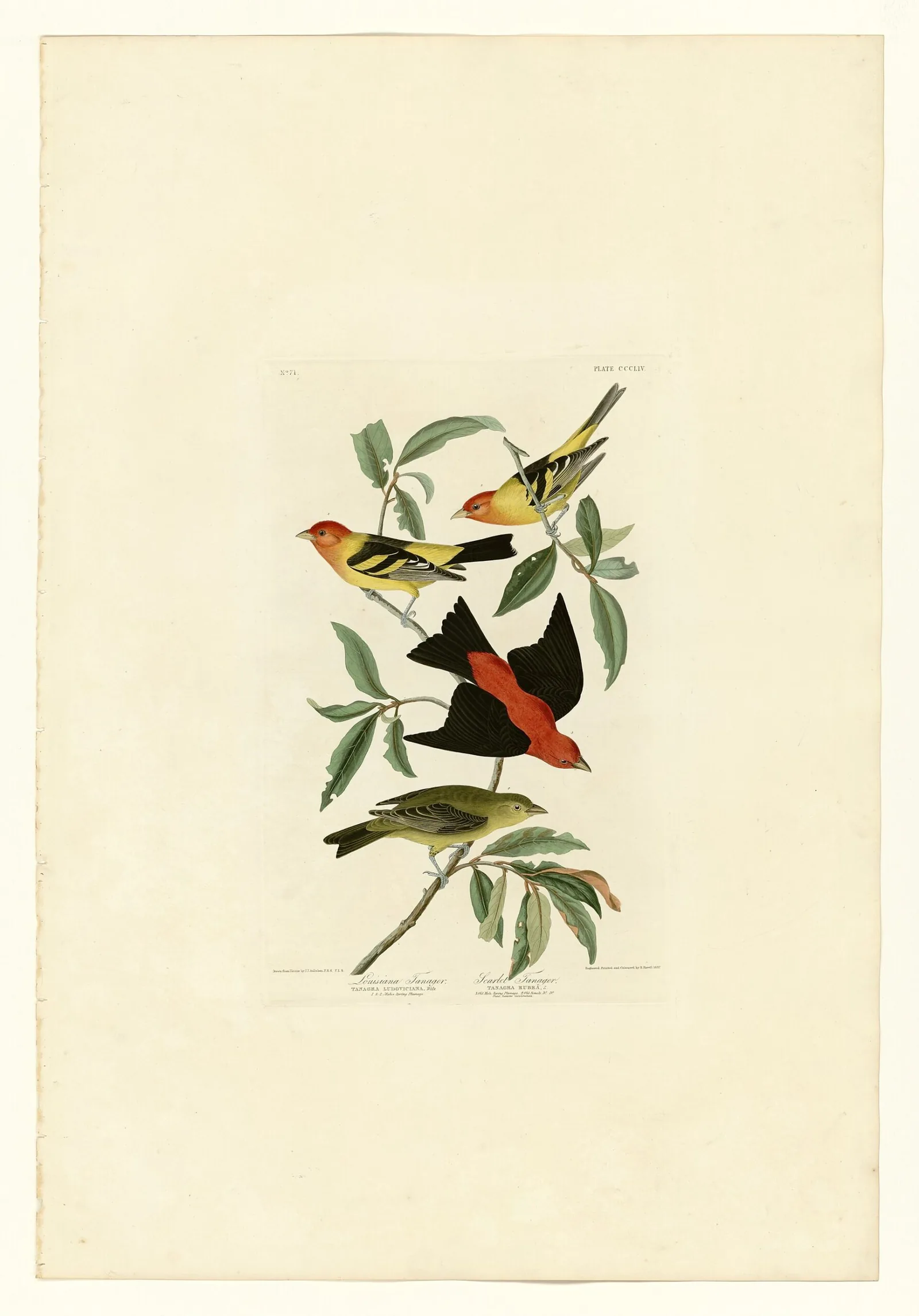
Through autumn the show winds down. Adult males molt out of red into the same yellow-olive that gave the species its scientific name, keeping only the black wings and tail as a clue to who they used to be. They then travel from eastern North American oak forests to the Andean foothills of northwestern South America, where they spend the rest of the year in tropical forest in Colombia, Ecuador, and Peru. In April they reverse the trip, passing through Central America with the males in their fresh red plumage again.
The same bird connects northern oak woods to South American foothills twice a year, in two different colors, under a Latin name borrowed from a continent it visits but does not breed on.
The bird most listeners meet is the louder half of the species. The other half, yellow-olive and mixed in with strangers, lives in the Andean foothills from October through March. By the time olivacea fits, the Tupi name and the wintering ground are finally describing the same bird at the same time.
Sources:
- Wikipedia: Scarlet tanager
- Wikipedia: Piranga (genus)
- Wikipedia: Johann Friedrich Gmelin
- Wikipedia: Louis Pierre Vieillot
- Wiktionary: olivaceus
- Wiktionary: piranga (Old Tupi)
- National Audubon Society: Scarlet Tanager field guide
- Birdfact: Scarlet Tanager
- Cornell Lab, Birds of the World: Scarlet Tanager, Introduction
- Wikimedia Commons: Audubon, Birds of America Plate 354 (Louisiana Tanager and Scarlet Tanager)
- YouTube, Navarre’s Wild Shots: Scarlet Tanager Songs and Sounds
