
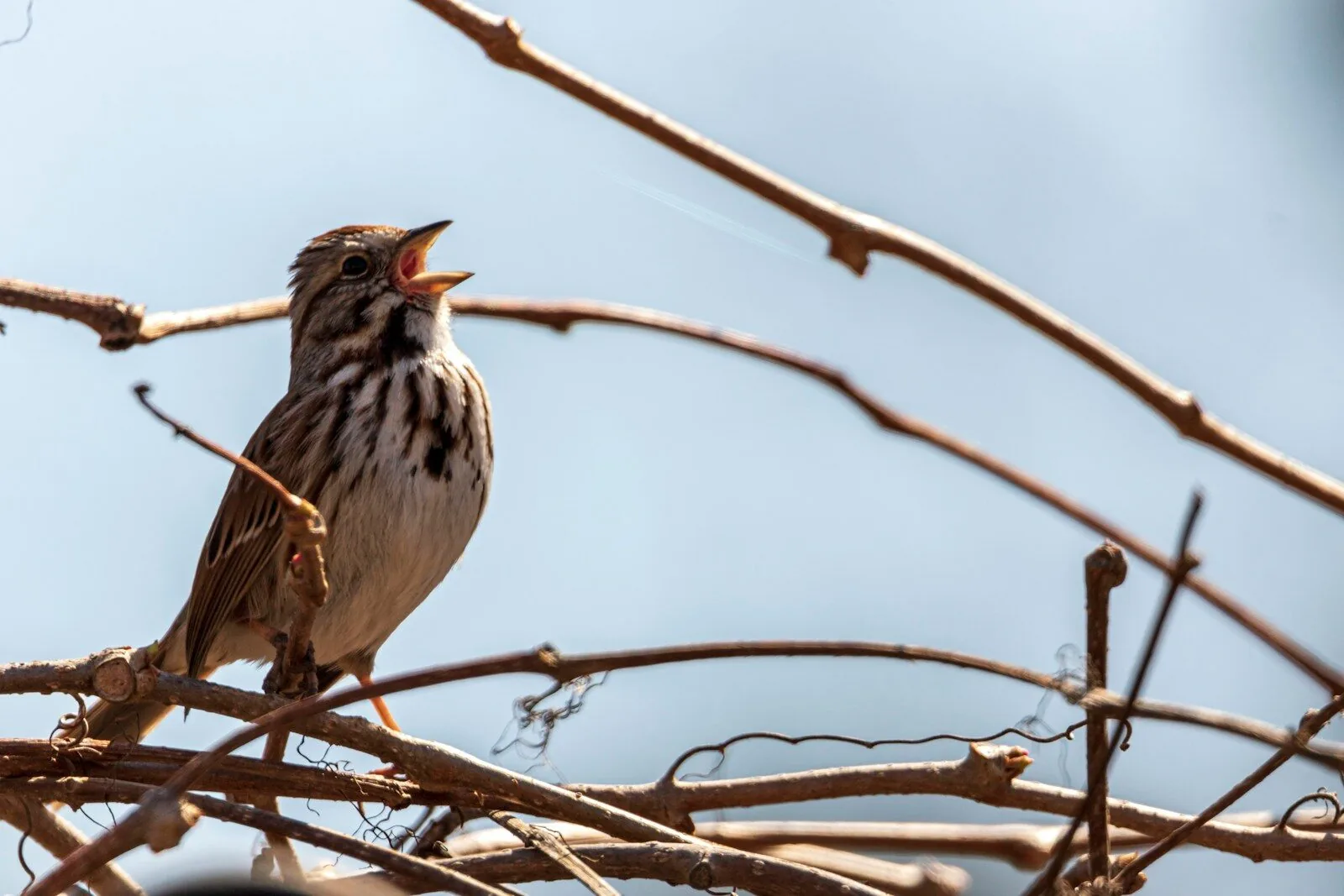
If you find yourself waking up in a brushy coastal meadow in British Columbia or a damp garden in Ontario, the first sound hitting your ears is likely a rhythmic, three-note “attack” followed by a chaotic trill. Some hear it as the opening to Beethoven’s Fifth Symphony; others insist it’s a demanding command: “Maids, maids, maids, put on your teakettle-ettle-ettle!”. This is the Song Sparrow, a bird whose scientific name, Melospiza melodia, translates redundantly to “melodious song-finch”. Despite being one of the most common birds in North America, its internal life is anything but ordinary.
The Spotify DJ of the Underbrush
While most birds possess a few “tracks” they repeat until they’ve driven every listener insane, the male Song Sparrow operates like a strategic DJ. Research shows these birds carry a repertoire of up to 20 different tunes and maintain a “long-distance dependency” memory that lasts 30 minutes. Unlike a canary, which can only remember the last few seconds of its performance, the Song Sparrow tracks exactly which songs he has played to ensure he doesn’t overplay a “hit.” He deliberately shuffles his playlist, waiting longer to return to a specific track if he just finished a high-repetition set. This isn’t just for show; it’s a cognitive feat designed to keep the “hype” alive for his female audience while signaling to rivals that he has the brainpower to manage a complex territory.
From Mud Spots to Spaghetti
The bird’s physical appearance—specifically the dark, messy blotch in the center of its chest—has inspired a wealth of storytelling. The naturalist Ernest Thompson Seton famously penned a “myth” explaining that the sparrow was born with a pristine white vest, only to be splashed with mud by an envious neighbor. Despite the stain, the bird refused to stop singing, making it a symbol of resilience in the face of adversity.
This persistent, loud personality eventually landed the species in modern pop culture. In a classic 1989 Calvin and Hobbes Sunday strip, Bill Watterson drew a remarkably accurate Song Sparrow that interrupts the morning peace by screaming a raucous rendition of “On Top of Spaghetti”. It’s a fitting tribute to a bird known for singing up to 2,300 times in a single day.
The Deadly Whisper
Perhaps the most fascinating contradiction in its behavior is how it handles a fight. If an intruder enters its territory, the Song Sparrow doesn’t start by screaming. It starts by matching the intruder’s song—an avian “I see you”. If the intruder stays, the sparrow switches to a “soft song.” This is a low-amplitude, muddled version of its call that can only be heard within a few meters. In the world of sparrows, this whisper is the ultimate threat. Biologists call it a “vulnerability handicap”; by singing quietly, the bird proves he is close enough to strike and confident enough to ignore the risk of being overheard by predators. It is the bird equivalent of a bar-room stare-down just before the first punch is thrown.
Whether it is navigating the “mud stains” of folklore or curating a 30-minute acoustic set, the Song Sparrow proves that ubiquity does not mean simplicity. It is a master of memory and a quiet, calculated brawler.
Sources:
- Duke Biology: Birds shuffle and repeat their tunes to keep audience listening
- University of Washington: ‘Get off my lawn’: Song sparrows escalate territorial threats
- Wikisource: The Myth of the Song Sparrow
- Calvin and Hobbes Wiki: Song Sparrow
- All About Birds: Song Sparrow Overview
- PubMed Central (PMC): Aggressive signaling in song sparrows