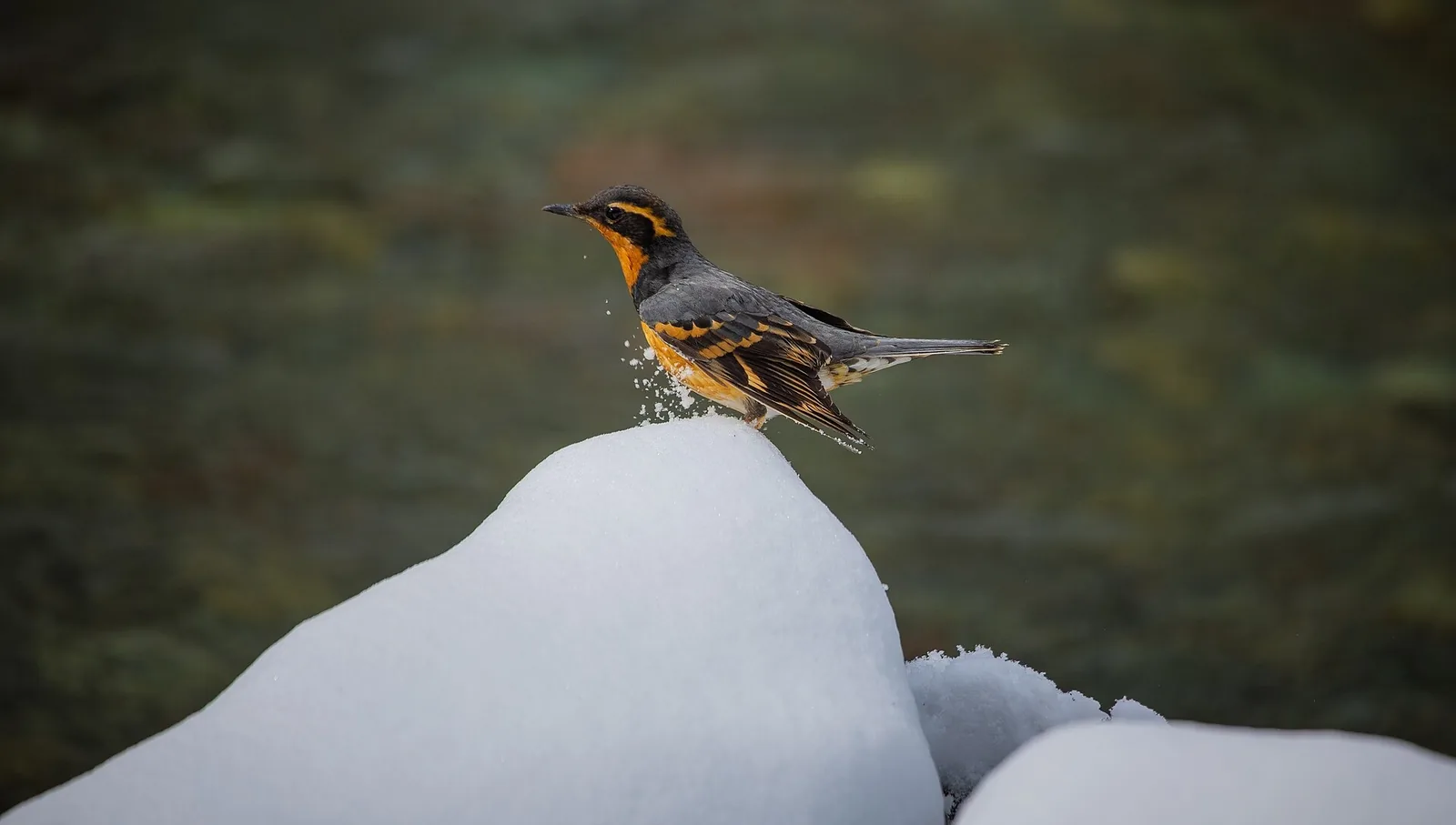
_(48490215156).jpg)
The Forest's One-Note Minor Chord
Drop a single note into a wet Pacific Northwest forest and let it hang for two seconds. That is what a Varied Thrush sounds like. The whistle sounds plain on first hearing, but listen close and the single note opens into a chord. People look around for the second bird. There is no second bird.
The Chord Inside the Whistle
The song itself is simple to describe. According to Audubon, the male sings “2 or 3 buzzy whistles, each drawn out until it fades away, followed by a short silence.” Each whistle sits on a single pitch. What the listener hears is stranger. Strong overtones ride on top of the note, and the ear stitches them into harmony. BirdNote sums up the perceptual trick: “Listen carefully to hear the overtones that turn the single sound of a Varied Thrush into a delicate minor chord.” Ralph Hoffmann, a Santa Barbara naturalist writing in 1927, tried to pin the feeling down in Birds of the Pacific States: a “long-drawn quavering note” with “a meditative quality” and “above all a strangeness.” The xeno-canto archive holds field recordings from across the bird’s range.
A Mistletoe Mix-Up
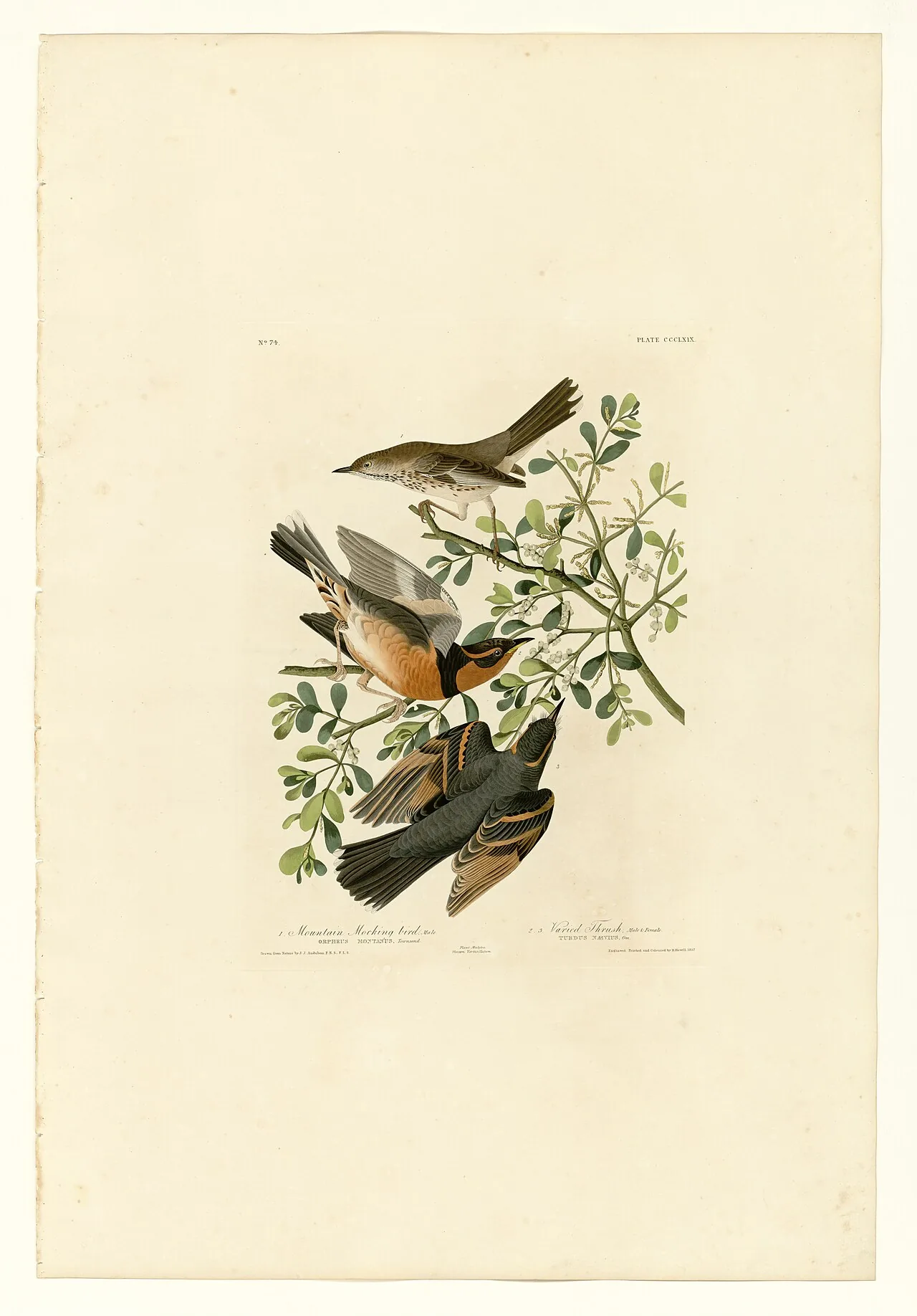
The scientific name is Ixoreus naevius, and both halves come with a story. Naevius is straightforward Latin for “spotted,” for the mottled plumage of the females and juveniles. Ixoreus comes from the Greek ixos, meaning mistletoe. It was an old, abandoned name for the mockingbird genus, and the French-American ornithologist Charles Lucien Bonaparte (yes, nephew of Napoleon) recycled it for this thrush in 1854. He had wrongly assumed the Varied Thrush was a mockingbird relative, because the English illustrator William Swainson had drawn the two species on the same plate of his book. The grouping fell apart later, but the name stuck. John James Audubon (the 19th-century bird painter) repeated the side-by-side composition in his Birds of America Plate 369, above. The mockingbird sits at the top with two Varied Thrushes wedged below, all of them tangled in mistletoe, the very plant whose Greek name had landed on the wrong bird.
The Forest That Shrank
In the wild, Varied Thrushes need wet, mature conifer forest with a thick understory of ferns and moss. That habitat used to run unbroken from southeast Alaska down through coastal British Columbia into northern California. Around the Puget Sound region today, BirdNote reports that the lowland conifer forests they once relied on cover less than one percent of their original area. In winter, individuals sometimes wander far east of their normal range, turning up at feeders in New England and even, in one well-documented case, in Brooklyn’s Prospect Park.

If you wake up in Seattle, Vancouver, or Juneau and hear a long whistle that sounds suspiciously like a tuning fork, you are probably hearing one of these birds. Everywhere else in the world, you are hearing a recording, which is what the Bird Rise app gives you. Either way, the trick is the same. Do not listen for melody. Listen for the second pitch hidden inside the first.
Sources:
- Audubon Field Guide: Varied Thrush
- BirdNote: Secretive Varied Thrush
- xeno-canto: Varied Thrush (Ixoreus naevius) field recordings
- Wikipedia: Varied thrush
- Wikimedia Commons: Audubon Plate 369, Mountain Mockingbird and Varied Thrush
- Internet Archive: Hoffmann, Birds of the Pacific States (1927)
