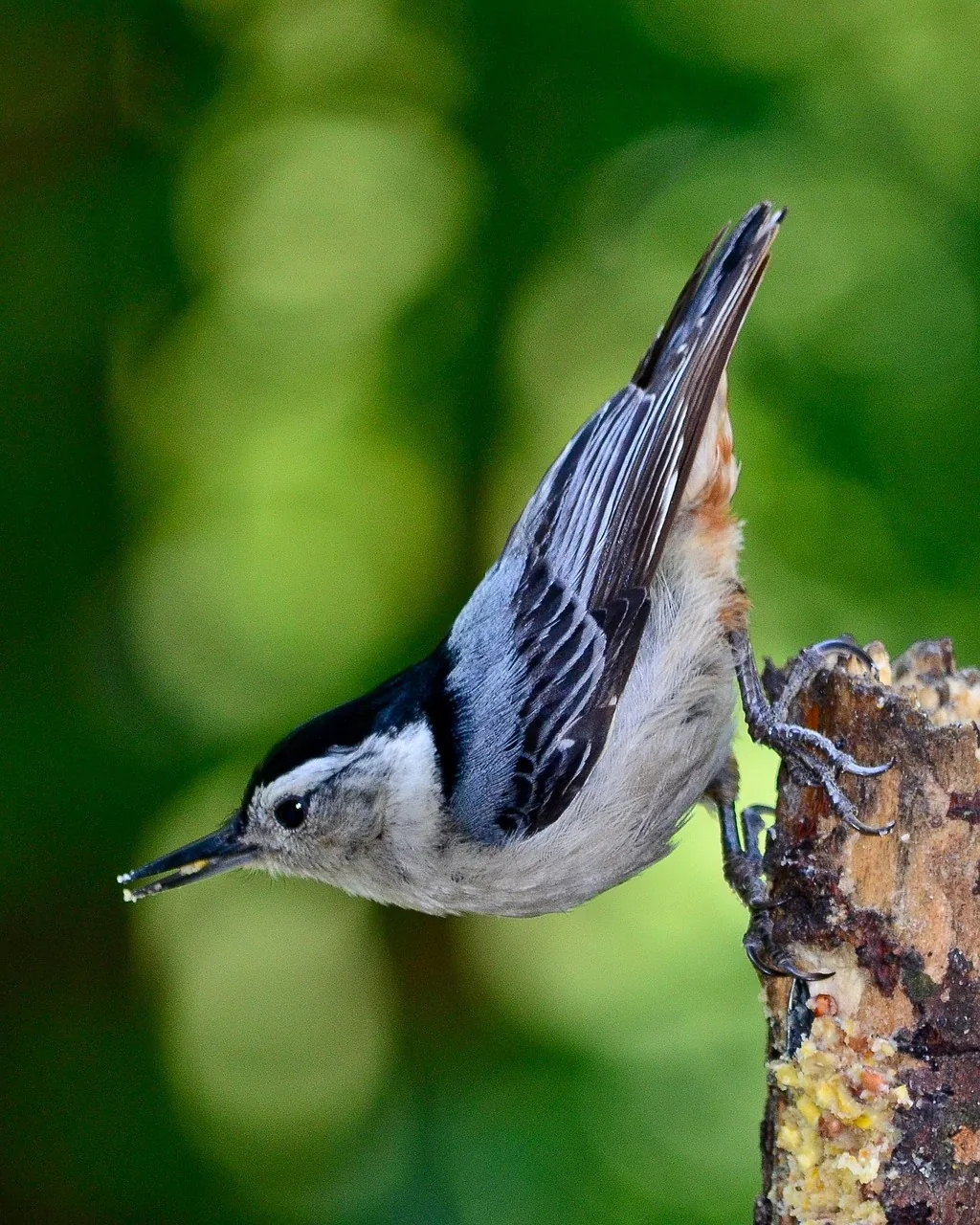
The White-breasted Nuthatch is often noticed for walking headfirst down tree trunks, but that behavior only hints at how the bird operates. Less commonly mentioned is how deliberately it manages access to its nest.
During breeding season, adults have been observed crushing insects and sweeping the remains around the entrance of their nesting cavity. The motion is repeated, slow, and focused on the rim of the hole. This is not feeding. Field guides and species accounts describe the behavior as a form of chemical defense, using the smell or secretions of crushed insects to discourage predators, especially squirrels that rely on scent and routine to locate cavities.
That strategy fits a bird that does not leave when competition increases. The White-breasted Nuthatch is a year-round resident across much of North America. Instead of avoiding pressure through migration, it modifies its surroundings. The insect-treated doorway is one example of that approach.
Food is hidden one item at a time under bark or in crevices, then covered with flakes of bark, lichen, or debris. Nest holes are altered. Territory is reinforced vocally. The call, often taught as “yank, yank,” is nasal and blunt, carrying through the woods without variation.
Even the name points in the same direction. “Nuthatch” comes from the bird’s habit of wedging nuts or seeds into bark and striking them open with its bill.
This is not a bird that relies on camouflage or distance. It relies on preparation. Wherever it lives, the logic is the same: reduce risk at the entrance, solve problems before they arrive, and make the nest harder to read than the forest around it.