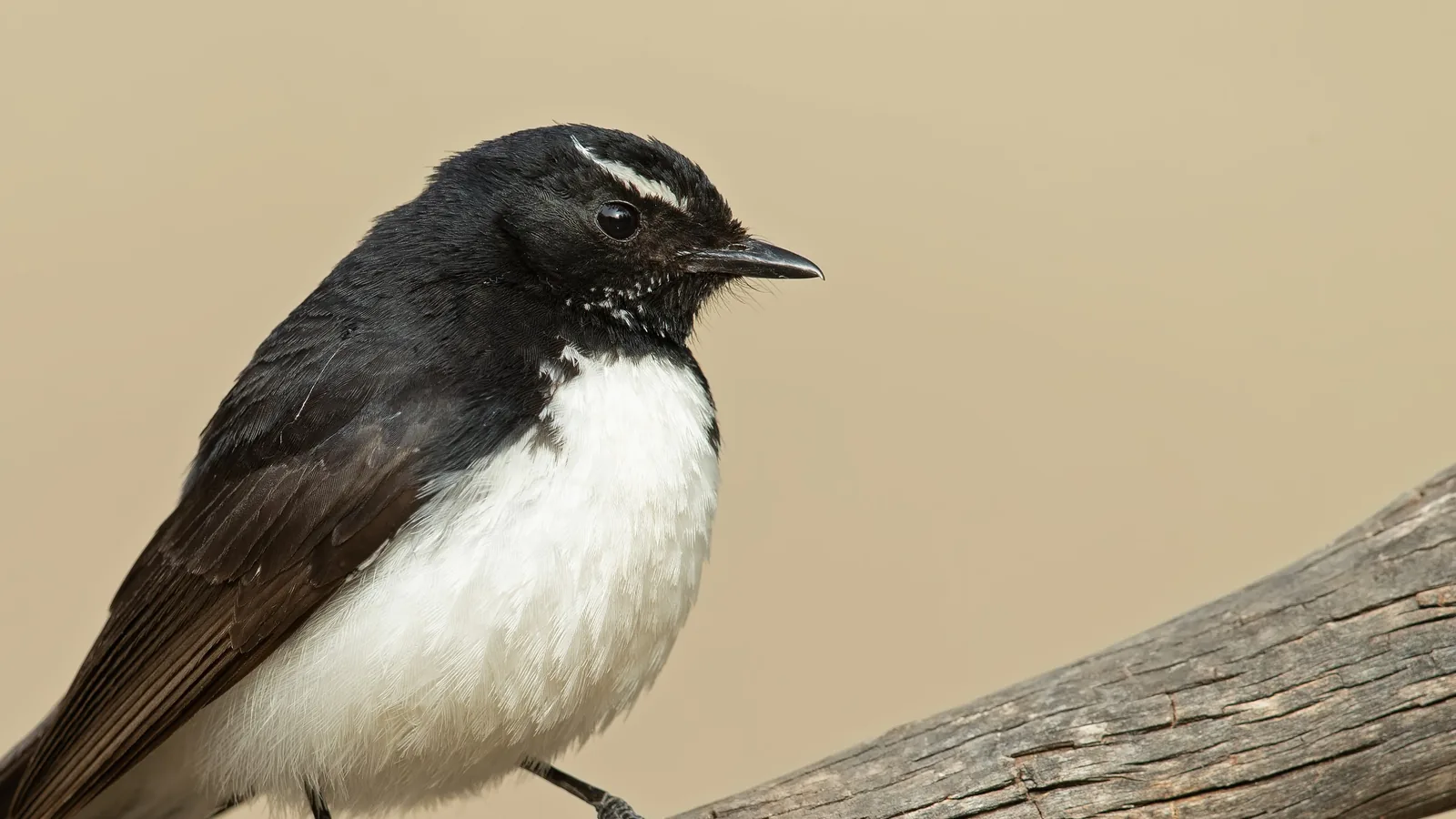

The Backyard's Fearless Tattletale
If you wake up almost anywhere on the Australian mainland, this is the bird already up before you, chattering on the fence like it has appointments. The willie wagtail is barely twenty grams of black-and-white feathers, and it carries on as if it owns the continent. The call is less a song than a running commentary, usually a complaint.
Small Bird, No Fear
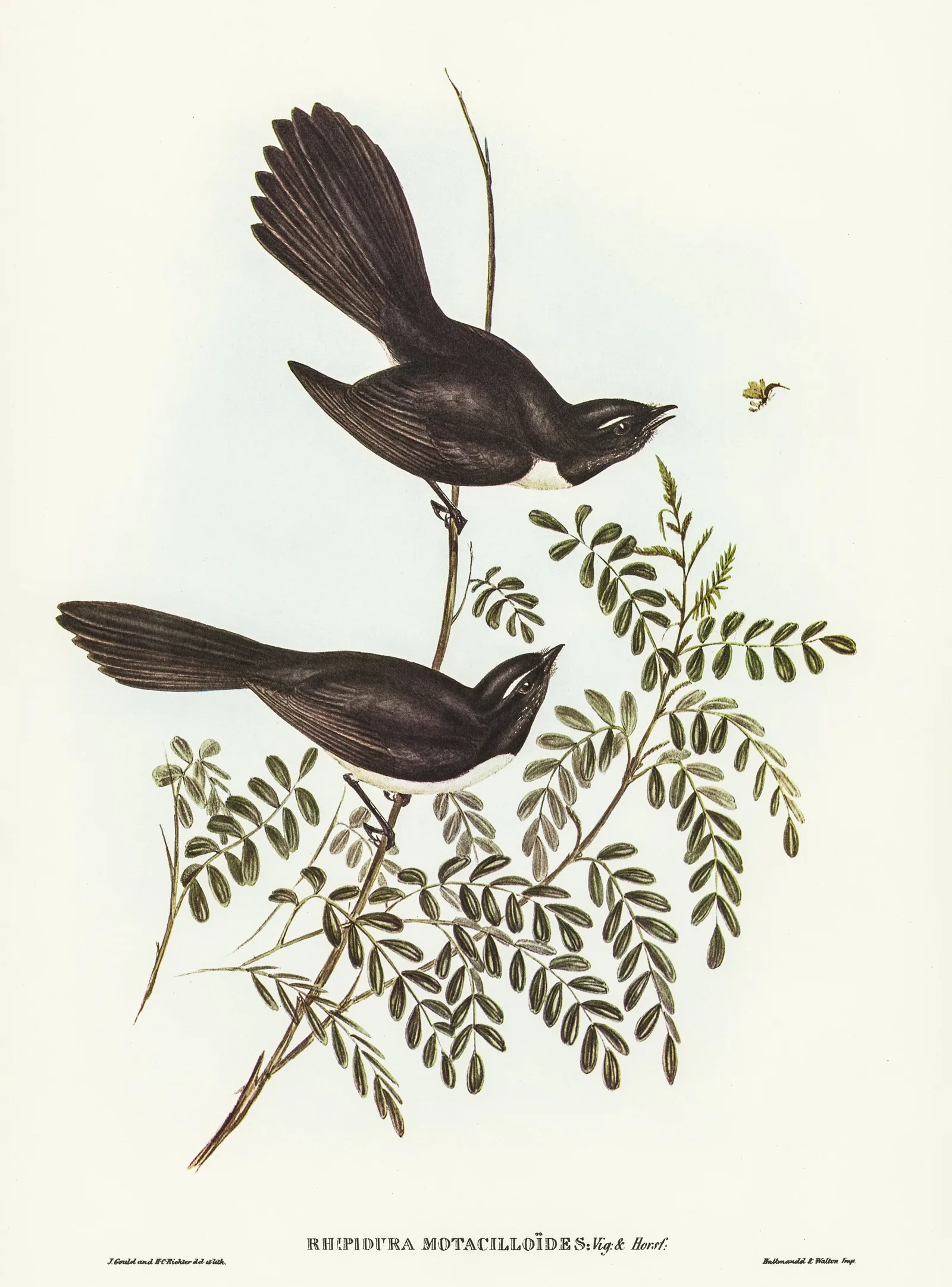
Its scientific name, Rhipidura leucophrys, is mostly description. Rhipidura means “fan tail” in Greek, for the tail it spreads and swivels. Leucophrys means “white eyebrow”, the thin pale stripe that flares when the bird is annoyed, which is most of the time. For a creature this size, it has no concept of a fair fight. Willie wagtails will harass kookaburras, magpies, ravens, and even wedge-tailed eagles, diving until something many times their weight gives up.
That restless tail is not only for show. The bird wags it from side to side while it forages, and the leading idea is that the sweeping motion casts a moving shadow that startles hidden insects into breaking cover. The exact reason is still argued over, which feels about right for a bird that refuses to sit still.
Sweet Pretty Creature
It is loud, and it is chatty. The Australian bird artist Neville Cayley wrote that one of its calls sounds like the words sweet pretty little creature, repeated through the day. The English ornithologist John Gould was less charmed, comparing the chatter to a child’s rattle, or to the “small cog-wheels of a steam mill”. When the bird is irritated, which is its resting state, the song collapses into a scolding chit-chit-chit-chit.
The odd part is the timing. In breeding season the males will sing into the night, especially on moonlit ones, so anyone camped nearby gets the full recital at two in the morning, asked for or not.
The Bird That Was Listening
All that eavesdropping energy did not go unnoticed. Across many Aboriginal Australian cultures the willie wagtail has a long reputation as a gossip. The Kunwinjku people of Arnhem Land cast it as a liar and a tattletale. Elsewhere it was said to linger around camps collecting secrets, so people kept their words careful when one was hopping close. In the Kimberley, it was believed to carry news to the spirits of the dead, reporting back if the living had spoken badly of them. To the Ngarrindjeri and Narrunga peoples of South Australia, it was plainly a bearer of bad news.
Many of its names echo the chatter directly. Noongar speakers in the southwest call it djididjidi. In the Solomon Islands, Pijin speakers nicknamed the little black-and-white bird the polis, the police bird, for the way it always seems to be watching.
None of this should fit inside twenty grams of bird, and yet there it is, wagging on the fence, certain it has your number. If a willie wagtail ever wakes you up, you will understand why so many people decided it must know something. Safer to assume it does.
Sources:
- Wikipedia: Willie wagtail
- Birds in Backyards (BirdLife Australia): Willie Wagtail
- Australian Wildlife: Foraging behaviours of Willie Wagtails Rhipidura leucophrys
- Wikimedia Commons: Rhipidura motacilloides, from Gould’s The Birds of Australia
